
Garcinia,
does it really help with body fat and body weight reduction?
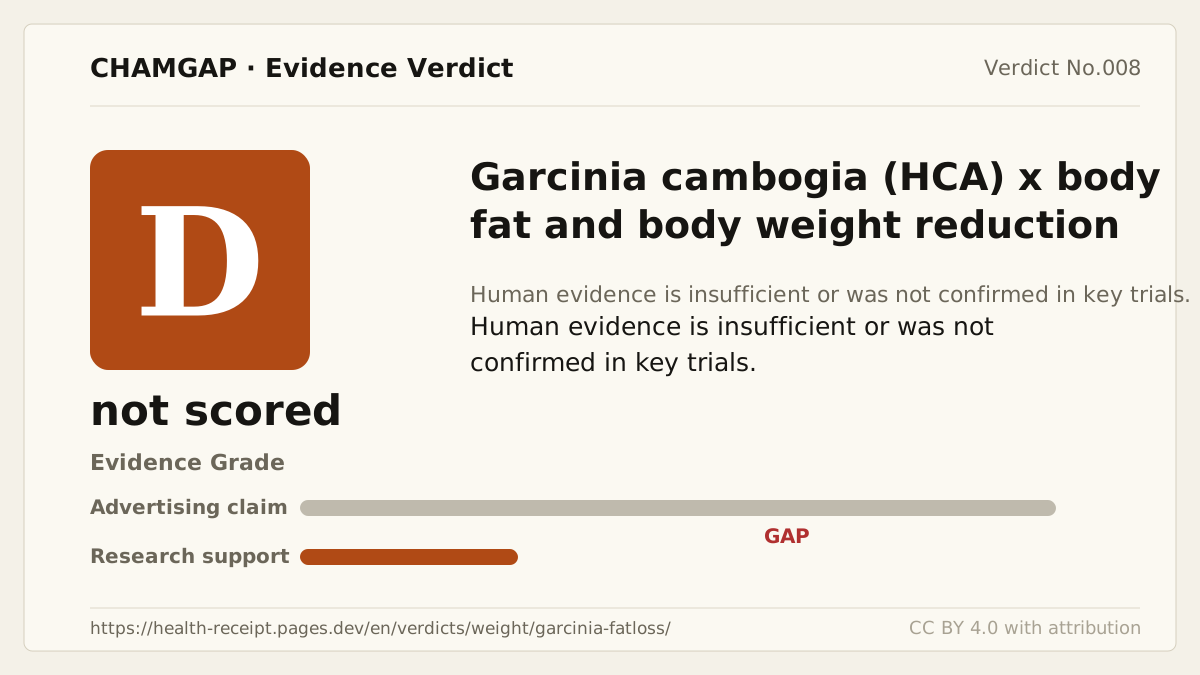
research showsGarcinia cambogia (HCA) is a generic health functional food ingredient recognized by the Korean MFDS as 'may help reduce body fat' (daily HCA 750-2,800mg). However, human evidence is conflicting. In the most representative independent large clinical trial, the 1998 JAMA trial funded by NIH with 135 participants, there was no significant difference from placebo (active 3.2kg vs placebo 4.1kg loss, p=.14), and a skeptical 2011 meta-analysis reported a small pooled effect of about -0.88kg and found that significance disappeared when only strict high-quality studies were considered. Conversely, a modestly positive meta-analysis in 2020 (-1.34kg) also exists, but effect sizes are consistently small, around 1% of body weight. On safety, U.S. LiverTox records rare but real liver injury (Category B, including some acute liver failure, transplant, and death cases), and in Korea consumer cases with hepatitis-like symptoms, product recalls, and the start of MFDS comprehensive safety review have been confirmed. The MFDS strengthened standards toward restricting combination with other body-fat-reduction ingredients such as green tea extract.
ads claimAdvertisements commonly present the mechanism that HCA inhibits a fat-synthesis enzyme, ATP-citrate lyase, together with MFDS 'body fat reduction' functionality recognition. However, inhibition at the test-tube or mechanism level and actual human weight loss are different layers, and detail pages rarely show that the largest independent human RCT found no difference from placebo. 'Functionality recognition' is regulatory metadata showing that certain evidence requirements were passed; it is not the same as saying 'the effect was reproduced in the most reliable trial.' There is a gap between the weight-loss magnitude emphasized by advertising and the roughly 1kg effect remaining in high-quality trials, which is clinically trivial.
Useful facts when choosing a product
- As a generic/recognized functional ingredient, it is recognized as 'may help reduce body fat,' meaning this labeling itself passed regulatory requirements, apart from the clinical meaning of the effect size.
- The main component is HCA (hydroxycitric acid), and HCA content and daily intake differ by product, so the actual HCA amount can be checked on the detail page.
- A prospective cohort (DILIN) reported 1 death, 1 liver transplant, and severe liver injury associated with this ingredient, and acute liver failure case reports also exist. Whether the detail page or caution label warns about liver-related adverse events is something to check.
- A signal has been reported that a specific genotype (HLA-B*35:01) may be associated with liver-injury risk, so this is a relevant fact to know if there is a history of liver disease.
What the research actually shows
The primary endpoint actually shown by studies is measured change in body weight and body fat. In trials that measured actual body weight rather than surrogate markers, the largest and most independent RCT, Heymsfield 1998 (n=135), found no difference from placebo (3.2 vs 4.1kg, p=.14). Some meta-analyses pooling lower-quality trials reported small reductions, for example Golzarand -1.34kg, but significance disappeared when only trials meeting quality criteria such as randomization and blinding were considered (Onakpoya 2011). Thus, while some directions are positive, the effect is not reproduced in the largest independent RCT, which carries the weight of the evidence, and the remaining effect size is about 1kg, a level difficult to regard as clinically meaningful. In terms of independence, positive results are concentrated in small, lower-quality trials.
Why this is classified as D (28)
Why it is D: the largest and most independent RCT among trials using measured body weight/body fat as the primary endpoint (Heymsfield 1998, NIH funding, n=135) found no difference from placebo (3.2 vs 4.1kg, p=.14), and when only trials meeting quality criteria such as randomization and blinding are considered, the significance of the pooled effect disappears (Onakpoya 2011). Some meta-analyses that include lower-quality, small trials report slight reductions (for example, Golzarand -1.34kg, 2011 pooled -0.88kg), but the remaining effect size is about 1kg, making it difficult to assign clinical meaning, and positive signals are concentrated in low-quality small trials. If the primary endpoint of the largest independent RCT is null, the grade is downgraded to D (boundary rule ②). Why not A~B: there is no consistent and strong independent evidence. Why not F: some effect directions are positive and the state is not one of complete disproof only; the verified literature was confirmed to exist and match its content (C1/C2 passed). Although the MFDS recognizes it as a generic ingredient with 'body fat reduction' functionality, regulatory recognition is an administrative judgment about the ingredient/labeling and does not guarantee effect size, felt benefit, or evidence grade; it is judged separately from the scientific evidence grade (boundary rule ④; the health.kr original also states that clinical evidence proving weight-loss effects is insufficient and that there are many conflicting results). Safety is marked as 'caution' because hepatotoxic adverse events exist - separately from the efficacy grade.
Counterpoint. An opposing view could argue for C or higher based on (1) MFDS recognition of the functionality, (2) some meta-analyses reporting statistically significant reduction, for example -1.34kg, and (3) a plausible mechanism of inhibiting fat synthesis. Our answer: regulatory recognition is metadata that does not guarantee effect size or reproducibility, and the signal in positive meta-analyses is pulled upward by small low-quality trials, so significance disappears when quality criteria are applied (Onakpoya 2011). The weight of evidence lies not in the number of trials but in the largest and most independent RCT, and the fact that this trial was null is decisive. Considering that the remaining effect is only about 1kg, evidence is insufficient to raise it, and hepatotoxicity safety signals add caution.
| Endpoint | S | Surrogate marker - laboratory or imaging measures |
| Replication | R1 | Single confirmatory trial |
| Independence | I1 | Mixed funding sources |
| Effect size | E0 | Null |
| Precision | C0 | The confidence interval leaves room for benefit |
The scoring table and the verdict agree (D).
Cross-check — Codex and Claude
Evidence Table
| Study | Design | Sample | Funding | Endpoint | Result | Weight |
|---|---|---|---|---|---|---|
| Heymsfield SB, Allison DB, Vasselli JR, Pietrobelli A, Greenfield D, Nunez C 1998 | randomized controlled trial | 135, | possible manufacturer or industry involvement | body fat / body weight | Overweight general adults n=135, HCA 1,500mg/day for 12 weeks; no significant difference from placebo in weight or body-fat change (3.2 vs 4.1kg, p=.14). Independent NIH funding. | key |
| Onakpoya I, Hung SK, Perry R, Wider B, Ernst E 2011 | meta-analysis of randomized controlled trials | 2 | possible manufacturer or industry involvement | body weight / gastrointestinal | Pooled weight difference -0.88kg (95%CI -1.75~-0.00), small effect with uncertain clinical relevance, and significance disappeared when only 2 strict/high-quality RCTs were considered. | key |
| Golzarand M, Omidian M, Toolabi K 2020 | meta-analysis of randomized controlled trials | 530 | possible manufacturer or industry involvement | body fat / body weight | 8 RCTs and 530 participants, modest positive result: weight -1.34kg, BMI -0.99, body-fat percentage -0.42%; statistically significant but small effect size. | key |
| Hayamizu K, Ishii Y, Kaneko I, Shen M, Okuhara Y, Shigematsu N, Tomi H, Furuse M, Yoshino G, Shimasaki H 2003 | double-blind randomized controlled trial | 44, | possible manufacturer or industry involvement | body weight / gastrointestinal | Overweight/obese general adults n=44, HCA 1,000mg/day for 12 weeks; visceral fat decreased (surrogate marker, 16 weeks P<0.001), but weight effect was weak. Manufacturer involvement. | key |
| National Institute of Diabetes and Digestive and Kidney Diseases (NIDDK) 2019 | liver | Liver injury Category B (possible rare cause), idiosyncratic pattern with onset 1-4 weeks, acute liver failure leading to death/transplant reported. Efficacy was not consistently confirmed in human studies (-0.9kg mild). | supporting | |||
| Kothadia JP, Kaminski M, Samant H, Olivera-Martinez M 2018 | body weight / liver | Case report and literature review of acute hepatitis after taking garcinia for weight loss. Causality is limited by case-report level evidence. | supporting | |||
| National Center for Complementary and Integrative Health (NCCIH), NIH 2025 | body weight / liver / pregnancy | Weight-loss conclusions are inconsistent (some small effects, some null), multiple liver injuries including some severe cases, drug interactions and pregnancy safety unclear; consultation before use recommended. | supporting | |||
| Amini MR, Rasaei N, Jalalzadeh M, Akhgarjand C, Hashemian M, Jalali P, Hekmatdoost A 2024 | meta-analysis of randomized controlled trials | 623 | possible manufacturer or industry involvement | body fat / body weight / LDL / cholesterol | 14 RCTs and 623 participants; lipid surrogate markers improved: total cholesterol -6.76, triglycerides -24.21, HDL +2.95 mg/dL, LDL not significant. Weight was not the main result. | supporting |
| Study 9 | body fat / body weight / liver / ALT | Recognized as a generic functional ingredient for 'body fat reduction,' HCA>=600mg/g and daily 750-2,800mg. 2026 comprehensive safety review started and combination with other body-fat ingredients restricted. | supporting |
Receipt — 9 References
Of 9 cited sources, 4 had limited original-page access (blocked or summary-only) and were verified via index/summary, marked partial; the rest were verified at the original page. As of 2026-07-06.
Reviewed and approved: Chamgap Editorial Team · Approval date: 2026-07-06 · Corrections: 1
Correction log — 1
Corrections applied to this verdict, in chronological order. Changes are logged, not erased.
- 2026-07-11 · Rationale alignment — The rationale stated it was 'judged C', but the final grade was D. Because the largest independent RCT (Heymsfield 1998) was null, D is correct under boundary rule 2, so the rationale was rewritten around D. Grade, score, and citations are unchanged. Found in the 2026-07-11 internal audit (Codex/Claude cross-check). (grade D unchanged)
Cite this verdict
[Chamgap] Garcinia (HCA) x body fat reduction — Evidence Grade D·28. 9 cited sources checked. Source: https://chamgap.com/en/verdicts/weight/garcinia-fatloss/ · CC BY 4.0CC BY 4.0 — free to use with attribution; do not distort grades, numbers, or verdict meaning.
What this document does and does not do
Chamgap is an information source. It reports what research has and has not confirmed; it does not tell readers what to take or buy. That decision belongs to readers and, when needed, medical or legal professionals. This verdict reflects literature available up to the search date and may change as new research appears. Nothing here is medical advice.