
CLA,
does it really help with body fat reduction?
research showsBottom line. CLA is an ingredient with several human randomized, double-blind, placebo-controlled trials (RCTs), and public data indicate that MFDS recognizes it as an individually recognized functional ingredient for 'may help reduce body fat in overweight adults.' Thus it is not at the level of 'animal experiments only' or 'no evidence at all.' Nevertheless, the true grade here is D (not confirmed in key independent/high-quality trials). There are three reasons. ① The effect size is small. Even in the largest meta-analysis with funding not stated in the abstract (Asbaghi 2024, 70 RCTs/4159 participants), body-fat reduction averaged -0.44kg, and the authors themselves concluded it 'may not reach a clinically important level' (clinically meaningful weight loss is usually 5-10% of baseline weight). ② Crucially, in the same meta-analysis, body-fat reduction disappears when only low-bias 'high-quality studies' are selected (fails to change). ③ The large long-term study with the clearest effect (Gaullier 2004/2005) was strongly linked to the test-product manufacturer line (Tonalin/Cognis), and there are also manufacturer-funded null results (Larsen 2006, failed prevention of regain). Body fat measured by DXA is the actual endpoint of this functionality, not a simple surrogate marker, so this differs from cases where D comes from surrogate-only endpoints. Still, the basis for D is that effects are not confirmed in the low-bias independent/high-quality layer. Advertising phrases such as '4,200mg highest content' and 'fat burning' have a gap from MFDS wording ('may help'). Safety is separately 'caution' (below).
ads claimAdvertisements use product-name/detail-page phrases such as 'body fat reduction,' 'diet,' 'fat burn/fat burning,' 'overweight,' '4,200mg highest content,' and 'German-made' (examples observed in this scope include products labeled 4,200mg/day, CLA stack, Fat Cut 4200; exact genuine-product/specification comparison is follow-up). Based on public data, 'may help reduce body fat in overweight adults' is known as MFDS-recognized wording for CLA individually recognized ingredients, so official health functional foods may use review-approved wording. Three distinctions matter. ① Emphasis such as '4,200mg,' 'highest content,' and 'fat burning' can evoke noticeable weight loss beyond the MFDS wording of help/possibility, but actual research effects are smaller and disappear in low-bias high-quality studies. ② The market appears to mix genuine 'health functional foods' and ordinary foods categorized only as 'health foods/diet foods' without functionality labeling; whether ordinary foods imply functionality requires further labeling checks. Typos such as 'conjugated linolenic acid' were also observed. ③ Individual recognition applies only to the specific recognized ingredient/company/specification, so a product name containing CLA/body-fat reduction does not guarantee it uses the recognized ingredient; seller-by-seller ingredient comparison is follow-up.
Useful facts when choosing a product
- Effect size: verified meta-analyses show body-fat reduction of about 0.09kg/week (Whigham 2007) or total -0.44kg (Asbaghi 2024), statistically significant but small. Authors explicitly say it may not reach clinical importance, and high-quality studies do not confirm body-fat reduction. Clinically meaningful weight loss is generally 5-10% of baseline weight (background outside citation list).
- Dose: effects/safety were generally observed around 3.0-3.4g/day (some meta-analysis ranges 1.0-6.8g/day). Many Korean ads show 4,200mg (4.2g), near the public MFDS upper limit (1.4-4.2g), so dose insufficiency is not the issue, but long-term safety signals coexist.
- Safety signals (separate from efficacy grade, safety=caution): pure t10,c12 isomer increased insulin resistance 19%, glucose 4%, and lowered HDL 4% (Riserus 2002, obese men with metabolic syndrome); mixed CLA effects were smaller. Long-term 1-2 year intake showed LDL increase, HDL decrease, Lp(a) increase, and AST increase signals (Gaullier 2004/2005). Short-term 12-week liver enzymes ALT/AST/GGT did not differ (Madry 2020), which suggests only short-term liver safety.
- MFDS recognition based on public data, government DB original not checked here: individually recognized functional ingredient, wording 'may help reduce body fat in overweight adults.' Daily intake conjugated linoleic acid 1.4-4.2g (about 3.0g/day for 70kg adult), isomer composition c9,t11 and t10,c12 each >=30-35% and sum 70-80% are known. Regulatory recognition is neutral metadata.
- Market distinction flag: genuine health functional foods and ordinary 'health/diet foods' appear mixed. Some products are categorized only as 'health foods,' lack visible functionality certification, or contain typos such as 'conjugated linolenic acid.' Label/ad compliance and recognized-ingredient matching are follow-up items.
- Unconfirmed items: government DB original comparison for MFDS individual recognition was not captured in this session; exact funding/COI wording for Gaullier, Larsen, and Madry requires full-text checks, and manufacturer/product links are based on public search-log data and may be refined after full-text confirmation.
What the research actually shows
Human evidence exists. The 7 verified papers were all confirmed by PubMed originals/PMIDs for existence and content. Several studies found statistically significant CLA reductions versus placebo in body-composition markers, mainly DXA body-fat mass, percentage, and visceral fat (Whigham 2007 meta-analysis about 0.09kg/week; Asbaghi 2024 body fat -0.44kg and body fat percentage -0.77%; Gaullier 2004 one-year body fat 6.9-8.7% lower than placebo, P<0.001; Madry 2020 12-week total body fat and visceral fat significant). One correction: DXA body-fat mass is not a simple surrogate marker but the actual endpoint of this functionality, so this D differs from cases where the endpoint is surrogate-only. The decisive signal preventing C or higher is that independence/quality weakens the effect. (a) In Asbaghi 2024, high-quality-study subsets lost body-fat mass/body-fat percentage reductions (fails to change), and manufacturer-funded Larsen 2006 failed to prevent weight regain (no significant between-group difference). (b) The largest effects are manufacturer-linked (Gaullier 2004/2005: public data indicate Scandinavian Clinical Research/Tonalin line; Madry 2020: test product supplied by Olimp). (c) Effect size is small, so statistical significance is not the same as felt effect, and Asbaghi authors themselves state it may not reach clinical importance. By evidence type, there are multiple human RCTs, but the conflict-of-interest-zero/high-quality layer does not confirm effect, so evidence is D.
Why this is classified as C (50)
Why it is C: CLA has a positive DXA body-fat signal, but surrogate status, industry funding, and a single confirmation cap the evidence at C. · Endpoint: DXA body-fat mass is an intermediate body-composition measure used in place of clinical events for weight management, corresponding to the fixed S axis. · Replication and independence: There is one same-unit DXA confirmatory trial, giving R1. Natural LTD and Cognis Nutrition and Health funded the representative trial, giving industry-funded I0. · Effect: After one year, body-fat mass was 8.7±9.1% lower in the CLA-TG group and 6.9±9.1% lower in the CLA-FFA group than with placebo; both comparisons had P<0.001, giving E+. The source did not provide the 95% CIs or between-group differences in kilograms. · Design: Enrollment of 180 creates one listed flaw, total sample below 200, giving B1. Why it is not A or B: This is an industry-funded single confirmation on a surrogate, the pooled body-fat effect is only −0.44 kg, and the effect disappears in the high-quality subgroup, so independent strong evidence is lacking. Why it is not D or F: The primary endpoint in a placebo-controlled human RCT and the overall meta-analysis retain positive signals, so the claim is neither unconfirmed nor repeatedly refuted. → Under the Chapter 2 ceiling rules, endpoint S and independence I0 cap the evidence at C; with one strength axis in the Chapter 3 baseline table, the result is C with 50 points.
Counterpoint. There is room to see this as C or a heavily qualified B. Human RCTs are numerous, not observational only; DXA body-fat decreases recur across different researchers/funding settings; and the largest meta-analysis with funding not stated in the abstract has a significant pooled result. Indeed, an earlier draft was B and the previous judgment was C. The final D logic is that methodology 2-1② explicitly treats 'significance disappears in high-quality subgroups' as a D trigger, and Asbaghi 2024 reported exactly that disappearance. The divide is whether to look at the whole evidence pool or prioritize the no-conflict/high-quality layer; the methodology chooses the latter. Common conclusion across views: even if an effect exists, it is too small to be clinically noticeable, the strongest positive evidence is manufacturer-linked, and safety issues such as insulin resistance, lipids, and liver enzymes require separate caution.
| Endpoint | S | Surrogate marker - laboratory or imaging measures |
| Replication | R1 | Single confirmatory trial |
| Independence | I0 | Evidence comes only from manufacturer studies |
| Effect size | E+ | Meets the clinically important threshold |
The scoring table and the verdict agree (C).
Cross-check — Codex and Claude
Evidence Table
| Study | Design | Sample | Funding | Endpoint | Result | Weight |
|---|---|---|---|---|---|---|
| Whigham LD, Watras AC, Schoeller DA 2007 | double-blind randomized controlled trials and meta-analysis | 18 | possible manufacturer or industry involvement | body fat | Meta-analysis of 18 double-blind placebo-controlled RCTs: about 3.2g/day CLA significantly reduced body fat versus placebo by about 0.09kg/week (body-fat reduction -0.024kg per 1g CLA per week), but authors described the effect as modest. Funding not stated in abstract/PubMed scope. | key |
| Study 2 | meta-analysis of randomized controlled trials | 70 | possible manufacturer or industry involvement | body fat | Dose-response meta-analysis of 70 RCTs and 4159 participants: body-fat mass -0.44kg and body-fat percentage -0.77%, significant but 'small effect'; authors state it may not reach clinical importance. Crucially, high-quality-study subgroups showed disappearance of body-fat mass/body-fat percentage reduction (fails to change). | key |
| Risérus U, Arner P, Brismar K, Vessby B 2002 | double-blind randomized controlled trial | 60 | possible manufacturer or industry involvement | body fat / body weight / blood glucose | 60 abdominally obese men, double-blind RCT with 3 groups (mixed CLA 3.4g/day vs pure t10,c12 vs placebo, 12 weeks, euglycemic clamp). Pure t10,c12 group had insulin resistance +19% (P<0.01), glucose +4%, HDL -4%. Body weight/body fat did not differ significantly vs placebo (not efficacy proof). | key |
| Study 4 | double-blind randomized controlled trial | 180 | possible manufacturer or industry involvement | body fat / body weight / LDL | 180 overweight adults, 1-year double-blind placebo-controlled RCT (DXA): CLA-TG body fat -8.7% and CLA-FFA -6.9% versus placebo (P<0.001). However, lipid safety signals accompanied it: LDL up (P=0.008), HDL down (P=0.003), Lp(a) up (P<0.001). | key |
| Study 5 | double-blind randomized controlled trial | 134 | AST / gastrointestinal | Same cohort 24 months: 12-month double-blind RCT followed by 12-month open-label extension (134 of 157 continued). Concluded 'well tolerated,' but AST significantly increased and Lp(a)/platelets rose in all groups. | supporting | |
| Larsen TM, Toubro S, Gudmundsen O, Astrup A 2006 | double-blind randomized controlled trial | 101 | possible manufacturer or industry involvement | body fat / body weight | 1-year double-blind RCT in adults with obesity after weight loss (122 enrolled, 101 randomized, 83 completed): CLA group regained 4.0kg weight and 2.1kg fat mass, not significantly different from placebo (4.0kg and 2.7kg); failed regain prevention (negative). CLA group had significant leukocyte increase (mild inflammatory signal). | supporting |
| Study 7 | double-blind randomized controlled trial | 74 | mixed or partly industry-related | body fat / body weight / liver / ALT | 74 obese/overweight women, 12-week double-blind placebo-controlled RCT (3g/day): DXA total body fat (P=0.0007), body-fat percentage (P=0.0006), and visceral fat (P=4.2e-9) decreased significantly; liver enzymes ALT/AST/GGT showed no significant between-group change (short-term liver safety only). Funding: Nutricia Research Foundation. | supporting |
Receipt — 7 References
All 7 cited sources were verified for existence at the original page (as of 2026-07-06).
Reviewed and approved: Chamgap Editorial Team · Approval date: 2026-07-06 · Corrections: 1
Correction log — 1
Corrections applied to this verdict, in chronological order. Changes are logged, not erased.
- 2026-08-19 · Methodology v0.7 migration (axes recorded, score derived) — Applied the seven axes and anchor table published in methodology v0.7 to this verdict. It had been graded under the pre-axis method and carried no score. The representative trial was re-established from the source, axes 1-6 recorded, and the score derived from the published anchor table. The old grade was less wrong than assigned before the rule was fully specified; the full rule is in section 2-3 of /methodology/. (grade D→C)
Cite this verdict
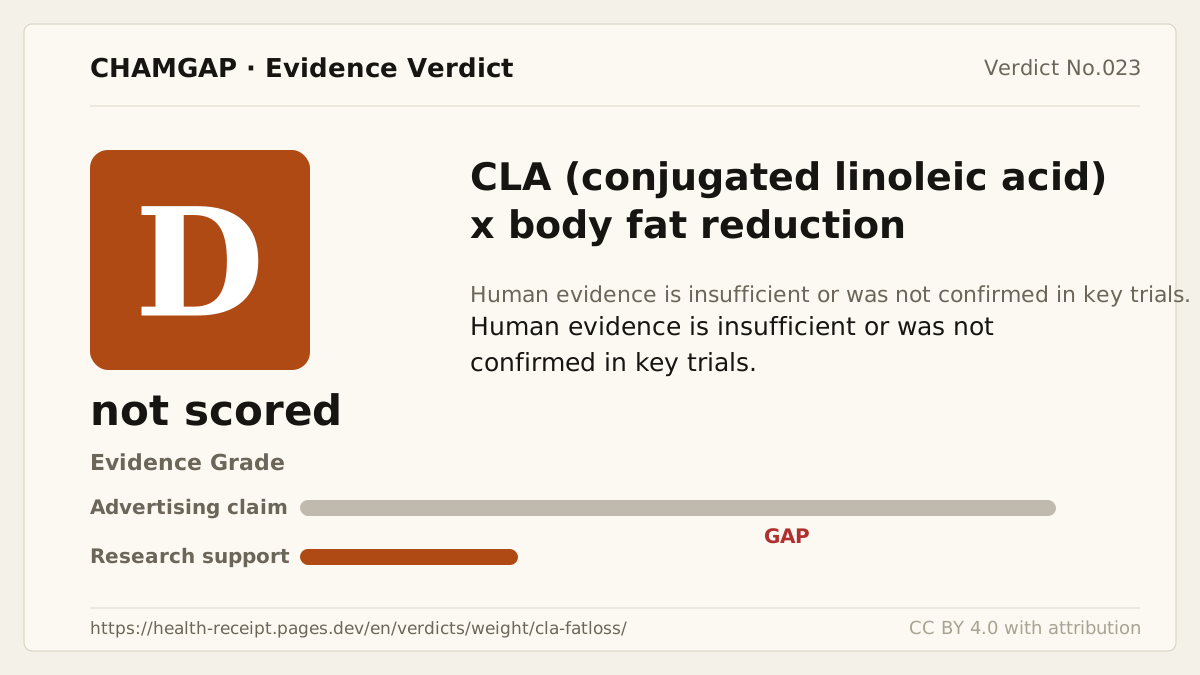
[Chamgap] CLA (conjugated linoleic acid) x body fat — Evidence Grade C·50. 7 cited sources checked. Source: https://chamgap.com/en/verdicts/weight/cla-fatloss/ · CC BY 4.0CC BY 4.0 — free to use with attribution; do not distort grades, numbers, or verdict meaning.
What this document does and does not do
Chamgap is an information source. It reports what research has and has not confirmed; it does not tell readers what to take or buy. That decision belongs to readers and, when needed, medical or legal professionals. This verdict reflects literature available up to the search date and may change as new research appears. Nothing here is medical advice.