
Whey protein,
does it really help with Muscle and dieting?
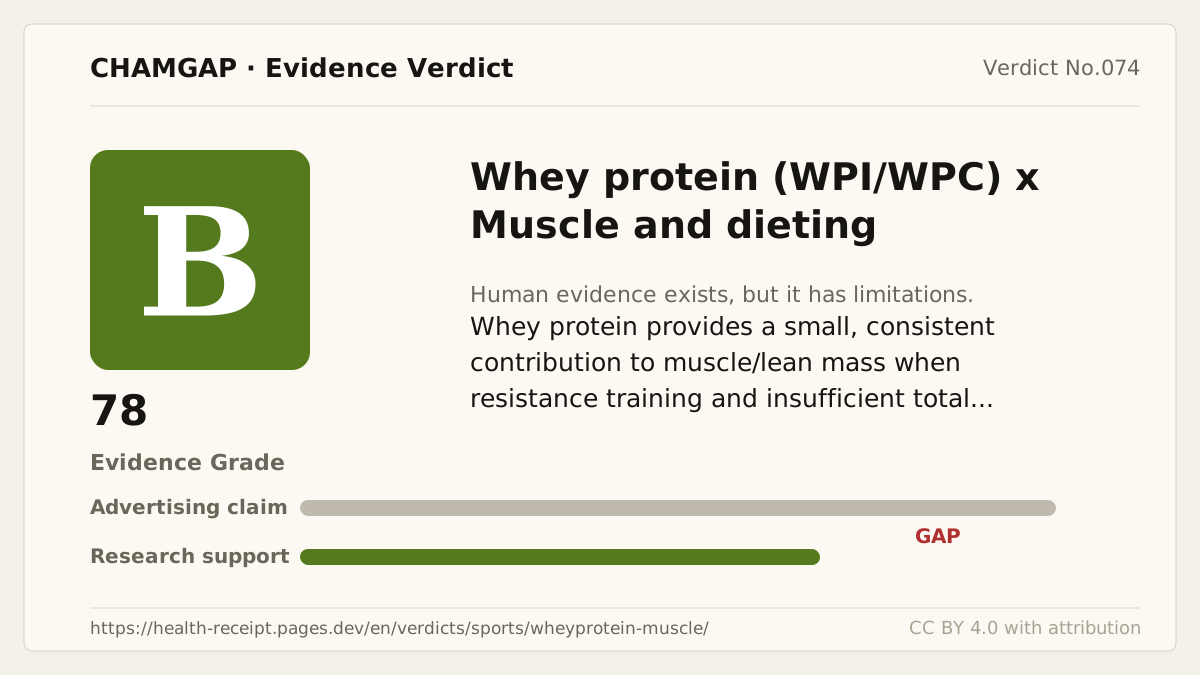
research showsWhey protein has a small but consistent additional effect on increasing muscle mass and strength when combined with resistance training and when total protein intake is insufficient. In weight-loss contexts, the evidence fits better with preserving lean mass during calorie restriction and exercise and helping with satiety and protein targets, rather than acting as a direct weight-loss ingredient.
ads claimKorean advertising and informational articles present WPI/WPC together with phrases such as "muscle strengthening," "muscle growth/muscle recovery," "essential after exercise," "dieting/weight management," "rapidly absorbed protein," and "WPI has less lactose and fat and higher protein purity." Coupang and 11st product names directly include expressions such as "fitness muscle-strengthening whey protein WPI," and Olive Young informational content emphasizes high protein content and low lactose in WPI. Product-promotion articles in news format also repeat messages about WPI's rapid absorption, BCAA, and post-exercise muscle recovery/growth.
Useful facts when choosing a product
- WPC is whey protein concentrate and may retain more lactose and fat than WPI; WPI is whey protein isolate and many products have higher protein purity and less lactose.
- Physiological differences between WPI and WPC mainly involve protein content, lactose/fat content, and digestive tolerance; when total protein and leucine are matched, long-term muscle-effect differences may become smaller.
- Per-serving protein, calories, sugars, sweeteners, and added BCAA/leucine vary by product, so dieting claims should be considered together with actual calories and meal-replacement context.
- For milk allergy, lactose intolerance, chronic kidney disease, or medical protein restriction, evidence from generally healthy people is difficult to apply directly.
What the research actually shows
Muscle efficacy is supported by relatively solid human RCT and meta-analytic evidence. Meta-analyses of protein supplementation plus resistance training repeatedly show increases in FFM and improvements in 1RM/leg press, and Morton 2018 reported FFM +0.30 kg and 1RM +2.49 kg across 49 studies and 1863 participants, with additional benefit slowing after total protein intake of about 1.62 g/kg/day. Whey-specific meta-analyses also show body-composition improvement, but some have industry funding, heterogeneity, and combination-product issues. Dieting efficacy should be interpreted as body-composition improvement and lean-mass preservation rather than stand-alone fat burning; in a 2022 meta-analysis of 35 RCTs, effects were small, such as BMI -0.769 and LBM +0.741 kg, and resistance training and energy intake were major sources of heterogeneity.
Why this is classified as B (78)
The muscle-mass and strength claim is close to A under resistance-training conditions because many RCTs and meta-analyses are consistent, but when narrowed to whey alone or WPI/WPC-specific effects, study sizes are smaller and industry-funded or combination-product studies are mixed in. Dieting evidence is centered on body composition and lean-mass preservation rather than weight loss itself, and effects are small, so the overall grade is B. This is not a pattern of independent null RCTs or repeated null findings, nor is it composed only of manufacturer-funded positive studies.
Counterpoint. If total protein intake is already sufficient or there is no resistance-training stimulus, the additional effect becomes smaller. In older-adult meta-analyses, WPS improved some lower-body strength measures, but LBM, fat mass, walking, and TUG were not significant. Advertising points such as "within 30 minutes after exercise," absorption speed, and BCAA content are smaller factors than total protein, training, and energy balance for long-term outcomes.
Rejudgment record. Convergent — Draft = blinded B. When resistance training and insufficient protein are addressed, muscle/lean mass improves modestly and significantly. It is not a general magic effect.
Cross-check — Codex and Claude
Evidence Table
| Study | Design | Sample | Funding | Endpoint | Result | Weight |
|---|---|---|---|---|---|---|
| Study 1 | Gastrointestinal | Korean informational commerce content presents WPI in the context of post-exercise protein supplementation, protein content, and lactose issues. | Core | |||
| Study 2 | Muscle | At the product-name level, "muscle strengthening" and "whey protein WPI" are directly linked. | Core | |||
| Study 3 | Gastrointestinal/muscle/recovery/absorption | Product-promotion context presents WPI rapid absorption, protein purity, BCAA, and post-exercise muscle recovery/growth messages. | Core | |||
| Cermak NM et al. 2012 | Meta-analysis/RCT | 680 | Possibly manufacturer/industry related | 1RM | A meta-analysis of 22 RCTs and 680 participants found protein supplementation plus resistance training produced FFM +0.69 kg and leg-press 1RM +13.5 kg. | Core |
| Morton RW et al. 2018 | Meta-analysis | 1863 | Possibly manufacturer/industry related | 1RM | Across 49 studies and 1863 participants, protein supplementation increased FFM by +0.30 kg, 1RM by +2.49 kg, and muscle-fiber CSA, with additional benefit slowing after about 1.62 g/kg/day. | Supporting |
| Miller PE, Alexander DD, Perez V 2014 | Meta-analysis/RCT | Possibly manufacturer/industry related | Body weight | A whey-protein RCT meta-analysis separated weight-loss studies and resistance-training studies to evaluate changes in body weight and body composition. | Supporting | |
| Sepandi M et al. 2022 | Meta-analysis/RCT | 1902 | Possibly manufacturer/industry related | Across 35 RCTs and 1902 participants, whey protein showed small body-composition effects including between-group BMI -0.769 and LBM +0.741 kg, with resistance training and energy intake as heterogeneity factors. | Supporting | |
| Wirunsawanya K et al. 2018 | Meta-analysis/RCT | Body weight | A meta-analysis of 9 RCTs in overweight/obese participants reported improvements in body weight, fat mass, and some cardiovascular risk markers. | Supporting | ||
| Volek JS et al. 2013 | Possibly manufacturer/industry related | In a 9-month resistance-training RCT, LBM gains were greater in the whey group (3.3 kg) than carbohydrate (2.3 kg) or soy (1.8 kg). | Supporting | |||
| Reidy PT et al. 2016 | 68 | Possibly manufacturer/industry related | Liver/strength | In a 12-week RCT of 68 healthy young men, whey isolate or soy-dairy blend slightly increased LBM but did not augment strength gains. | Supporting | |
| Verreijen AM et al. 2015 | 80 | Possibly manufacturer/industry related | In an 80-person 13-week RCT during a hypocaloric diet plus resistance training, a whey/leucine/vitamin D combination supplement produced an appendicular muscle mass difference of +0.95 kg. | Supporting | ||
| Li H et al. 2024 | Meta-analysis/RCT | Strength | In a meta-analysis of 26 RCTs in older adults, WPS improved lower-body strength when combined with resistance training, but LBM, fat mass, walking, and TUG were not significant. | Supporting |
Receipt — 12 References
Of 12 cited sources, 4 had limited original-page access (blocked or summary-only) and were verified via index/summary, marked partial; the rest were verified at the original page. As of 2026-07-07.
Reviewed and approved: Chamgap Editorial Team · Approval date: 2026-07-07 · Corrections: none
Cite this verdict
[Chamgap] Whey protein (WPI/WPC) × muscle and dieting — Evidence Grade B·78. 12 cited sources checked. Source: https://chamgap.com/en/verdicts/sports/wheyprotein-muscle/ · CC BY 4.0CC BY 4.0 — free to use with attribution; do not distort grades, numbers, or verdict meaning.
What this document does and does not do
Chamgap is an information source. It reports what research has and has not confirmed; it does not tell readers what to take or buy. That decision belongs to readers and, when needed, medical or legal professionals. This verdict reflects literature available up to the search date and may change as new research appears. Nothing here is medical advice.