
Caffeine,
does it really help with Alertness and exercise performance?
research showsFor short-term alertness, attention/reaction speed, mitigation of performance decline under sleep loss, and exercise-performance markers, human randomized trials and meta-analyses are repeatedly positive for caffeine. However, the effect is acute and context-dependent and does not mean memory, complex judgment, or technical accuracy are always improved.
ads claimIn the Korean market, energy drinks, sports energy drinks, pre-workouts, and exam-student jellies/tablets commonly use phrases such as 'relieves sleepiness,' 'concentration,' 'attention,' 'reaction time,' 'functionality during exercise,' and 'energy, intensity, focus.' Monster Energy Korea's ingredient page explains that caffeine can lead to increased physical endurance, attention, concentration, and reaction time. Hot6 The Pro articles/materials introduce a 355 ml product containing caffeine 120 mg and taurine 1000 mg as strengthening functionality during exercise. Exam-student jelly products were reported as 75-100 mg caffeine sticks advertised to 'wake you up and increase concentration,' and issues of excessive intake and labeling among adolescents were also raised.
Useful facts when choosing a product
- Explains that caffeine can lead to increased physical endurance, attention, concentration, and reaction time
- Contains caffeine 120 mg and taurine 1000 mg; introduced as strengthening functionality during exercise
- Reports that products with 75-100 mg caffeine per stick are advertised as waking users up and increasing concentration
- The sales page explains that 250 mg caffeine supports energy, increased intensity, and focus
- Liquid foods at or above 0.15 mg/ml require high-caffeine labeling; guidance is adults 400 mg/day, pregnant women 300 mg/day, and children/adolescents no more than 2.5 mg/kg/day
What the research actually shows
Studies of standalone caffeine capsules, beverages, and gum are mixed with energy-drink/pre-workout combination-product studies. The core of this verdict is standalone caffeine or studies in which the caffeine effect can be separated. For alertness/attention, meta-analysis and Cochrane review show improved direct performance markers such as reaction time, attention accuracy, PVT, and error counts under sleep-deprivation/shift-work conditions. For exercise performance, repeated small-to-moderate benefits appear across endurance time trials, average power, muscular endurance/strength, jump, sprint, and other exercise tasks after acute intake around 3-6 mg/kg. Combination-product studies were treated only as supporting evidence because co-ingredients such as taurine, sugar, beta-alanine, and citrulline are present.
Why this is classified as A (88)
A. Many independent human RCTs exist for acute standalone caffeine intake, and systematic reviews/meta-analyses are consistently positive for both sleep-loss/attention and exercise performance. Core endpoints directly match the claim, such as reaction time, attention accuracy, errors, time trial, mean power, and muscular endurance, rather than being blood surrogate markers. The claim does not rely only on industry funding or combination products and is not caught by C/D boundary rules. The score avoids the 90s because the effect is limited to acute performance support and higher-order cognition, technical accuracy, and individual responses are heterogeneous.
Counterpoint. Evidence that higher doses are better is weak, and very high doses such as 9 mg/kg increase adverse effects with little additional benefit. Caffeine can worsen sleep and cause anxiety, palpitations, gastrointestinal discomfort, and tremor. Safety interpretation differs in pregnancy/lactation, adolescents, people with anxiety disorders, arrhythmia, hypertension, or sleep disorders, and when combined with caffeine-containing cold medicines or analgesics. Long-term health, learning enhancement, and body-fat reduction claims are not included in this alertness/exercise-performance assessment.
Rejudgment record. Draft=blinded convergent — Acute alertness/attention and exercise-performance effects of standalone caffeine are repeatedly positive in human RCTs and meta-analyses, but effects are limited to short-term performance markers and safety requires caution because of sleep, anxiety, and cardiovascular sensitivity
Cross-check — Codex and Claude
Evidence Table
| Study | Design | Sample | Funding | Endpoint | Result | Weight |
|---|---|---|---|---|---|---|
| Irwin C, Khalesi S, Desbrow B, McCartney D 2020 | Meta-analysis | liver/sleep | Meta-analysis of 45 papers and 327 effect estimates after sleep restriction/deprivation found that acute caffeine improved attention reaction time, accuracy, executive function, information processing, and driving performance. | Core | ||
| Ker K, Edwards PJ, Felix LM, Blackhall K, Roberts I | Systematic review of RCTs | Possible manufacturer/industry involvement | cognition | Review of 13 RCTs in shift-work/jet-lag conditions found no injury endpoints but reported fewer errors and improved cognitive performance; orientation/attention SMD -0.55 (95% CI -0.83 to -0.27). | Core | |
| McLellan TM, Caldwell JA, Lieberman HR 2016 | liver/exercise performance | Open review summarizing that low-to-moderate doses (about 40-300 mg) improve alertness, attention, and reaction time, and that various exercise-performance benefits are observed at 200 mg or higher or about 3 mg/kg or higher. | Supporting | |||
| Lieberman HR, Tharion WJ, Shukitt-Hale B, Speckman KL, Tulley R 2002 | RCT | 68 | Possible manufacturer/industry involvement | liver/sleep/stress | After 72 hours of sleep deprivation/stress, 68 SEAL trainees were randomized to 100/200/300 mg caffeine or placebo; 200-300 mg improved visual vigilance, choice reaction time, and fatigue/sleepiness. | Core |
| Southward K, Rutherfurd-Markwick KJ, Ali A 2018 | Meta-analysis of RCTs | liver | Meta-analysis of 46 randomized placebo-controlled endurance exercise studies summarized that 3-6 mg/kg caffeine improved average power by about 2.9% and time-trial completion time by about 2.3%. | Supporting | ||
| Grgic J, Grgic I, Pickering C, Schoenfeld BJ, Bishop DJ, Pedisic Z 2020 | Meta-analysis | Possible manufacturer/industry involvement | muscle strength/endurance | Umbrella review of 11 reviews and 21 meta-analyses found ergogenic effects of caffeine on aerobic endurance, strength, muscular endurance, power, jumping, and exercise velocity. | Supporting | |
| Guest NS, VanDusseldorp TA, Nelson MT et al. 2021 | sleep/anxiety/exercise performance | ISSN position stand summarized that exercise performance improves consistently at 3-6 mg/kg, and very high doses (for example, 9 mg/kg) have many adverse effects and are not necessary. | Supporting | |||
| EFSA NDA Panel 2015 | sleep | EFSA summarized that a single 200 mg dose or up to 400 mg/day in healthy adults has low safety concern, and that even 100 mg can affect sleep when taken close to bedtime. | Supporting | |||
| EFSA NDA Panel 2011 | EFSA recognized a cause-and-effect relationship between caffeine and increased alertness/attention and indicated a condition of at least 75 mg per serving. | Supporting |
Receipt — 9 References
Of 9 cited sources, 3 had limited original-page access (blocked or summary-only) and were verified via index/summary, marked partial; the rest were verified at the original page. As of 2026-07-07.
Reviewed and approved: Chamgap Editorial Team · Approval date: 2026-07-07 · Corrections: none
Cite this verdict
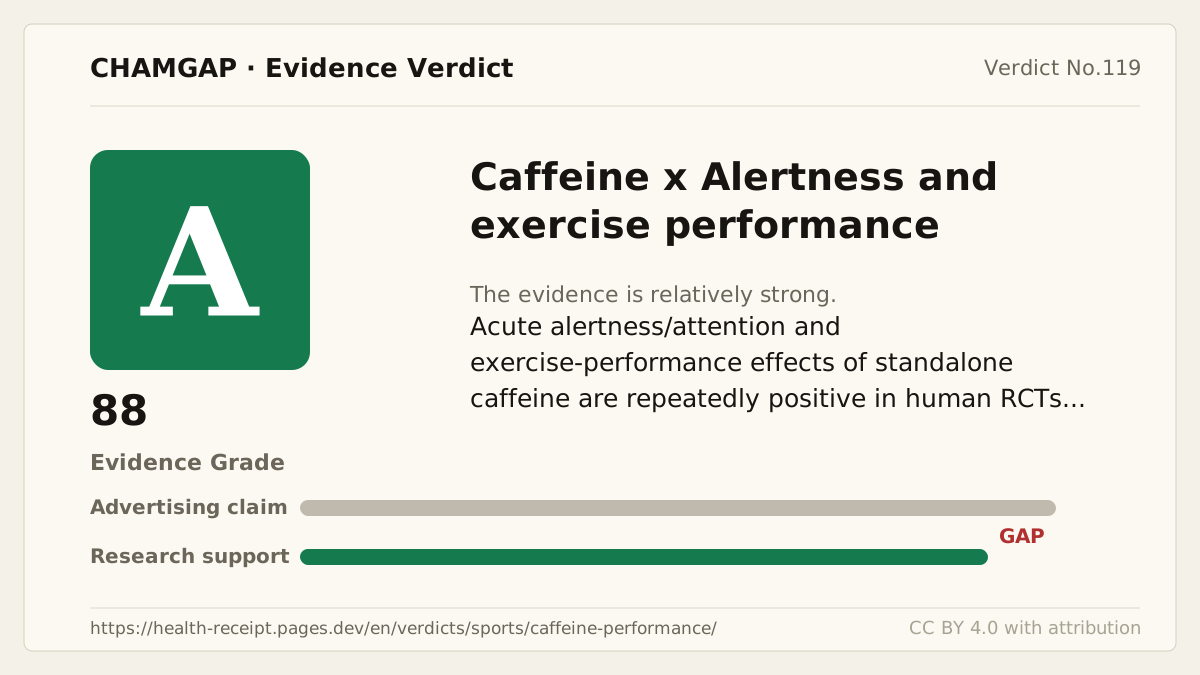
[Chamgap] Caffeine x alertness and exercise performance — Evidence Grade A·88. 9 cited sources checked. Source: https://chamgap.com/en/verdicts/sports/caffeine-performance/ · CC BY 4.0CC BY 4.0 — free to use with attribution; do not distort grades, numbers, or verdict meaning.
What this document does and does not do
Chamgap is an information source. It reports what research has and has not confirmed; it does not tell readers what to take or buy. That decision belongs to readers and, when needed, medical or legal professionals. This verdict reflects literature available up to the search date and may change as new research appears. Nothing here is medical advice.