
Beet,
does it really help with Blood pressure and exercise performance?
research showsThe core evidence for red beet/beetroot juice is nitrate. For beetroot juice with standardized nitrate content, RCTs and meta-analyses show reductions in systolic blood pressure of roughly 3-5 mmHg, and exercise performance shows small but repeated benefits in some outcomes such as endurance, high-intensity 2-10 minute exercise, and time to exhaustion. However, effect sizes are not large and depend strongly on the product's nitrate content, intake dose, and exercise conditions. Therefore, it is not "no evidence," but rather B: human RCT evidence exists, with limited effects, rather than A-level evidence as robust and reproducible as creatine.
ads claimKorean informational articles and product descriptions frame red-beet juice, beetroot juice, and beetroot powder as "blood-pressure management," "vasodilation," "nitric oxide generation," "blood-flow improvement," "pre-workout booster," and "endurance/exercise-performance improvement." Articles from pharmacist and health-media sources mention doses such as 6-8 mmol (about 350-500 mg) nitrate 2-3 hours before exercise, 250 mL beetroot juice, or 70 mL concentrated shots. Shopping and brand content sell powders, liquid sticks, and juice concentrates as pre-workout products, and some mix citrulline, creatine, caffeine, and beta-alanine, making single-ingredient interpretation difficult.
Useful facts when choosing a product
- What has mainly been tested clinically is beetroot juice or concentrated beetroot juice with confirmed nitrate content; simple red-beet juice or powder cannot be assumed equivalent if nitrate content is not labeled.
- Common blood-pressure RCT ranges are 70-250 mL/day, roughly 5-8 mmol nitrate, for days to weeks. Low-dose nitrate increases through ordinary vegetable diets did not guarantee the same effect.
- Exercise-performance studies commonly used about 5-14.9 mmol nitrate 2-3 hours before exercise or repeated intake over several days.
- The pathway in which oral bacteria convert nitrate to nitrite is important, so antibacterial mouthwash can reduce the effect.
- Red pigments/antioxidants in beet should be separated from nitrate effects. ABC juice, mixed pressed juices, and low-content powders cannot directly inherit nitrate evidence.
- Nitrate can lower blood pressure, so people using antihypertensives, PDE-5 inhibitors, nitrate/nitrite medications, or with low blood pressure tendencies need separate medical context.
- Beet can discolor urine/stool and cause gastrointestinal discomfort, and caution is needed with a history of kidney stones because of oxalate content.
- If exercise products include caffeine, citrulline, beta-alanine, or creatine together, they should not be judged as beet/nitrate-alone evidence.
What the research actually shows
Blood pressure: a 2022 meta-analysis of nitrate-rich beetroot-juice RCTs in hypertensive patients found systolic blood pressure -4.95 mmHg (95% CI -8.88 to -1.01) across 7 RCTs and 218 participants, while diastolic blood pressure was not statistically clear at -0.90 mmHg. The Kapil 2015 RCT reported reductions in clinic/home/24h blood pressure with 250 mL/day, about 6.4 mmol nitrate, for 4 weeks. Conversely, an independent RCT increasing a low-dose nitrate vegetable diet (about 150 mg/day) for 4 weeks found no blood-pressure reduction. Exercise performance: a 2021 meta-analysis of 73 RCTs found power output +4.59 W, time to exhaustion +25.27 seconds, and distance +163.7 m, but time-trial performance was not significant. A 2022 meta-regression of 123 studies found a small but significant overall effect (SMD 0.101), with larger effects for beetroot juice/high-nitrate diets, 5-14.9 mmol taken at least 150 minutes before exercise, and 2-10 minute exercise.
Why this is classified as B (72)
Standardized nitrate beetroot juice has real human evidence. RCTs and meta-analyses in patients with hypertension repeatedly report reduced systolic blood pressure, and multiple RCTs and meta-analyses of exercise performance show improvements in power output, time to exhaustion, and some 2-10 minute high-intensity exercise indicators. However, the blood-pressure effect is generally small, around 3-5 mmHg systolic, and diastolic blood pressure, 24-hour ambulatory blood pressure, and cardiovascular event reduction are not consistently established. Exercise-performance effect sizes are also small, and results vary for time trials, elite athletes, and long-duration events. Study effects also depend greatly on standardization: products with confirmed nitrate content, doses around 5-14.9 mmol, and intake 2-3 hours before exercise. Thus, the direction of evidence is accepted, but it does not reach creatine-like A-level evidence; it is B, 72 points, with human RCTs but limited effects.
Counterpoint. There is no need to dismiss positive evidence for beetroot juice. If nitrate content is sufficient and intake timing and exercise conditions match, systolic blood pressure or some exercise-performance indicators may improve. However, ordinary red-beet juice, powders, and mixed juices often have unclear nitrate content; a low-nitrate food-increase RCT was negative; and exercise-performance meta-analyses often show nonsignificant results for time trial, VO2max, and lactate. Because product standardization and condition dependence are large, B is more conservative than A.
Rejudgment record. Re-adjudication (downgraded A -> B) — Standardized nitrate beetroot juice has real RCT/meta-analysis improvements in systolic blood pressure and some exercise performance, but effects are small and depend on conditions, dose, and product standardization -> not creatine-level A, but B with human RCTs. Consistent with blinded B.
Cross-check — Codex and Claude
Evidence Table
| Study | Design | Sample | Funding | Endpoint | Result | Weight |
|---|---|---|---|---|---|---|
| Benjamim CJR et al. 2022 | Meta-analysis/RCT | 218 | Possibly manufacturer/industry related | Blood pressure | In 7 RCTs and 218 hypertensive patients, nitrate-rich beetroot juice lowered systolic blood pressure by -4.95 mmHg, while diastolic blood pressure was not significant. | Core |
| Kapil V et al. 2015 | Double-blind RCT | Possibly manufacturer/industry related | Blood pressure | In hypertensive patients, 250 mL/day beetroot juice (about 6.4 mmol nitrate) for 4 weeks reportedly reduced clinic/home/24h blood pressure. | Core | |
| Siervo M et al. 2013 | Meta-analysis | Possibly manufacturer/industry related | Blood pressure | An early meta-analysis linked inorganic nitrate/beetroot juice supplementation with reduced adult systolic blood pressure. | Core | |
| Blekkenhorst LC et al. 2018 | RCT | 30 | Possibly manufacturer/industry related | Liver/blood pressure | In 30 people with prehypertension/stage 1 hypertension, about 200 g/day high-nitrate vegetables (about 150 mg nitrate/day) for 4 weeks did not reduce 24h/home/clinic blood pressure. | Core |
| Gao C et al. 2021 | Meta-analysis/RCT | 1061 | Possibly manufacturer/industry related | Across 73 RCTs and 1061 participants, power output, time to exhaustion, and distance improved, but time trial, work done, and VO2max were not significant. | Supporting | |
| Silva KVC et al. 2022 | Systematic review | 1705 | Mixed/partly industry related | Exercise performance | In 123 studies and 1705 participants, nitrate slightly improved exercise performance (SMD 0.101), with larger effects for beetroot juice/high-nitrate diets, 2-10 minute exercise, and 5-14.9 mmol doses. | Supporting |
| Wong TH et al. 2022 | Meta-analysis | Possibly manufacturer/industry related | Across 24 high-intensity endurance time-trial studies lasting 5-30 minutes, the overall effect was borderline (Hedges g 0.15); acute intake was not significant and repeated intake was more favorable. | Supporting | ||
| Lansley KE et al. 2011 | 9 | Possibly manufacturer/industry related | In 9 club-level male cyclists, acute 0.5 L beetroot juice (6.2 mmol nitrate) reportedly shortened 4 km and 16.1 km time trials by about 2.7-2.8%. | Supporting |
Receipt — 8 References
Of 8 cited sources, 3 had limited original-page access (blocked or summary-only) and were verified via index/summary, marked partial; the rest were verified at the original page. As of 2026-07-07.
Reviewed and approved: Chamgap Editorial Team · Approval date: 2026-07-07 · Corrections: none
Cite this verdict
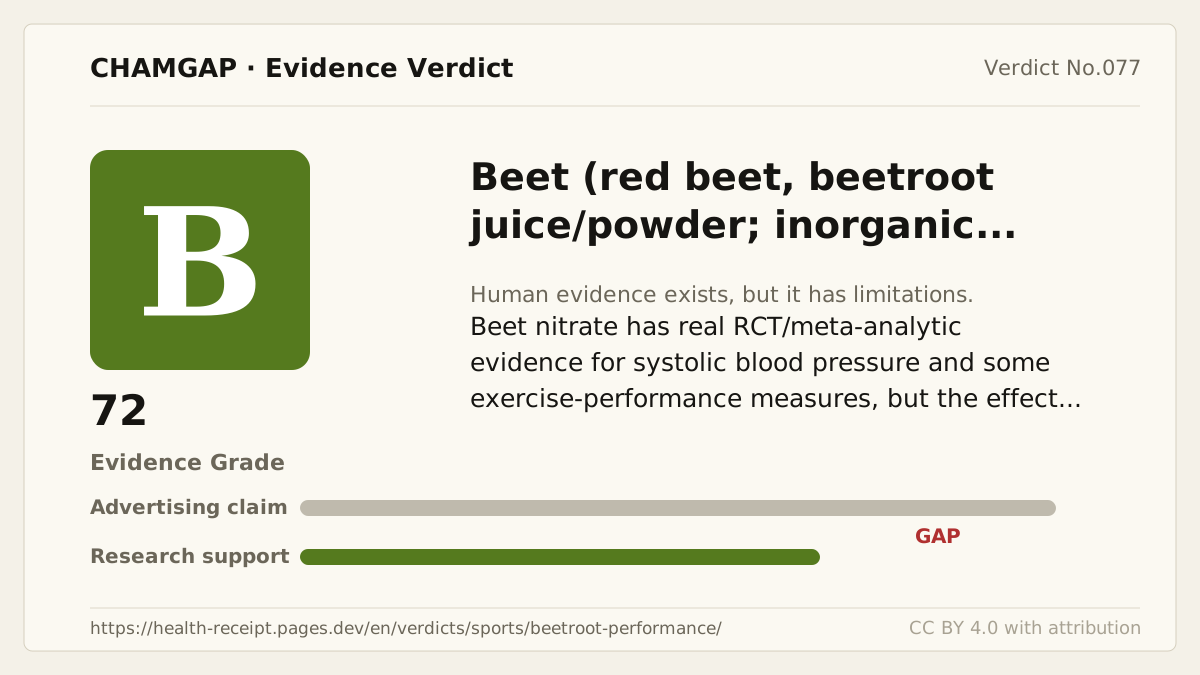
[Chamgap] Beet × blood pressure and exercise performance — Evidence Grade B·72. 8 cited sources checked. Source: https://chamgap.com/en/verdicts/sports/beetroot-performance/ · CC BY 4.0CC BY 4.0 — free to use with attribution; do not distort grades, numbers, or verdict meaning.
What this document does and does not do
Chamgap is an information source. It reports what research has and has not confirmed; it does not tell readers what to take or buy. That decision belongs to readers and, when needed, medical or legal professionals. This verdict reflects literature available up to the search date and may change as new research appears. Nothing here is medical advice.