
Creatine,
does it really help with Strength and exercise performance?
research showsFor the narrow claim that creatine monohydrate improves strength and exercise-performance measures during resistance training or short, repeated high-intensity exercise, the human RCT and meta-analytic evidence is very strong. Claims that it builds muscle without exercise, or broader claims extending to long-distance endurance, cognition, recovery, or bone density, should be evaluated as separate claims.
ads claimIn the Korean market, phrases such as "creatine monohydrate for improved exercise performance," "helps improve exercise performance during strength training," "sustained exercise performance," "more repetitions," "pure/100% creatine monohydrate," and "3,000 mg per day" recur in product names, detail pages, and Instagram advertisements. Informational articles and hospital/pharmacist media also mention 20 g/day loading followed by 3-5 g/day maintenance, or long-term intake of 3-5 g/day, combined resistance training, caution in kidney disease, and possible weight gain or gastrointestinal discomfort. Some shopping and content language extends to muscle-mass gain, recovery, cognitive function, and bone density, but this verdict is limited to "strength and exercise performance."
Useful facts when choosing a product
- The most studied form is creatine monohydrate, and evidence that other forms are superior to monohydrate is weak.
- Korean products often list 3 g or 3,000 mg per day; studies commonly use 20 g/day loading for 5-7 days followed by 3-5 g/day maintenance, or continuous intake of 3-5 g/day.
- The best-supported range is resistance training and short repeated high-intensity performance. Generalizing to pure endurance exercise or strength improvement without exercise weakens the evidence.
- Early weight gain or gastrointestinal discomfort may occur, and creatine can affect interpretation of serum creatinine, so people with kidney disease require separate caution.
- Combination products may mix effects and safety issues from caffeine, protein, carbohydrate, or herbal extracts, making direct application of single-ingredient creatine evidence difficult.
What the research actually shows
The core evidence consists of meta-analyses of human RCTs assessing resistance training or high-intensity performance lasting less than 3 minutes. A 2024 meta-analysis in adults <50 years old used 1RM-based maximal strength as the primary outcome across 23 RCTs and found that creatine plus resistance training improved upper-body strength by +4.43 kg and lower-body strength by +11.35 kg more than placebo plus resistance training. The Lanhers 2015 lower-body meta-analysis reported squat ES 0.336, leg press ES 0.297, and overall lower-body ES 0.235 across 60 RCTs, 646 participants versus 651 participants. The Lanhers 2017 upper-body meta-analysis found significant effects for bench press/chest press and overall upper-limb strength across 53 double-blind placebo-controlled RCTs, 563 participants versus 575 participants. In older adults, a meta-analysis of 22 RCTs and 721 participants found lean mass +1.37 kg, chest press SMD 0.35, and leg press SMD 0.24. The outcomes are direct performance measures such as 1RM, bench press, squat, leg press, and repeated performance, not blood or muscle surrogate markers.
Why this is classified as A (92)
A. There are many human RCTs, and meta-analyses in upper-body strength, lower-body strength, older adults, and resistance-training combinations generally show consistent positive results on direct performance measures. Independent meta-analyses without manufacturer funding exist, and the positive evidence does not depend only on manufacturer-funded studies. Deductions are warranted because effect sizes are generally small to moderate, female samples are limited, and some original RCTs have manufacturer funding, incomplete reporting, and signals of publication bias in upper-body outcomes.
Counterpoint. Creatine has strong evidence as a supplement that modestly supports training adaptation; it is not evidence that replaces exercise, protein intake, or sleep. Claims involving women, non-exercisers, long-distance endurance events, cognition, bone density, or recovery do not automatically receive an A rating in this verdict.
Rejudgment record. Convergent — Draft = blinded A. Multiple double-blind RCTs and meta-analyses show consistent improvement in creatine-related strength and exercise performance. Safety is favorable. Highest score in the project.
Cross-check — Codex and Claude
Evidence Table
| Study | Design | Sample | Funding | Endpoint | Result | Weight |
|---|---|---|---|---|---|---|
| Wang Z et al. 2024 | Meta-analysis | Mixed/partly industry related | Strength/1RM | Across 23 RCTs, maximal strength based on 1RM was analyzed as the primary outcome, with additional gains of +4.43 kg in upper-body strength and +11.35 kg in lower-body strength. | Core | |
| Lanhers C et al. 2015 | Systematic review/RCT | 651 | Mixed/partly industry related | Strength | Across 60 lower-body strength RCTs, 646 creatine participants versus 651 placebo participants showed significant improvements in squat, leg press, and overall lower-body performance. | Core |
| Lanhers C et al. 2017 | Double-blind meta-analysis/RCT | Mixed/partly industry related | Strength | Across 53 double-blind placebo-controlled RCTs on upper-body strength, bench press/chest press and overall upper-limb strength improved significantly. | Core | |
| Chilibeck PD et al. 2017 | Meta-analysis/RCT | 721 | Mixed/partly industry related | Strength | Across 22 RCTs and 721 older adults, creatine during resistance training further improved lean mass and chest-press and leg-press strength. | Supporting |
| Kreider RB et al. 2017 | Possibly manufacturer/industry related | The ISSN position stand summarizes creatine monohydrate as a representative ergogenic supplement effective for high-intensity exercise capacity and increasing lean mass during training. | Supporting | |||
| Antonio J et al. 2021 | Possibly manufacturer/industry related | Gastrointestinal | At recommended intakes of 3-5 g/day or 0.1 g/kg/day, creatine is generally well tolerated, and evidence does not support kidney damage in healthy people. | Supporting | ||
| Kley RA et al. | Liver/strength/exercise performance/muscle | A Cochrane review exists for treatment of muscle disorders and was not directly applied to this verdict on strength and exercise performance in healthy exercisers. | Supporting |
Receipt — 7 References
All 7 cited sources were verified for existence at the original page (as of 2026-07-07).
Reviewed and approved: Chamgap Editorial Team · Approval date: 2026-07-07 · Corrections: none
Cite this verdict
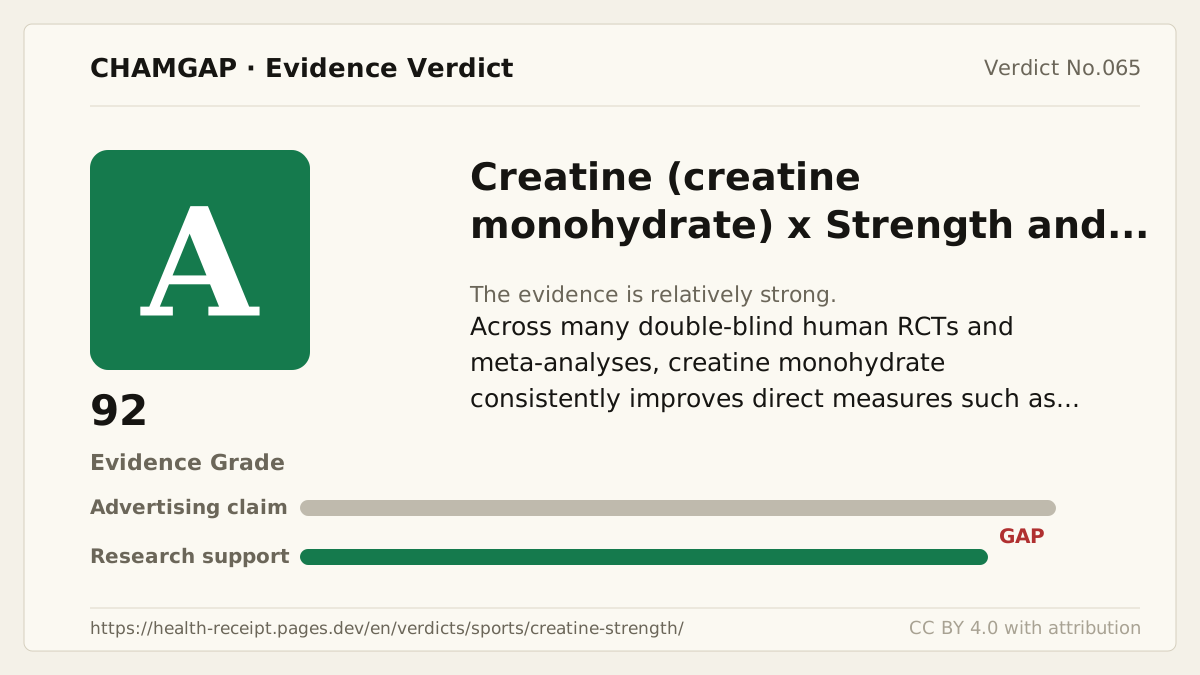
[Chamgap] Creatine (creatine monohydrate) × strength and exercise performance — Evidence Grade A·92. 7 cited sources checked. Source: https://chamgap.com/en/verdicts/sports/creatine-strength/ · CC BY 4.0CC BY 4.0 — free to use with attribution; do not distort grades, numbers, or verdict meaning.
What this document does and does not do
Chamgap is an information source. It reports what research has and has not confirmed; it does not tell readers what to take or buy. That decision belongs to readers and, when needed, medical or legal professionals. This verdict reflects literature available up to the search date and may change as new research appears. Nothing here is medical advice.