
Glutamine,
does it really help with Gut, exercise recovery, and immunity?
research showsGlutamine has physiological plausibility as a major fuel for intestinal epithelial cells and immune cells, and there are human RCT signals in specific IBS-D patient groups. However, when it is broadly bundled as a single ingredient for general gut health, post-exercise recovery, and immune support, as in Korean market advertising, the evidence is limited. For the gut, results are positive in narrow conditions such as post-infectious IBS-D; for exercise recovery, small acute studies suggest muscle soreness and torque recovery effects, but athlete meta-analyses generally found no effect on immune function, aerobic performance, body composition, or CK.
ads claimKorean advertisements, informational articles, and sales pages introduce glutamine together with "intestinal mucosal function," "leaky gut/gut barrier," "digestive function," "improved post-exercise recovery," "reduced muscle soreness and muscle fatigue," "immunity," and "fuel for immune cells and the GI tract." Some advertorial content extends to postoperative condition, skin/wound recovery, and cosmetic effects. Shopping malls commonly sell 5 g powders and 500-1000 mg capsules/tablets with phrases such as "before/after exercise," "amino acid," "post-workout," and "immune support."
Useful facts when choosing a product
- Serving size 1 rounded teaspoon, about 5 g, L-glutamine 5,000 mg. Suggested use is 5 g per serving 1-2 times daily. The product description states it is a major fuel for rapidly growing cells of the immune system and GI tract. The label is for adults and cautions pregnancy/lactation, medication use, liver disease, bipolar disorder, and other medical conditions.
- 5,000 mg L-glutamine powder per serving, 250-1000 g per bottle. It emphasizes vegan, Non-GMO, gluten/soy free, and manufacture in a GMP/FDA registered facility.
- L-glutamine 1,000 mg per tablet. Advertises support for "muscle tissue," "immune support," and "intestinal lining integrity," and presents adult use as 1 tablet 1-2 times daily or after exercise.
- Korean sales listings expose NOW 5 g powder, 500-1000 mg tablets/capsules, and phrases such as "amino acid before/after exercise," "5 g efficacy powder," and "immune function support muscle cell growth."
What the research actually shows
Effects differ substantially by domain. In gut/IBS-D, 2 RCTs using glutamine 15 g/day for 6-8 weeks improved IBS severity, especially in post-infectious IBS-D and patients with increased intestinal permeability. However, the intestinal-permeability meta-analysis, which is the core evidence for generic "gut health," found no overall effect, with positive signals only in high-dose and short-term subgroups. In IBD and Crohn's disease, systematic reviews/Cochrane reviews judged effects null or evidence insufficient. For exercise recovery, small RCTs reported improved muscle soreness and torque recovery after eccentric exercise, but a meta-analysis reviewing 47 athlete clinical trials found no significant association with immune cell counts, VO2max, body composition, or CK. For immune support, human clinical endpoint evidence such as infection prevention is weak, and athlete meta-analyses found leukocyte, lymphocyte, and neutrophil indicators mostly null.
Why this is classified as C (49)
Overall C. In narrow IBS-D, human RCTs exist, so the claim is not merely speculative. But when extended to general gut health, the evidence centers on intestinal-permeability surrogate markers and specific patient groups, while overall intestinal-permeability meta-analyses and IBD/Crohn's evidence are inconsistent. Exercise recovery has positive subjective muscle-soreness and torque-recovery results in small acute experiments, but not at the level of large independent RCTs or consistent meta-analysis. Immune support has repeatedly failed to show clinically persuasive effects in athlete meta-analyses. Under the composite-claim rule, effects are separated by domain, but the broad advertising bundle remains within C.
Counterpoint. In post-infectious IBS-D, IBS-D with confirmed increased intestinal permeability, or IBS studies combined with a low-FODMAP diet, RCTs using 15 g/day showed improvement in IBS severity. Therefore, "symptom improvement in specific IBS contexts" can be viewed more favorably than general gut health, immunity, or exercise-recovery claims.
Rejudgment record. Convergent — Only narrow gut-symptom signals in IBS-D; evidence is insufficient for broad general gut, exercise-recovery, and immune expansion.
Cross-check — Codex and Claude
Evidence Table
| Study | Design | Sample | Funding | Endpoint | Result | Weight |
|---|---|---|---|---|---|---|
| Zhou Q, Verne ML, Fields JZ, Lefante JJ, Basra S, Salameh H et al. 2019 | RCT | Possibly manufacturer/industry related | ALT/gastrointestinal | In post-infectious IBS-D with increased intestinal permeability, glutamine 5 g TID for 8 weeks increased IBS-SS improvement of at least 50 points to 79.6% vs 5.8%, and improved stool frequency/form and lactulose/mannitol. | Core | |
| Rastgoo S, Ebrahimi-Daryani N, Agah S, Karimi S, Taher M, Rashidkhani B et al. 2021 | 50 | Mixed/partly industry related | In a 50-person IBS adult RCT, adding glutamine 15 g/day for 6 weeks to a low-FODMAP diet produced a larger IBS-SSS response rate and total-score change than placebo. | Core | ||
| Abbasi F, Haghighat Lari MM, Khosravi GR, Mansouri E, Payandeh N, Milajerdi A 2024 | Meta-analysis/RCT | 10 | Gastrointestinal | In a meta-analysis of 10 intestinal-permeability RCTs, the overall effect was not significant (WMD -0.00, 95% CI -0.04 to 0.03), with positive signals only in high-dose/short-term subgroups. | Core | |
| Severo JS, Barros VJDS, da Silva ACA, Parente JML, Lima MM, Lima AAM et al. 2021 | Meta-analysis | 7 | Possibly manufacturer/industry related | Gastrointestinal/stress | A systematic review of 7 IBD clinical trials concluded there was no overall effect on disease course, intestinal permeability/morphology, symptoms, or inflammatory/oxidative-stress markers. | Core |
| Akobeng AK, Elawad M, Gordon M 2016 | RCT | 2 | Gastrointestinal | A Cochrane review of 2 RCTs and 42 people with active Crohn's disease found no benefit for clinical remission or intestinal permeability and judged evidence insufficient. | Supporting | |
| Ramezani Ahmadi A, Rayyani E, Bahreini M, Mansoori A 2019 | Meta-analysis/preclinical | 25 | Immune | In 47 athlete clinical trials (25 included in meta-analysis), glutamine generally had no effect on immune cell counts, VO2max, body composition, or CK. | Supporting | |
| Legault Z, Bagnall N, Kimmerly DS 2015 | 16 | Possibly manufacturer/industry related | Liver/muscle/recovery | In a crossover RCT of 16 healthy adults, glutamine 0.3 g/kg/day for 72 hours improved peak-torque recovery and muscle-soreness scores after eccentric knee exercise versus placebo. | Supporting | |
| Street B, Byrne C, Eston R 2011 | Possibly manufacturer/industry related | Liver | In an eccentric exercise damage model, L-glutamine preserved peak torque and improved subjective soreness over 96 hours, but did not change the CK response. | Supporting |
Receipt — 8 References
Of 8 cited sources, 2 had limited original-page access (blocked or summary-only) and were verified via index/summary, marked partial; the rest were verified at the original page. As of 2026-07-07.
Reviewed and approved: Chamgap Editorial Team · Approval date: 2026-07-07 · Corrections: none
Cite this verdict
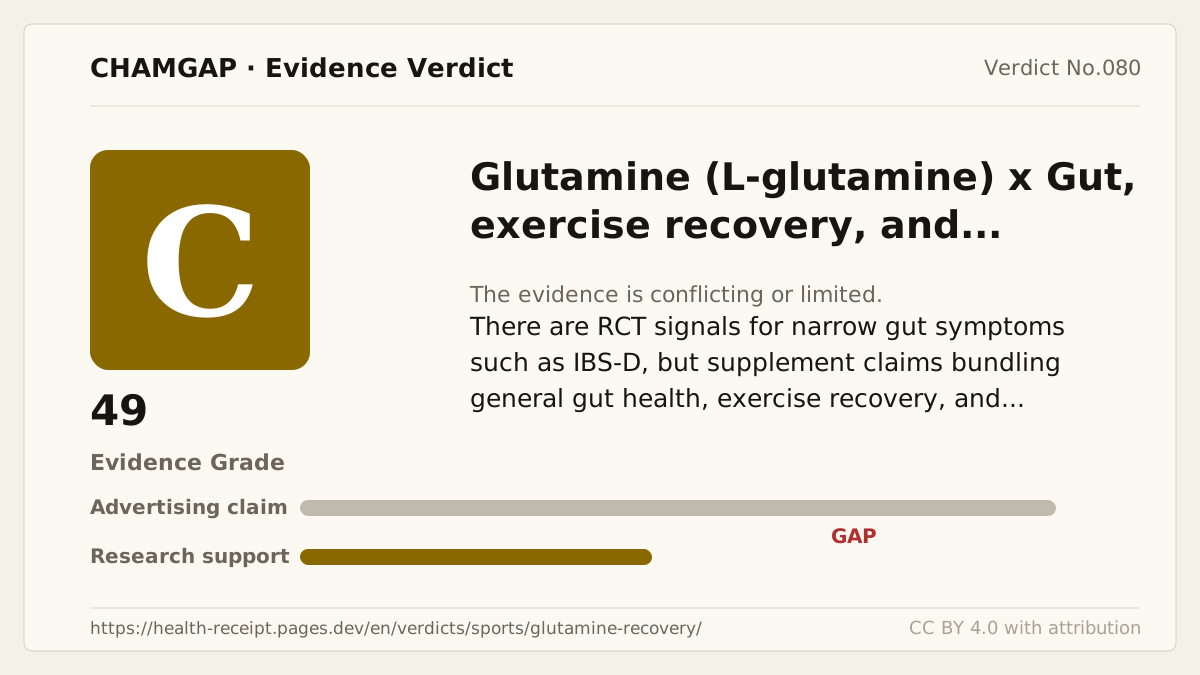
[Chamgap] Glutamine × gut, exercise recovery, and immunity — Evidence Grade C·49. 8 cited sources checked. Source: https://chamgap.com/en/verdicts/sports/glutamine-recovery/ · CC BY 4.0CC BY 4.0 — free to use with attribution; do not distort grades, numbers, or verdict meaning.
What this document does and does not do
Chamgap is an information source. It reports what research has and has not confirmed; it does not tell readers what to take or buy. That decision belongs to readers and, when needed, medical or legal professionals. This verdict reflects literature available up to the search date and may change as new research appears. Nothing here is medical advice.