
Citrulline,
does it really help with Exercise performance and blood-flow/nitric-oxide-related support?
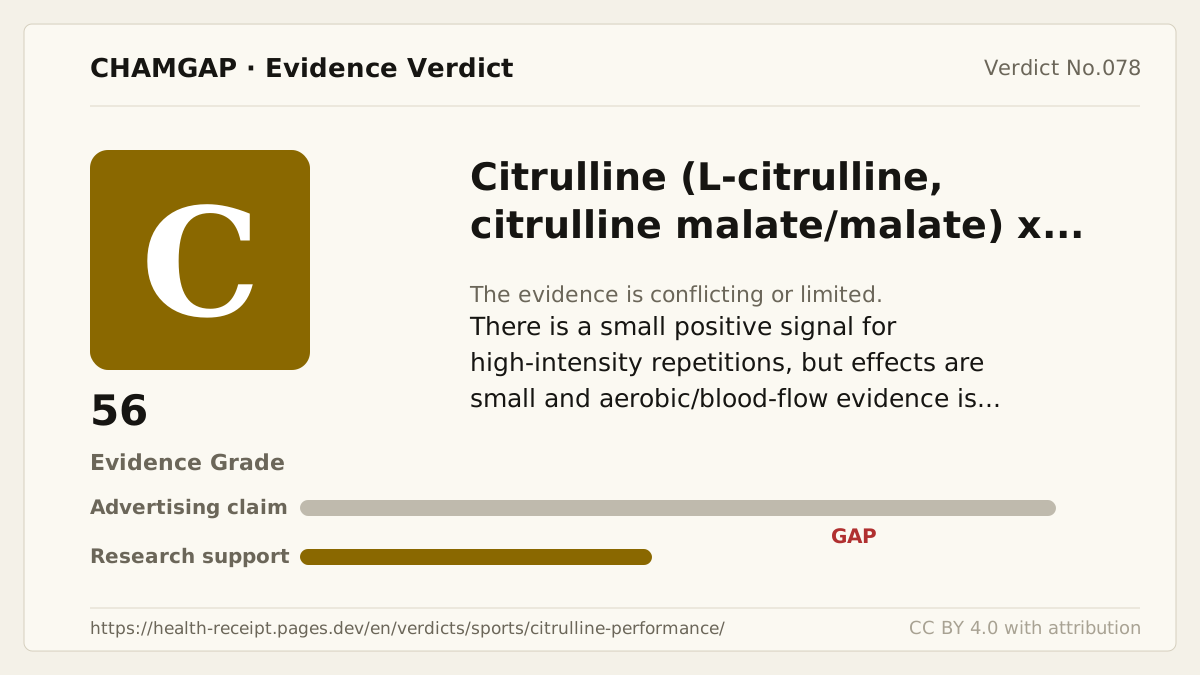
research showsCitrulline increases blood arginine, and citrulline malate has small improvement signals for some high-intensity and resistance-exercise repetitions. However, effect sizes are small and results differ by exercise type, while the link that "increased blood flow improves exercise performance" remains mainly in surrogate markers and small trials.
ads claimKorean market advertisements and informational phrases generally combine "pre-workout pump," "vasodilation," "nitric oxide generation," "blood-flow improvement," "increased oxygen/nutrient supply," "endurance/fatigue reduction," and "more efficient than arginine." iHerb Korean informational content broadly mentioned exercise performance, heart health, and blood pressure, while Instagram/Threads promotional posts framed citrulline malate and arginine combinations as "pump," "sustainability," and "strong vasodilation." Some informational articles, such as pharmacist-media coverage, noted that the exercise-performance effect is controversial.
Useful facts when choosing a product
- Product forms commonly include L-citrulline alone, citrulline malate (CM), and pre-workout combinations mixed with arginine, ornithine, BCAA, caffeine, beetroot/nitrate, and other ingredients.
- Common study doses include L-citrulline 2.4-6 g/day for 6-8 days, or single citrulline malate doses of 6-12 g taken 40-120 minutes before exercise.
- Combination products make it difficult to separate the effect of citrulline alone because of other active ingredients such as caffeine, creatine, beta-alanine, and nitrate.
- Health-functional-food recognition was treated separately from the evidence grade; this draft is an assessment of human evidence, not a regulatory decision.
What the research actually shows
Human randomized trials and meta-analyses exist. A 2019 strength/power meta-analysis showed a small effect across 12 studies and 198 participants (Hedges g 0.20), and a 2026 citrulline-malate-specific meta-analysis reported a small, low-certainty overall exercise-performance effect, g=0.16, across 30 RCTs and 644 participants. Conversely, a 2022 aerobic meta-analysis found no significant benefit for performance, RPE, VO2 kinetics, or lactate, and a 2023 endurance meta-analysis found no significant benefit for either TTE or TTC. For blood flow, a positive surrogate marker such as an 11% increase in femoral blood flow during exercise in older men exists, but not in women, and another elderly-men study found no improvement in blood flow, microcirculation, or muscle protein synthesis.
Why this is classified as C (56)
Small RCT and meta-analytic positive signals exist for high-intensity and resistance-exercise repetitions, so this is not F or D. However, effect sizes (g about 0.16-0.20) are small; null meta-analyses exist for aerobic/endurance/maximal-strength outcomes; and blood-flow improvement is closer to a physiological surrogate marker than to a clinical primary endpoint leading to exercise performance. Under the composite-claim rule, the blood-flow component is capped at C, and evidence is not consistent enough to generalize to broad exercise-performance advertising, so the rating is C (56).
Counterpoint. In domains where small performance differences matter, such as total repetitions in resistance exercise or very short high-intensity tasks, the small average effect may be perceptible to some users. However, this signal does not extend to all exercise types or all people.
Rejudgment record. Convergent — Only small positive signals for high-intensity repetitions; broad exercise-performance and blood-flow consistency is insufficient.
Cross-check — Codex and Claude
Evidence Table
| Study | Design | Sample | Funding | Endpoint | Result | Weight |
|---|---|---|---|---|---|---|
| Wang X et al. 2026 | Meta-analysis/RCT | 644 | Mixed/partly industry related | Liver/exercise performance | Across 30 CM-only RCTs, 644 participants, and 138 effect sizes, the overall exercise-performance effect was small (g=0.16, 95% CI 0.05-0.27, p=0.01), with low to very low GRADE certainty. | Core |
| Trexler ET et al. 2019 | Meta-analysis | 198 | Mixed/partly industry related | Across 12 studies, 13 samples, and 198 participants, high-intensity strength/power performance showed SMD (Hedges g)=0.20 (95% CI 0.01-0.39), p=0.036. | Core | |
| Viribay A et al. 2022 | Meta-analysis/RCT | 173 | Mixed/partly industry related | In 10 aerobic-related RCTs and 173 participants, aerobic performance SMD=0.15 (95% CI -0.02 to 0.32), and RPE/VO2/lactate were not significant. | Core | |
| Harnden CS et al. 2023 | Meta-analysis/RCT | 158 | In 9 RCTs and 158 participants, TTE SMD=0.03 (-0.27, 0.33) and TTC SMD=-0.07 (-0.50, 0.15), showing no significant endurance benefit. | Core | ||
| Suzuki T et al. 2016 | 3 | Possibly manufacturer/industry related | Liver | In a crossover RCT of 22 trained male cyclists, 2.4 g/day for 7 days plus 2.4 g before testing reduced 4 km TT time from 578±15 to 569±14 seconds (1.5%). | Supporting | |
| Cunniffe B et al. 2016 | 10 | Possibly manufacturer/industry related | In a 10-man well-trained crossover RCT, a single 12 g CM dose did not improve TTE (120±61 vs 113±50 sec), PP/mean power/RPE, or acid-base markers. | Supporting | ||
| Gonzales JU et al. 2017 | In older adults, L-citrulline increased femoral blood flow by 11% and vascular conductance by 14% during lower-body exercise in men, but not women. | Supporting | ||||
| Churchward-Venne TA et al. 2014 | 21 | In 21 elderly men, 10 g citrulline plus low-dose whey increased arginine but did not improve blood flow, microcirculation, or MPS. | Supporting |
Receipt — 8 References
Of 8 cited sources, 4 had limited original-page access (blocked or summary-only) and were verified via index/summary, marked partial; the rest were verified at the original page. As of 2026-07-07.
Reviewed and approved: Chamgap Editorial Team · Approval date: 2026-07-07 · Corrections: none
Cite this verdict
[Chamgap] Citrulline × exercise performance and blood-flow/nitric-oxide-related support — Evidence Grade C·56. 8 cited sources checked. Source: https://chamgap.com/en/verdicts/sports/citrulline-performance/ · CC BY 4.0CC BY 4.0 — free to use with attribution; do not distort grades, numbers, or verdict meaning.
What this document does and does not do
Chamgap is an information source. It reports what research has and has not confirmed; it does not tell readers what to take or buy. That decision belongs to readers and, when needed, medical or legal professionals. This verdict reflects literature available up to the search date and may change as new research appears. Nothing here is medical advice.