
BCAA,
does it really help with Muscle and exercise (muscle mass/strength/exercise performance, post-exercise recovery and muscle soreness)?
research showsHuman evidence is not consistent that BCAA alone clearly increases muscle mass, strength, endurance, or exercise performance. Some RCTs and meta-analyses show signals of reduced post-exercise muscle soreness or muscle-damage markers such as CK, but the evidence is generally short-term, small, and centered on indirect markers.
ads claimKorean BCAA advertisements and informational content often present "muscle growth," "muscle protein synthesis," "reduced fatigue during exercise," "post-exercise recovery," "reduced muscle soreness," "prevention of muscle loss," "lean muscle," and "performance improvement" together. Products commonly use 2:1:1 ratios, 5,000-10,000 mg per serving, and powder/capsule/drink formats, and combinations with arginine, citrulline, glutamine, taurine, electrolytes, and caffeine are common. Informational articles also introduce dosing such as 5-10 g within 1-2 hours after exercise or up to 20 g for high-intensity exercise, but these dosing claims were treated separately from the efficacy judgment.
Useful facts when choosing a product
- BCAA is a combination of the three essential amino acids leucine, isoleucine, and valine; labels mix stand-alone supplements with BCAA naturally contained in protein or EAA products.
- Common Korean product/search advertising labels include BCAA 5000, 7000, 9000, 10000 mg and a 2:1:1 ratio.
- Exercise-feel, fatigue, and pump claims for products that also contain arginine, citrulline, glutamine, taurine, electrolytes, or caffeine are hard to interpret as BCAA-alone effects.
- In people with sufficient protein intake, the additional effect of BCAA alone may be small or unclear.
- Short-term studies in healthy adults do not show prominent major safety signals, but separate caution is needed in pregnancy/lactation, children, kidney/liver disease, inherited amino-acid metabolism disorders, Parkinson disease medications, and high-caffeine combination products.
What the research actually shows
Human evidence has two main branches. First, an RCT found that BCAA 5.6 g after acute resistance exercise increased muscle protein synthesis more than placebo, but the sample was 10 people and the endpoint was a 4-hour biopsy surrogate marker, not muscle-mass gain; it was also industry-funded. Second, in post-exercise recovery, 2021 and 2024 meta-analyses reported reductions in CK and DOMS. However, LDH, functional recovery, and actual performance are more unstable, and studies vary in dose, duration, and exercise protocol. Recent systematic reviews in athletes and adults conclude that results for strength, endurance, aerobic capacity, and body-composition change are conflicting and too heterogeneous for firm meta-analysis. No large independent long-term RCT or Cochrane review of exercise effects was identified.
Why this is classified as C (52)
BCAA is not completely unsupported; there are signals for short-term recovery markers. However, the core advertising claims of increased muscle mass, strength, and exercise performance have not been consistently confirmed in human RCTs and recent systematic reviews. Important positive evidence is based on short-term surrogate markers or subjective symptoms such as muscle protein synthesis, CK, and DOMS, while independent replication of long-term hypertrophy or performance primary endpoints is insufficient. Under boundary rule 1, surrogate-centered evidence is capped at C, and partial consistency in recovery markers supports a middle C score.
Counterpoint. If narrowed to post-exercise muscle soreness or CK reduction, meta-analyses combining several RCTs show favorable results. Signals appear stronger in studies using relatively high weight-based doses for several days before exercise. However, whether this leads to actual muscle gain, athletic performance improvement, or long-term training adaptation still needs to be verified separately.
Rejudgment record. Convergent — Some short-term signals for muscle soreness/CK; direct effects on muscle mass/strength are minimal when total protein is accounted for.
Cross-check — Codex and Claude
Evidence Table
| Study | Design | Sample | Funding | Endpoint | Result | Weight |
|---|---|---|---|---|---|---|
| Salem N et al. 2024 | Meta-analysis/RCT | 457 | Mixed/partly industry related | Liver/muscle/recovery | A meta-analysis of 18 randomized clinical trials and 457 participants of BCAA alone found CK and DOMS reductions at some time points, but LDH was not significant. | Core |
| Khemtong C et al. 2021 | Meta-analysis/RCT | Mixed/partly industry related | Liver/muscle/recovery | In a meta-analysis of 10 RCTs in trained men, CK was lower at several time points, muscle soreness was significant only before 24 hours, and LDH was not significant. | Core | |
| Martinho DV et al. 2022 | Meta-analysis | Liver/strength/muscle/recovery | A review of 24 athlete studies evaluated 30 outcomes including CK, LDH, muscle soreness, strength, jump, and oxygen uptake; positive results depended on dose, duration, and exercise-damage conditions. | Core | ||
| Julea SL, Saleh P 2025 | Meta-analysis | 511 | Possibly manufacturer/industry related | Body fat/strength/recovery/endurance | A systematic review of 22 pure BCAA studies and 511 participants found conflicting results for strength, endurance, aerobic capacity, body fat, and recovery, with many study-quality issues. | Core |
| Jackman SR et al. 2017 | 10 | Possibly manufacturer/industry related | Liver/ALT/gastrointestinal/strength | In a crossover RCT of 10 resistance-trained men, BCAA 5.6 g increased 4-hour myofibrillar protein synthesis by about 22% more than placebo. | Supporting | |
| Khemtong C et al. 2022 | Double-blind | 12 | Mixed/partly industry related | Liver/muscle/recovery | In a double-blind crossover RCT of 12 basketball players, BCAA 0.17 g/kg did not improve muscle-damage markers, soreness, physical performance, or arterial-stiffness recovery over 72 hours versus placebo. | Supporting |
Receipt — 6 References
Of 6 cited sources, 1 had limited original-page access (blocked or summary-only) and were verified via index/summary, marked partial; the rest were verified at the original page. As of 2026-07-07.
Reviewed and approved: Chamgap Editorial Team · Approval date: 2026-07-07 · Corrections: none
Cite this verdict
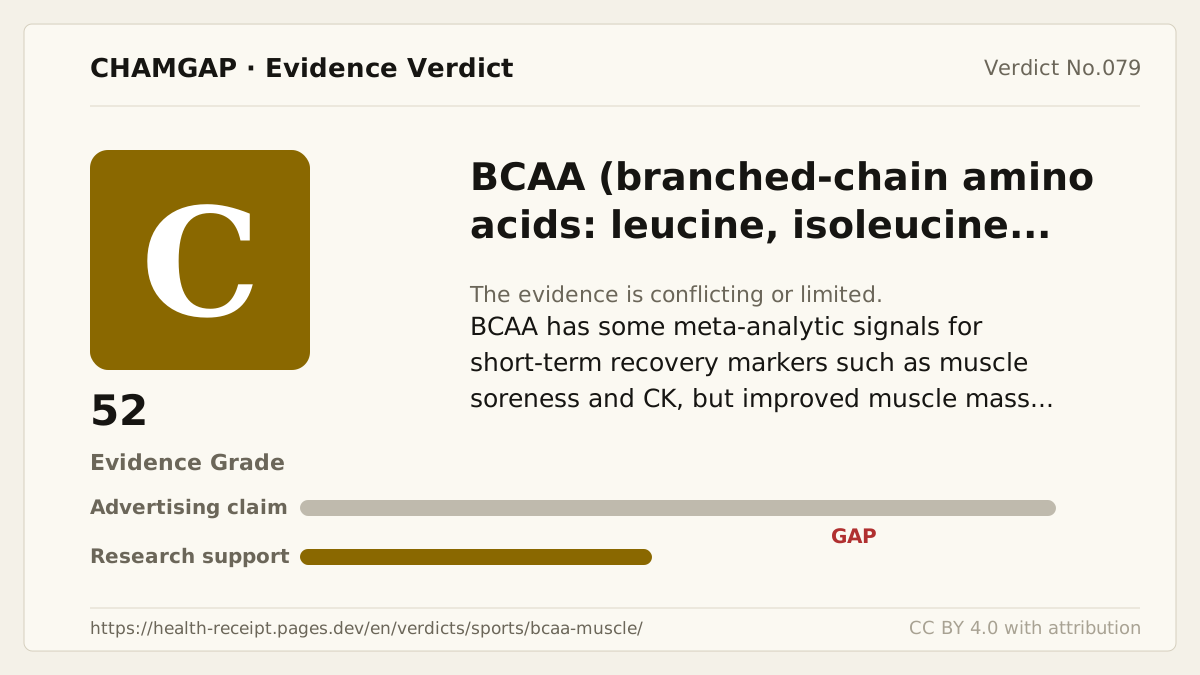
[Chamgap] BCAA × muscle and exercise (muscle mass/strength/exercise performance, post-exercise recovery and muscle soreness) — Evidence Grade C·52. 6 cited sources checked. Source: https://chamgap.com/en/verdicts/sports/bcaa-muscle/ · CC BY 4.0CC BY 4.0 — free to use with attribution; do not distort grades, numbers, or verdict meaning.
What this document does and does not do
Chamgap is an information source. It reports what research has and has not confirmed; it does not tell readers what to take or buy. That decision belongs to readers and, when needed, medical or legal professionals. This verdict reflects literature available up to the search date and may change as new research appears. Nothing here is medical advice.