
Valerian,
does it really help with sleep and anxiety?
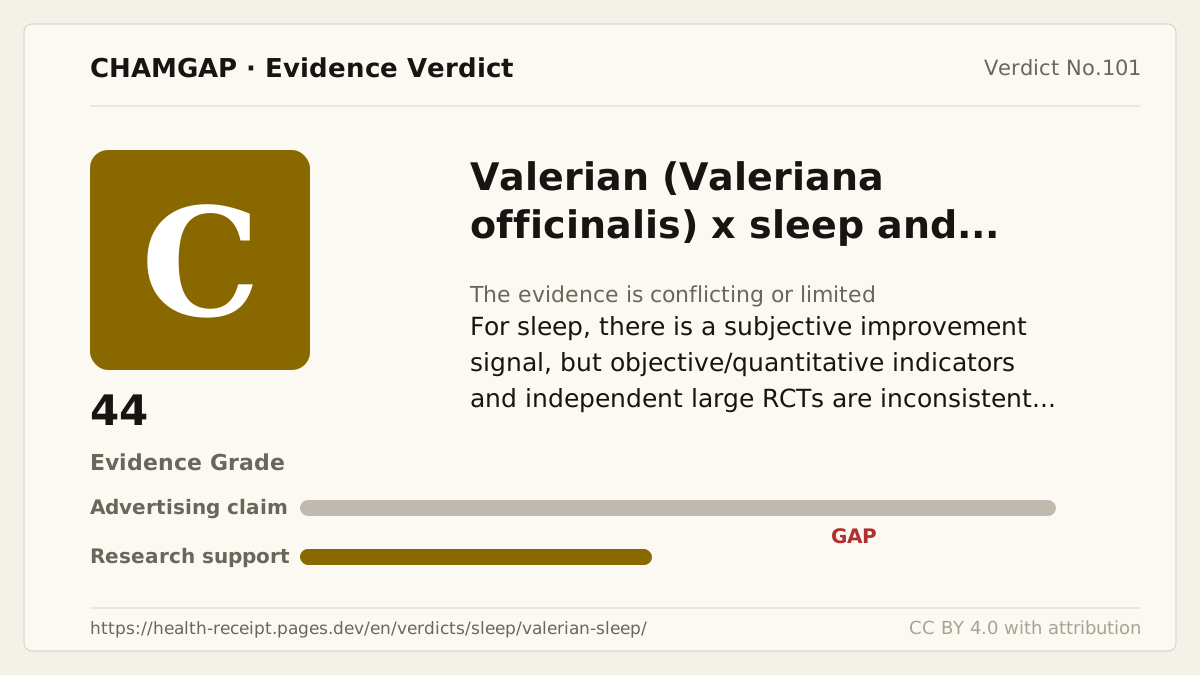
research showsValerian is widely advertised as a sleep-support herb, but human evidence is closer to a signal that 'subjective sleep quality may improve a little.' Consistency is weak in objective sleep indicators and large independent clinical trials. Evidence for anxiety relief is even more insufficient as a separate treatment effect.
ads claimKorean advertising and informational posts often present valerian/valerian root together with 'sleep supplement,' 'deep sleep,' 'sleep induction,' 'comfortable sleep,' 'tension relief,' and 'anxiety and stress relief.' Some informational articles and blogs introduce animal-experiment numbers (sleep maintenance from 360 seconds to 670 seconds, 59% reduction in eye blinking, 43% reduction in cortisol) as if they were evidence for human insomnia improvement. Overseas-direct-purchase and herbal product posts sell not only valerian-root single-ingredient capsules, teas, and tinctures but also combinations with hops, lemon balm, passionflower, theanine, magnesium, tryptophan, melatonin, and other ingredients. MFDS-related reporting has found cases where general foods were labeled or advertised with phrases such as 'sleep health,' 'deep sleep,' 'sleep aid,' 'sleep induction,' 'tension relief,' and 'treatment of insomnia/anxiety,' so regulatory recognition status and evidence grade must be viewed separately.
Useful facts when choosing a product
- Valerian products commonly use dried root/rhizome, extracts, teas, and capsules, and standardization markers include valerenic acid or valepotriates, but product content differs greatly.
- Clinical-trial sleep doses vary widely by study, including 100 mg three times daily, 300-600 mg before bedtime, 450 mg before bedtime, and 200 mg standardized extract.
- Combination studies and advertising are common. Valerian-hop, valerian-lemon balm, and passionflower combinations should not be summed as evidence for valerian alone.
- Animal experiments and mechanisms (GABA, cortisol, IGF-1, etc.) cited in Korean online posts do not directly prove human clinical effects on sleep or anxiety.
What the research actually shows
Sleep: there are several valerian-alone RCTs and meta-analyses, but results differ. A 2006 meta-analysis reported a dichotomous subjective outcome of 'sleep improved' with RR 1.8 (95% CI 1.2-2.9) across 16 RCTs and 1,093 participants, but noted small studies, many methodological problems, and publication bias. A 2010 meta-analysis of 18 RCTs found subjective improvement positive, RR 1.37 (95% CI 1.05-1.78), but sleep-onset latency difference 0.70 minutes (95% CI -3.44 to 4.83) and sleep-quality VAS SMD -0.02 (95% CI -0.35 to 0.31) were not significant. A 2023 meta-analysis of 21 RCTs and 1,433 participants found PSQI and subjective indicators positive, but among objective indicators only NREM stage 3 time was significant. A 2024 umbrella review evaluated 8 systematic reviews and concluded that there was no evidence of efficacy for treating insomnia and that the possibility of improved subjective sleep quality was not confirmed by objective or quantitative indicators. Individual RCTs are also mixed. A 2009 independent RCT in 16 older women with insomnia found no significant improvement in PSG, actigraphy, or self-report. A 2011 phase III RCT in cancer-treatment patients (227 randomized, 119 evaluable for primary analysis) failed the primary endpoint, with 8-week PSQI AUC 51.4 vs 49.7, p=0.6957. Conversely, a 2023 standardized-extract RCT (80 randomized, 72 evaluated) reported improvements in PSQI, wrist actigraphy, some PSG, and BAI, but product developer OmniActive supported the research and publication fees. Anxiety: a Cochrane review included only one 4-week pilot RCT in 36 GAD patients and judged that HAM-A total score did not differ significantly between valerian and placebo. Later reviews mix heterogeneous situations such as stress response, dental-procedure anxiety, and premenstrual symptoms to discuss positive signals, but independent replication as treatment evidence for clinical anxiety disorders is absent.
Why this is classified as C (44)
C. Human RCTs and meta-analyses exist, but positive results are concentrated mainly in subjective sleep quality, and heterogeneity, small samples, and formulation differences are large. Objective or quantitative indicators are repeatedly weak or inconsistent, and a relatively large independent RCT failed its primary sleep endpoint. For anxiety, by Cochrane standards there is only one GAD pilot RCT and no major-scale difference versus placebo, so human proof is insufficient as a separate effect. The 2023 standardized-extract RCT is positive, but as a single manufacturer-supported study it is difficult to use as upgrade evidence under boundary rule 2b.
Counterpoint. Valerian is not an ingredient with no signal at all. The 2010 and 2023 meta-analyses and the 2023 standardized-extract RCT reported improvements in subjective sleep quality, some actigraphy/PSG, and anxiety scales. However, it is difficult to say that these signals have been independently and repeatedly confirmed with the same formulation and same primary endpoint.
Rejudgment record. Convergent — Valerian sleep RCTs are small and inconsistent, with weak objective-marker effects
Cross-check — Codex and Claude
Evidence Table
| Study | Design | Sample | Funding | Endpoint | Result | Weight |
|---|---|---|---|---|---|---|
| Valente V, Machado D, Jorge S, Drake CL, Marques DR 2024 | systematic review | not reported | sleep | Review of 8 systematic reviews concluded that there was no evidence of efficacy for treating insomnia and weak evidence for objective/quantitative indicators other than subjective sleep quality. | core | |
| Zhang X, Lu Y, Lv F et al. 2023 | meta-analysis of RCTs | 1433 | not reported | liver/gastrointestinal/sleep | 21 RCTs, 1,433 participants; PSQI SMD -1.21, subjective sleep quality RR 1.37, and sleep duration RR 1.27 were positive, but among objective indicators only NREM stage 3 was significant. | core |
| Fernandez-San-Martin MI, Masa-Font R, Palacios-Soler L et al. 2010 | meta-analysis of RCTs | not reported | sleep | 18 RCTs; subjective improvement RR 1.37 was positive, but sleep-onset latency 0.70 minutes and sleep-quality VAS SMD -0.02 were not significant. | core | |
| Bent S, Padula A, Moore D, Patterson M, Mehling W 2006 | meta-analysis of RCTs | 1093 | not reported | sleep | 16 RCTs, 1,093 participants; subjective sleep improvement RR 1.8 (95% CI 1.2-2.9), but study-quality problems and possible publication bias were noted. | core |
| Taibi DM, Vitiello MV, Barsness S, Elmer GW, Anderson GD, Landis CA 2009 | RCT | 16 | not reported | sleep | Crossover RCT in 16 older women with insomnia; after 300 mg for 2 weeks, self-report, PSG, and actigraphy sleep latency, WASO, efficiency, and sleep quality all showed no significant improvement. | supportive |
| Barton DL, Atherton PJ, Bauer BA et al. 2011 | RCT | 119 | not reported | not specified | Cancer-treatment patient phase III RCT; 227 randomized and 119 evaluable for primary assessment, with 8-week PSQI AUC 51.4 vs 49.7, p=0.6957, failing the primary endpoint. | supportive |
| Shekhar HC, Joshua L, Thomas JV 2023 | RCT | 72 | not reported | not specified | 80 randomized and 72 evaluated; 2% valerenic acid standardized extract 200 mg for 56 days improved PSQI, actigraphy, some PSG, and BAI. Supported by OmniActive. | supportive |
| Miyasaka LS, Atallah AN, Soares BG 2006 | systematic review/RCT | 36 | not reported | not specified | Only one pilot RCT in 36 GAD patients was included; HAM-A total and factor scores did not differ significantly between valerian and placebo. | supportive |
| Andreatini R, Sartori VA, Seabra MLV, Leite JR 2002 | RCT | 36 | not reported | liver | 36 GAD outpatients, valepotriates/diazepam/placebo for 4 weeks; no significant between-group differences in HAM-A total score or STAI-trait change. | supportive |
| NIH Office of Dietary Supplements | not specified | not reported | gastrointestinal | Summarizes insufficient/inconsistent clinical evidence, lack of long-term safety data, headache, dizziness, gastrointestinal symptoms, and possible additive sedation with sedatives or alcohol. | supportive | |
| Study 11 | not specified | 605 | not reported | gastrointestinal/sleep/anxiety | Domestic advertising cases were found using expressions such as sleep health, deep sleep, sleep aid, sleep induction, tension relief, and treatment of insomnia/anxiety. | supportive |
| iHerb Korea Blog 2025 | not specified | not reported | gastrointestinal/sleep/anxiety/stress | Example of Korean consumer information presenting sleep and relief of anxiety/stress symptoms together. | supportive |
Receipt — 12 References
Of 12 cited sources, 3 had limited original-page access (blocked or summary-only) and were verified via index/summary, marked partial; the rest were verified at the original page. As of 2026-07-07.
Reviewed and approved: Chamgap Editorial Team · Approval date: 2026-07-07 · Corrections: none
Cite this verdict
[Chamgap] Valerian (Valeriana officinalis) × sleep and anxiety — Evidence Grade C·44. 12 cited sources checked. Source: https://chamgap.com/en/verdicts/sleep/valerian-sleep/ · CC BY 4.0CC BY 4.0 — free to use with attribution; do not distort grades, numbers, or verdict meaning.
What this document does and does not do
Chamgap is an information source. It reports what research has and has not confirmed; it does not tell readers what to take or buy. That decision belongs to readers and, when needed, medical or legal professionals. This verdict reflects literature available up to the search date and may change as new research appears. Nothing here is medical advice.