
Melatonin,
does it really help with sleep?
research showsMelatonin has clearer evidence in situations where biological-clock timing is the issue, such as delayed sleep-wake rhythm or jet-lag adaptation. It is not at the level of repeatedly confirmed large effects like a sleeping pill for all general adult chronic insomnia, and the average reduction in sleep latency differs by condition from a few minutes to tens of minutes.
ads claimIn the Korean market, phrases such as plant-derived melatonin, sleep supplement, improved sleep quality, helps you sleep well, sleep-improvement supplement, sleep inducer, and insomnia relief are found. MFDS/Korea Consumer Agency inspection data stated that in 2023, of 294 online pages claiming sleep/melatonin content, 233 were found to be improper advertisements. Informational articles distinguish plant-derived melatonin general foods from sources such as pistachio and tomato, prescription prolonged-release melatonin tablets, and overseas-direct-purchase melatonin supplements.
Useful facts when choosing a product
- In Korea, explanations confirm that prolonged-release tablets containing melatonin as the main ingredient are managed as drugs for the indication 'short-term treatment of insomnia patients aged 55 or older with poor sleep quality.' This regulatory fact is separate from the evidence grade.
- 'Plant-derived melatonin' seen in Korean online/pharmacy contexts is introduced in articles as a general food derived from ingredients such as pistachio, chlorella, and tomato, and is distinguished from health-functional-food functional-recognition ingredients.
- A substantial portion of the clinical evidence is from synthetic melatonin or drug-type prolonged-release 2 mg tablets. Tart cherry, plant extracts, and combination-product advertising cannot be converted directly into effects from melatonin-alone RCTs.
- In the U.S. and other supplement markets, discrepancies between labeled and actual content and detection of serotonin have been reported, so overseas supplement data are difficult to interpret as product-by-product quality assurance.
What the research actually shows
Research centers on melatonin alone or prolonged-release melatonin (PRM). A 2013 PLOS ONE meta-analysis reported across 19 randomized placebo-controlled trials and 1,683 participants that sleep latency decreased by 7.06 minutes, total sleep time increased by 8.25 minutes, and sleep quality improved with SMD 0.22. A 2024 dose-response meta-analysis also reported improved sleep latency and total sleep time across 26 double-blind RCTs, but the publicly available abstract had limited absolute-effect figures. In contrast, a 2022 chronic-insomnia meta-analysis summarized that, in adults, improvements in sleep latency, total sleep time, and sleep efficiency were not significant. By condition, a DSWPD RCT found that 0.5 mg melatonin combined with behavioral sleep scheduling advanced actigraphy sleep timing by 34 minutes, and a Cochrane jet-lag review viewed short-term use of 0.5-5 mg as relatively strongly effective. PRM 2 mg RCTs in insomnia aged 55 years or older were positive, but many key studies were funded by the manufacturer Neurim.
Why this is classified as C (48)
B: there are many human randomized placebo-controlled trials and meta-analyses, and positive results recur for sleep latency, total sleep time, sleep quality, or sleep-timing indicators. However, for general adult chronic insomnia, recent systematic reviews and AASM guidelines are conservative, with small average effects and large heterogeneity. Key RCTs of prolonged-release melatonin in people aged 55 or older have clear manufacturer funding and author conflicts of interest. The structure is not one in which independent RCTs completely nullify the evidence, so it is not D, and because the human clinical outcomes are actual sleep outcomes, the evidence is sufficient not to lower to C.
Counterpoint. The situation in which melatonin is effective is closer to regulating darkness signals and biological-clock timing than to being a drug that forcibly increases sleep itself. Evidence is weak or less direct for all adults with chronic insomnia, sleep maintenance, long-term constant use, plant-derived melatonin general foods, and combination-product advertising.
Rejudgment record. Re-adjudicated (downgraded B to C) — There is evidence for jet lag and delayed sleep phase, but effects in general chronic insomnia are small and inconsistent, and representative prolonged-release (PRM) evidence has manufacturer conflicts of interest; when combined claims are separated, broad sleep improvement is C. Consistent with blinded C
Cross-check — Codex and Claude
Evidence Table
| Study | Design | Sample | Funding | Endpoint | Result | Weight |
|---|---|---|---|---|---|---|
| Ferracioli-Oda E, Qawasmi A, Bloch MH 2013 | meta-analysis of RCTs | 1,683 | not reported | liver/sleep | Meta-analysis of 19 RCTs and 1,683 participants found sleep latency decreased by 7.06 minutes, total sleep time increased by 8.25 minutes, and sleep quality improved with SMD 0.22. | core |
| Centre for Reviews and Dissemination 2013 | meta-analysis | not reported | not specified | Regarding the same 2013 meta-analysis, reliability caution was advised because of search limitations, absence of quality assessment, and influence from one large study. | core | |
| Cruz-Sanabria F, Bruno S, Crippa A et al. 2024 | double-blind RCT | not reported | liver/gastrointestinal/sleep | Across 26 double-blind RCTs and 1,689 observations, sleep latency reduction and total sleep time increase varied by dose and timing. | core | |
| Choi K, Lee YJ, Park S, Je NK, Suh HS 2022 | RCT | not reported | liver/sleep | A review of 24 RCTs in chronic insomnia concluded that in adults, sleep latency, total sleep time, and sleep efficiency did not improve significantly. | core | |
| Wade AG, Ford I, Crawford G et al. 2007 | not specified | 354 | possible manufacturer/industry involvement | sleep | In 354 people aged 55-80, PR-melatonin 2 mg for 3 weeks in an RCT produced sleep quality+morning alertness responders 26% vs 15%, and sleep latency -24.3 vs -12.9 minutes. | supportive |
| Wade AG, Ford I, Crawford G et al. 2010 | RCT | 791 | possible manufacturer/industry involvement | sleep | In a PRM/placebo RCT after adult run-in, n=791, the primary variable did not differ in the low-melatonin group, while in the older group sleep latency was -19.1 vs -1.7 minutes. | supportive |
| Sletten TL, Magee M, Murray JM et al. 2018 | not specified | 116 | possible manufacturer/industry involvement | gastrointestinal/sleep | In a DSWPD RCT of 116 participants, 0.5 mg melatonin plus sleep scheduling advanced actigraphy sleep timing by 34 minutes versus placebo. | supportive |
| Herxheimer A, Petrie KJ 2002 | systematic review/RCT | not reported | liver | A review based on 10 jet-lag RCTs suggested that 0.5-5 mg melatonin reduced jet lag after travel across at least 5 time zones, with NNT about 2. | supportive | |
| Sateia MJ, Buysse DJ, Krystal AD et al. 2017 | not specified | not reported | not specified | AASM gave a weak recommendation against melatonin for sleep-onset/maintenance treatment of adult chronic insomnia. | supportive | |
| Auger RR, Burgess HJ, Emens JS et al. 2015 | not specified | not reported | not specified | For adults with DSWPD and blind adult N24SWD, strategically timed melatonin was recommended weakly for use. | supportive | |
| NCCIH 2024 | not specified | not reported | gastrointestinal/pregnancy | Short-term use is generally safe, but the review summarizes cautions about lack of long-term safety, anticoagulants, epilepsy, pregnancy/lactation, children, and older adults with dementia. | supportive | |
| Study 12 | not specified | 233 | not reported | gastrointestinal/sleep | Inspection of 294 sleep/melatonin-containing advertisements found 233 improper ads, with examples such as sleep inducer and insomnia relief. | supportive |
| Study 13 | not specified | not reported | gastrointestinal | Market information confirmed that domestic plant-derived melatonin products are distributed as general foods and are distinguished from prescription prolonged-release tablets. | supportive |
Receipt — 13 References
Of 13 cited sources, 4 had limited original-page access (blocked or summary-only) and were verified via index/summary, marked partial; the rest were verified at the original page. As of 2026-07-07.
Reviewed and approved: Chamgap Editorial Team · Approval date: 2026-07-07 · Corrections: none
Cite this verdict
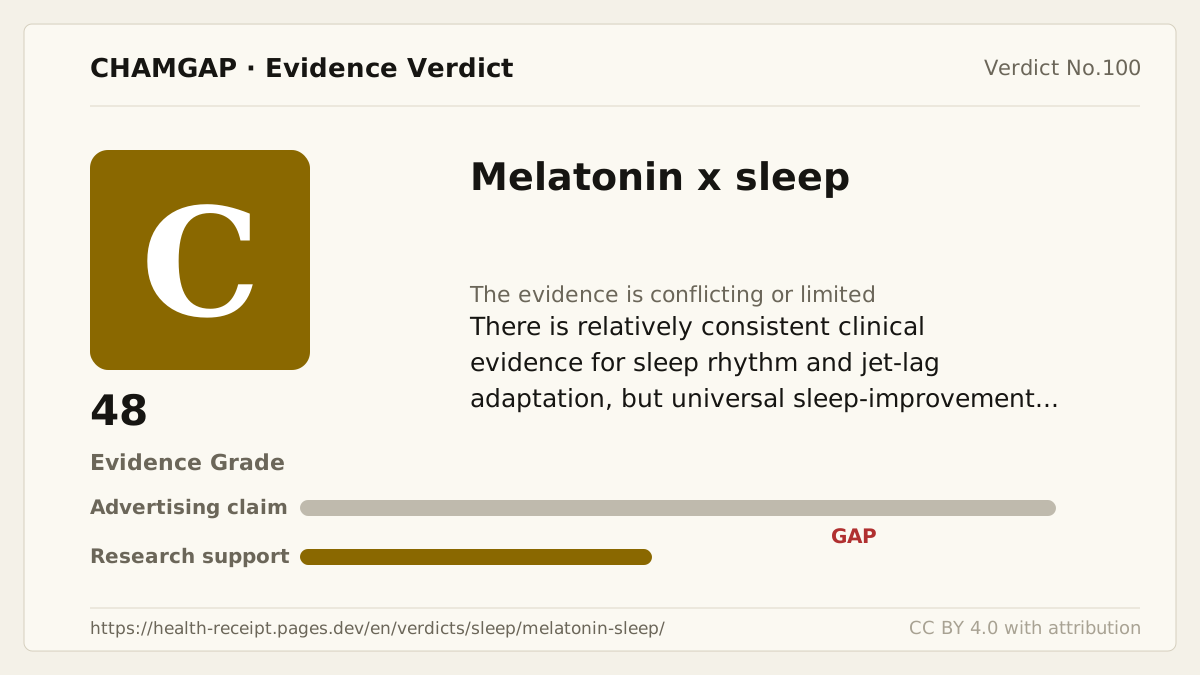
[Chamgap] Melatonin × sleep — Evidence Grade C·48. 13 cited sources checked. Source: https://chamgap.com/en/verdicts/sleep/melatonin-sleep/ · CC BY 4.0CC BY 4.0 — free to use with attribution; do not distort grades, numbers, or verdict meaning.
What this document does and does not do
Chamgap is an information source. It reports what research has and has not confirmed; it does not tell readers what to take or buy. That decision belongs to readers and, when needed, medical or legal professionals. This verdict reflects literature available up to the search date and may change as new research appears. Nothing here is medical advice.