
Magnesium,
does it really help with sleep improvement and eye-twitching relief?
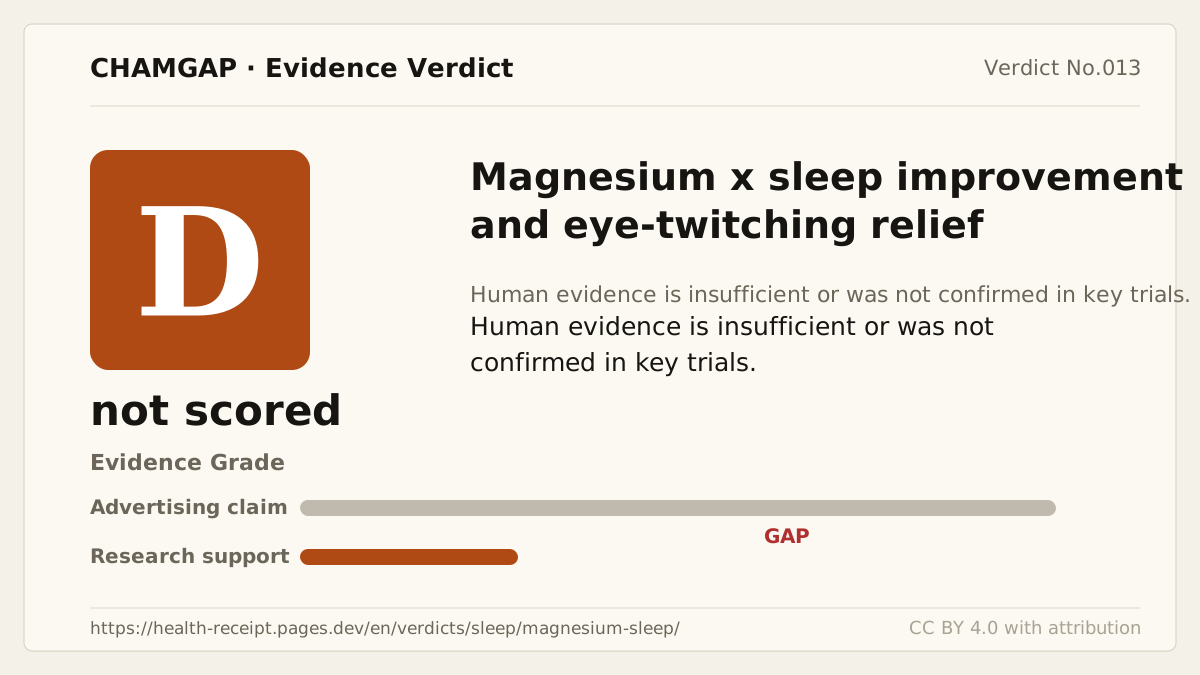
research showsThis claim should be read in two branches. (1) Sleep improvement: human randomized controlled trials (RCTs) exist, but effects are not confirmed in the layer without conflicts of interest and with objective markers. There is a signal that in older adults with magnesium deficiency or low-magnesium status, sleep latency was about 17 minutes shorter than placebo, but the authors themselves rated the evidence quality 'low to very low (GRADE)' and wrote that the literature quality was insufficient for a definitive recommendation. In trials of non-deficient general adults, (a) a manufacturer-funded trial measuring objective sleep markers with Oura Ring (Lopresti 2026) found no between-group differences in total sleep, sleep efficiency, or latency; (b) Nielsen 2010 found no difference in sleep scores between magnesium and placebo groups and the author explicitly suggested a possible placebo effect, although the trial's funding and study-material supplier were not visible in the checked materials, so complete independence cannot be asserted; and (c) the general-adult trial reporting benefit (Schuster 2025) had a small effect size, Cohen's d=0.2, all markers were self-reported, and author conflicts were disclosed. Thus strong positive signals are concentrated in deficiency-correction contexts and conflict-bearing trials, while effects in general adults were not reproduced in layers without conflicts or with objective markers. (2) Eye-twitching relief: no confirmed intervention study tested whether taking magnesium reduces eyelid twitching. The only confirmed observational study (Gunes 2024) found that blood magnesium was in the normal range and did not differ between patients with eyelid twitching and controls; the associated factor was screen time. This study does not support the common belief that magnesium deficiency causes eye twitching. Also, within the confirmed scope, Korean MFDS-recognized magnesium functionalities are only 'needed for energy use' and 'needed to maintain nerve and muscle function,' and 'sleep improvement' and 'eye-twitching relief' are not included. Overall, sleep effects were not confirmed in the conflict-of-interest-zero/high-quality layer and eye twitching has no intervention evidence, so the overall evidence grade is D.
ads claimCollected Korean advertising phrases, within the confirmed range, imply relief or treatment of specific symptoms beyond recognized functionality ('needed to maintain nerve and muscle function'). Garden of Life Korea official mall: title 'If you have insomnia or lack of sleep, get help from magnesium supplements,' body text 'effective for sleep deprivation and insomnia' and 'helps deep sleep.' Nutrione official mall: title 'If the area under your eye twitches, try taking this ingredient!' with a footer notice that it is ingredient health information rather than a product efficacy/effect; the human trials in the body text present only sleep and blood pressure, not eye-twitching clinical data. Yuyu Pharma official blog: 'If under-eye twitching, muscle cramps, insomnia, or chronic fatigue persist, suspect magnesium deficiency,' 'muscle relaxation and nerve-stabilizing effects help sleep,' and 'involved in regulating melatonin, the sleep-inducing hormone.' Many open-market products such as NatureGrand on Gmarket directly insert the efficacy keyword 'eye twitching' into product names. These phrases are based on screens at collection time, and individual URLs/posting dates are follow-up verification outside this scope. Advertisements generally (a) extend deficient-person studies to general adults, (b) broaden limited/self-reported surrogate-marker signals such as '17-minute shorter sleep latency' into 'deep sleep/insomnia effect,' and (c) rely on the folk belief 'magnesium deficiency -> eye twitching' without clinical intervention evidence. Open-market detail pages (item.gmarket, Coupang) were blocked by 403/bot filters, so seller name and labeled dose rechecking is incomplete (C1 incomplete flag).
Useful facts when choosing a product
- Within the confirmed scope, under Korean MFDS standards magnesium is a generic nutrient (mineral), not an individually recognized functional ingredient. The recognized functionality wording is twofold: (1) 'needed for energy use' and (2) 'needed to maintain nerve and muscle function.' Thus the recognized expression is only 'needed for maintenance,' not improvement, relief, or treatment of diseases or symptoms.
- Within the confirmed scope, 'sleep quality improvement' functionality is granted not to magnesium but to separate ingredients such as L-glutamic-acid-fermented GABA powder, Ecklonia cava extract, lime peel extract, rice-bran alcohol extract, ashwagandha extract, and milk-protein hydrolysate (Lactium), and magnesium is not on the sleep-health functionality ingredient list. 'Eye-twitching relief' was not confirmed as any generic or individually recognized functionality. MFDS notice/recognition list originals are follow-up items.
- Public data indicate MFDS daily intake recommendation is about 94.5-250mg and the upper limit (UL) about 350mg. The positive deficiency trial Abbasi 2012 used elemental magnesium 500mg/day for 8 weeks, exceeding that upper limit and differing from ordinary market labeled doses (specific numeric comparison is a follow-up item).
- Absorption and dose differ by form: magnesium oxide (MgO) is reported to have low bioavailability, and negative trials such as Gholizadeh 2022 generally used low-dose MgO. Citrate, bisglycinate, and L-threonate are marketed as better absorbed, but in confirmed trials better absorption did not prove sleep or eye-twitching efficacy (absorption and efficacy are separate).
- According to public Severance Hospital guidance, regarding the common belief that under-eye twitching is due to magnesium deficiency, under-eye twitching after accumulated fatigue or excess caffeine is usually temporary, and if it persists or spreads, neurologic disorders such as hemifacial spasm should be considered (original URL comparison is a follow-up item).
- High-dose magnesium, especially oxide or citrate, can cause osmotic diarrhea, and people with impaired kidney function are known to have hypermagnesemia risk. Serious adverse events within the research dose ranges were rarely reported in the confirmed trials.
What the research actually shows
Based on 9 verified papers, 6 adopted as citations and the other 3 used as narrative support. [Sleep] ① Meta-analysis (Mah & Pitre 2021, BMC Complement Med Ther, PMID 33865376): 3 RCTs in older adults with insomnia (N=151), sleep latency was significantly shorter than placebo by -17.36 minutes (95% CI -27.27~-7.44, p=0.0006), but total sleep time +16.06 minutes was nonsignificant (p=0.15). Authors concluded that all trials had medium-to-high risk of bias, evidence quality low to very low (GRADE), and no definitive recommendation was possible. No funding-source subgroup analysis (A2 flag). ② Abbasi 2012 (J Res Med Sci, PMID 23853635): relatively deficient older insomnia patients with dietary Mg RDA<75% + serum Mg<0.95mmol/L received elemental Mg 500mg/day for 8 weeks, improving sleep time, efficiency, ISI, and latency significantly, while early-morning awakening was nonsignificant. Small deficiency-correction context; manufacturer provision of study product unconfirmed. ③ Nielsen 2010 (Magnes Res, PMID 21199787): age 51+ with PSQI>5, magnesium citrate 320mg/day for 7 weeks; PSQI improved in both groups (10.4->6.6) but there was no between-group difference, and the author explicitly noted possible placebo effect. Magnesium's demonstrated effects were limited to low magnesium and inflammatory markers. Funding/study-material suppliers were not visible on checked pages, so independence cannot be determined (A1 caution). ④ Schuster 2025 (Nat Sci Sleep, PMID 40918053): healthy poor sleepers, not deficient, elemental magnesium bisglycinate 250mg/day for 4 weeks; ISI Mg -3.9 vs placebo -2.3 (p=0.049), but Cohen's d=0.2 was 'small,' all markers were self-reported, and author conflicts were disclosed. ⑤ Lopresti 2026 (Front Nutr, PMID 41601871): adults, L-threonate (Magtein) 2g/day, equivalent to about 145mg elemental Mg, for 6 weeks; primary endpoint was cognition, not sleep, and objective Oura sleep markers total sleep, efficiency, and latency all showed no between-group differences, while PROMIS sleep disturbance also did not differ (only PROMIS sleep-related impairment p=0.043). Threotech Inc. funded and supplied product. ⑥ Rawji 2024 systematic review (Cureus, PMID 38817505): among 8 sleep studies, 5 improved, 2 null, 1 mixed, and usefulness may be greater in people with low baseline magnesium. ⑦ Gholizadeh-Moghaddam 2022 (Health Sci Rep, PMID 36620514): 64 PCOS women, MgO 250mg/day for 10 weeks, PSQI between-group p=0.85 null (low-dose MgO alone). ⑧ Zhang 2022 CARDIA (Sleep, DOI 10.1093/sleep/zsab276): observational study, highest dietary Mg quartile had lower short-sleep risk (OR 0.64, 95% CI 0.51~0.81), sleep quality borderline (OR 1.23, p trend 0.051), authors said objective-marker RCTs are needed to establish causality. [Eye twitching] ⑨ Gunes 2024 (Cureus, PMID 39282492): eyelid myokymia patients 103 vs controls 103; blood electrolytes including Mg did not differ between groups (p>0.05), and the actual associated factor was screen time (6.88 vs 4.84 hours/day, p<0.001, r=0.670). No magnesium intervention trial was found (no evidence). Note: ⑥⑦⑧ were used only as narrative support and not among the 6 adopted citations, so separate tracking is limited.
Why this is classified as C (50)
Why it is C: Magnesium has a small positive signal in a sleep-symptom RCT, but it missed the six-point threshold declared by the source, and there is no intervention trial for eye twitching, leaving limited C-level evidence. · Endpoint: ISI is a patient-experienced insomnia symptom scale, while eye twitching is a symptom event; neither is a hard endpoint, so the axis is P. · Replication and independence: There is one same-unit ISI confirmatory trial, giving R1. The representative report did not identify a separate funding source or product provider, and product-company sponsorship was not confirmed, corresponding to the fixed I2 axis. · Effect: Four-week ISI change was −3.9 with magnesium and −2.3 with placebo, a −1.6-point difference (P=0.049), but this missed the source-declared six-point threshold, giving E~; it should not be expanded into confirmed clinical benefit. · Design: Enrollment below 200 (155) and duration below 12 weeks (four weeks) are two flaws, giving B2. Why it is not A or B: A small short-term signal below threshold, two design flaws, and no eye-twitching intervention evidence do not form strong, complete evidence for the compound claim. Why it is not D or F: Placebo-controlled sleep RCTs and meta-analyses retain a positive direction, so evidence is neither absent nor repeatedly refuted, although the eye-twitching evidence gap must remain explicit. → Under the Chapter 2 ceiling rules, E~ and B2 cap the grade at C; with one strength axis in the Chapter 3 baseline table, the result is C with 50 points.
Counterpoint. [People arguing upward to C or higher] 'The meta-analysis found statistically significant sleep-latency shortening (p=0.0006), several RCTs exist, and a clear effect in deficient people has practical meaning. Since evidence conflicts, it is C, not D.' -> That signal is not denied. However, methodology 2-1② says that when evidence conflicts, the conflict-of-interest-zero/high-quality layer should be read first, and in that layer (objective-marker trials and independent trials), effects in general adults were not confirmed. Significant signals concentrate in self-reported surrogate markers, conflict-bearing trials, and deficient subgroups, so under the general-adult/independent layer it is D. [People arguing downward to F] 'Since general-adult/objective-marker trials were repeatedly null, it is effectively no effect (F).' -> Positive RCTs and significant meta-analysis signals in deficiency-correction contexts exist, so evidence is insufficient to declare 'disproved (F).' A conditional effect in specific subgroups such as deficient people may remain, so lack of evidence for a general-adult claim fits D. [Eye-twitching objection] 'Clinically, magnesium is recommended for eye twitching and some improve.' -> That clinical experience was not confirmed by verifiable intervention studies, and the confirmed observational study did not support a magnesium-eye twitching association. The grade can change if evidence appears.
| Endpoint | P | Patient-reported treatment goal - the symptom is the goal |
| Replication | R1 | Single confirmatory trial |
| Independence | I2 | Decisive evidence is publicly or non-profit funded |
| Effect size | E~ | Statistically positive but below the threshold |
The scoring table and the verdict agree (C).
Cross-check — Codex and Claude
Evidence Table
| Study | Design | Sample | Funding | Endpoint | Result | Weight |
|---|---|---|---|---|---|---|
| Mah J, Pitre T 2021 | meta-analysis of randomized controlled trials | 151 | possible manufacturer or industry involvement | liver / sleep | Meta-analysis of 3 RCTs in older adults with insomnia (total N=151): sleep latency was significantly shortened versus placebo by -17.36 minutes (95% CI -27.27~-7.44, p=0.0006), but total sleep time +16.06 minutes was nonsignificant, and the authors rated all trials medium-to-high risk of bias and evidence quality low to very low (GRADE), stating that no definitive recommendation was possible. | key |
| Abbasi B, Kimiagar M, Sadeghniiat K et al. 2012 | double-blind trial | 46 | possible manufacturer or industry involvement | liver / sleep | Double-blind RCT giving elemental magnesium 500mg/day for 8 weeks to 46 relatively deficient older adults with insomnia; sleep time (p=0.002), efficiency (p=0.03), insomnia severity index (p=0.006), and latency (p=0.02) improved significantly versus placebo, while early awakening p=0.08 was nonsignificant; small deficiency-correction context and dose (500mg) exceeds supplement upper-limit recommendations. | key |
| Nielsen FH, Johnson LK, Zeng H 2010 | possible manufacturer or industry involvement | liver / sleep | RCT in poor sleepers aged 51+, magnesium citrate 320mg/day for 7 weeks; PSQI improved in both groups from 10.4 to 6.6 (p<0.0001), but there was no between-group difference, the author explicitly noted possible placebo effect, and demonstrated magnesium effects were limited to low-magnesium/inflammation markers. | key | ||
| Schuster J, Cycelskij I, Lopresti A, Hahn A 2025 | randomized controlled trial | 155 | possible manufacturer or industry involvement | sleep | RCT in 155 healthy non-deficient poor-sleeping adults, elemental magnesium bisglycinate 250mg/day for 4 weeks; ISI was significantly better with magnesium -3.9 vs placebo -2.3 (p=0.049), but effect size was Cohen's d=0.2 ('small') and all markers were self-reported. | key |
| Lopresti AL, Smith SJ 2026 | possible manufacturer or industry involvement | liver / gastrointestinal / sleep / cognition | RCT giving L-threonate (Magtein) 2g/day, about 145mg elemental Mg, for 6 weeks to sleep-dissatisfied adults aged 18-45; primary endpoint was cognition, objective Oura Ring sleep markers total sleep, efficiency, and latency all showed no between-group difference, and PROMIS sleep disturbance also did not differ (only PROMIS sleep-related impairment p=0.043). | supporting | ||
| Gunes IB 2024 | 103 | possible manufacturer or industry involvement | liver | Case-control study of eyelid myokymia lasting at least 2 weeks, 103 patients vs 103 controls; blood electrolytes including magnesium showed no significant group differences (p>0.05), and the strong actual associated factor was digital screen time (6.88 vs 4.84 hours/day, p<0.001, r=0.670). | supporting |
Receipt — 6 References
Of 6 cited sources, 1 had limited original-page access (blocked or summary-only) and were verified via index/summary, marked partial; the rest were verified at the original page. As of 2026-07-06.
Reviewed and approved: Chamgap Editorial Team · Approval date: 2026-07-06 · Corrections: 1
Correction log — 1
Corrections applied to this verdict, in chronological order. Changes are logged, not erased.
- 2026-08-19 · Methodology v0.7 migration (axes recorded, score derived) — Applied the seven axes and anchor table published in methodology v0.7 to this verdict. It had been graded under the pre-axis method and carried no score. The representative trial was re-established from the source, axes 1-6 recorded, and the score derived from the published anchor table. The old grade was less wrong than assigned before the rule was fully specified; the full rule is in section 2-3 of /methodology/. (grade D→C)
Cite this verdict
[Chamgap] Magnesium x sleep and eye twitching — Evidence Grade C·50. 6 cited sources checked. Source: https://chamgap.com/en/verdicts/sleep/magnesium-sleep/ · CC BY 4.0CC BY 4.0 — free to use with attribution; do not distort grades, numbers, or verdict meaning.
What this document does and does not do
Chamgap is an information source. It reports what research has and has not confirmed; it does not tell readers what to take or buy. That decision belongs to readers and, when needed, medical or legal professionals. This verdict reflects literature available up to the search date and may change as new research appears. Nothing here is medical advice.