
Ecklonia cava extract,
does it really help with sleep?
research showsEcklonia cava extract had a signal of reduced wake after sleep onset (WASO) in a small 1-week human RCT, but overall perceived sleep-quality indicators such as total PSQI were not significant and independent replication is still insufficient. Current evidence is at a level of “possible but difficult to regard as definitive.”
ads claimIn the Korean market, the central phrase is “may help improve sleep quality,” recognized by the MFDS, and repeated expressions include “when you cannot sleep,” “deep sleep,” “sleep supplement,” “7-day human application trial,” “reduced time awake after falling asleep,” “increased sleep duration,” “GABA receptor,” and “natural sleep aid.” Some informational articles/advertisements for products such as Gamtajamtae emphasize single active ingredient Ecklonia extract, meeting dieckol 30 mg, disintegration in 27-30 minutes, KFRI technology transfer, GMP/GLP, and similar points. Conversely, MFDS/media inspection articles explain that even for health functional foods, expressions read as medicine/disease treatment, such as “improves insomnia,” “sleep inducer,” or “medicine that helps you sleep,” are classified as unfair advertising cases.
Useful facts when choosing a product
- The Food Safety Korea sleep-health page lists Ecklonia cava extract (No. 2015-6) among individually recognized functional ingredients and presents the functional wording as “may help sleep (improve quality).”
- Korea Pharmaceutical Information Center drug encyclopedia presents expected functional daily intake of Ecklonia cava extract as 500 mg and lists cautions for iodine-rich foods, thyroid disease, gastrointestinal disease/disorders, pregnancy/lactation, and children under 12.
- According to Korea Food Research Institute/Policy Briefing materials, Ecklonia cava extract was developed in a KFRI R&D project, transferred to KGC Life & Gin in 2012, and received individual recognition on January 8, 2015 after industrialization research with KGC Life & Gin and S&D.
- EU authorization of Ecklonia cava phlorotannins as novel food concerns a 90 +/- 5% phlorotannin extract and sets adult maximum 263 mg/day plus labeling requirements related to thyroid disease and iodine coadministration. It should not automatically be assumed to have the same composition/marker components as Korean “Ecklonia cava extract 500 mg” products.
- Search results show health-functional-food Ecklonia extract products alongside ordinary Ecklonia powder/pill products. “Sleep improvement” expressions on ordinary-food Ecklonia products must be distinguished from labels of functionally recognized products.
What the research actually shows
The core human evidence is one RCT, Um et al. 2018. Twenty-four adults were randomized to take an Ecklonia cava-derived phlorotannin supplement 500 mg/day or placebo 30-60 minutes before bedtime for 1 week, with 20 participants in completed analysis. Questionnaires and polysomnography (PSG) were assessed together. Total PSQI was not significant, but PSQI “sleep duration” subscore (p=.044), PSG WASO change (-25.5 +/- 30.5 min vs -1.7 +/- 14.9 min, p=.045), and respiratory disturbance index during supine REM (p=.035) were significant versus placebo. A single prespecified primary endpoint was not clearly shown in the accessible abstract/index. A 2023 polyphenol-rich intervention meta-analysis pooled 10 RCTs and 334 participants and reported improvement in sleep latency and total sleep time, but because it is indirect evidence combining several polyphenol foods/extracts, it cannot raise Ecklonia-alone evidence to A/B. Animal/mechanistic studies suggest possible GABA-A/benzodiazepine receptor modulation, but remain supporting evidence for human efficacy judgment.
Why this is classified as C (49)
To raise this to B, there is only one standalone human RCT, the sample is very small (24 randomized, 20 completed), and the duration is only 1 week. Total PSQI was not significant, and a single prespecified primary endpoint was not confirmed in the accessible full text/abstract. Significant results are mainly concentrated in PSG WASO and some sub/supporting indicators, making it difficult to generalize to actual perceived sleep-quality improvement. In addition, development, technology transfer, and industrialization context is close to the ingredient holder/commercializing entities, and repeated RCTs by independent researchers are not confirmed, so the borderline rule supports viewing it as maximum C.
Counterpoint. On the positive side, reduced WASO, an objective PSG indicator, was observed in a placebo-controlled double-blind RCT, and mechanisms related to the GABA-A/benzodiazepine receptor are consistent with animal/experimental studies. However, this signal does not prove insomnia treatment, long-term use effects, next-day function improvement, or improved perceived sleep quality in the general population.
Rejudgment record. Converged — Draft=blind C. Small PSG WASO surrogate indicator.
Cross-check — Codex and Claude
Evidence Table
| Study | Design | Sample | Funding | Endpoint | Result | Weight |
|---|---|---|---|---|---|---|
| Um MY, Kim JY, Han JK, Kim J, Yang H, Yoon M, Kim J, Kang SW, Cho S 2018 | double-blind randomized controlled trial | 24 | manufacturer/industry involvement possible | Standalone Ecklonia-derived phlorotannins 500 mg/day, 1 week, n=24 RCT; WASO decreased, but total PSQI was not significant. | core | |
| Wang W, Liu T, Ding Y, Zhang Y 2023 | meta-analysis of RCTs | 334 | liver and sleep | Meta-analysis of 10 polyphenol intervention RCTs, 334 participants; sleep latency and total sleep time improved, but sleep efficiency and PSQI were not significant. | supporting | |
| EFSA NDA Panel 2017 | not specified | Safety assessment of Ecklonia cava phlorotannins for food supplements presented adult maximum 263 mg/day and iodine/thyroid cautions. | core | |||
| European Commission 2018 | not specified | sleep | EU authorization document specifies exclusion under age 12, thyroid disease/iodine coadministration caution, and adult limit 263 mg/day. | core | ||
| Study 5 | not specified | sleep | Labels Ecklonia cava extract (No. 2015-6) as an individually recognized ingredient “may help sleep (improve quality).” | supporting | ||
| Study 6 | randomized controlled trial | Presents ingredient commercialization context: KFRI development, 2012 technology transfer to KGC Life & Gin, and 2015 functional recognition after industrialization research with KGC/S&D. | supporting | |||
| Study 7 | preclinical study | gastrointestinal and sleep | Confirmed public communication text on GABA receptor explanation, animal/human trial proof claims, and differentiation from sleeping pills. | supporting | ||
| Study 8 | not specified | pregnancy | Presents Ecklonia cava extract 500 mg/day, GABA-A receptor explanation, and cautions for iodine, thyroid, pregnancy/lactation, and children. | supporting | ||
| Study 9 | not specified | gastrointestinal | Domestic informational advertising article presents 7-day human trial, dieckol 30 mg, 30-minute disintegration, and KFRI technology transfer as product advantages. | supporting | ||
| Study 10 | randomized controlled trial | liver, gastrointestinal, and sleep | Advertising article mentions improvements in “time awake after falling asleep,” “respiratory disturbance index during sleep,” and “sleep duration” as 7-day human-trial results. | supporting | ||
| Study 11 | not specified | gastrointestinal and sleep | Reported MFDS inspection content that health functional foods for sleep must be distinguished from insomnia treatment/sleep-inducer advertising. | supporting |
Receipt — 11 References
Of 11 cited sources, 1 had limited original-page access (blocked or summary-only) and were verified via index/summary, marked partial; the rest were verified at the original page. As of 2026-07-07.
Reviewed and approved: Chamgap Editorial Team · Approval date: 2026-07-07 · Corrections: none
Cite this verdict
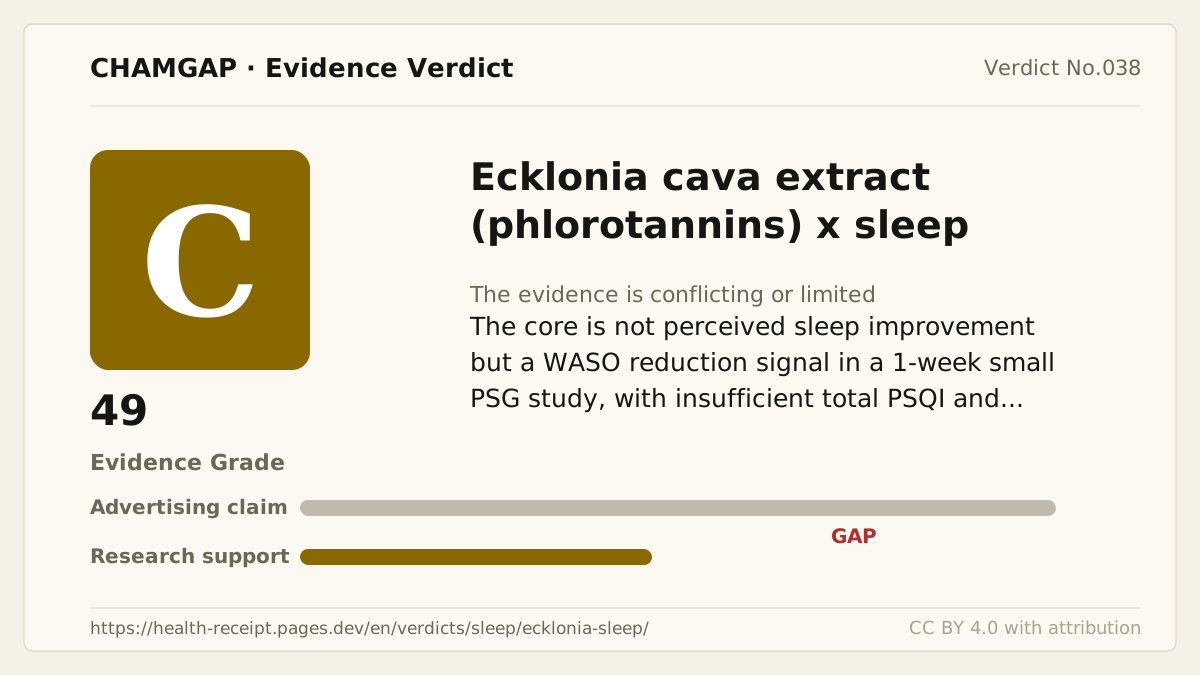
[Chamgap] Ecklonia cava extract x sleep — Evidence Grade C·49. 11 cited sources checked. Source: https://chamgap.com/en/verdicts/sleep/ecklonia-sleep/ · CC BY 4.0CC BY 4.0 — free to use with attribution; do not distort grades, numbers, or verdict meaning.
What this document does and does not do
Chamgap is an information source. It reports what research has and has not confirmed; it does not tell readers what to take or buy. That decision belongs to readers and, when needed, medical or legal professionals. This verdict reflects literature available up to the search date and may change as new research appears. Nothing here is medical advice.