
Pantothenic acid,
does it really help with skin and hair-loss improvement?
research showsBottom line: the claim that “taking pantothenic acid (vitamin B5) improves skin and hair loss” has conflicting and limited evidence (grade C, borderline case). Positive signals are not entirely absent: for acne, an RCT (Yang 2014) found that an ultra-high-dose oral combination product (2.2 g/day) significantly reduced lesions versus placebo, and in female hair loss, an RCT (Siavash 2017) using oral calcium pantothenate with zinc found a small but significant increase in hair density (about +2.8%). However, these signals come with major caveats. The acne study dose was 2.2 g/day, about 440 times the adult adequate intake (5 mg), it was not pantothenic acid alone but a proprietary combination product, and it was a single industry-funded study paid for by the product seller. The hair-loss study used it with zinc, so the independent contribution of pantothenic acid cannot be isolated, and hair thickness was not significant. In other words, no independent (zero-conflict) trial confirming oral pantothenic acid alone at normal dose was found. Meanwhile, studies often cited as evidence for “moisturizing, skin barrier, and hair texture” (Ebner 2002, Gehring 2000) are all “topical” dexpanthenol and cannot be directly applied to an “oral” claim. From the regulatory side, based on public materials confirmed in this verification, the labeling functionality of oral pantothenic acid concerns metabolism/energy production, and improvement of skin/hair loss appears separate from that labeling scope (MFDS original-text cross-check is outside this verification and remains a follow-up target). In short, beyond deficiency correction, the evidence that taking normal-dose commercially available pantothenic acid improves skin or hair loss in the general population is hard to regard as established, and the existing signals are tied to ultra-high dose, combination products, coadministration, and industry funding.
ads claimAdvertising appeals (known from Ople.com, AhnGook Health, SOK SOK, Gradium, etc.) reportedly connect oral pantothenic-acid intake directly to skin, acne, and hair-loss effects such as “acne relief through fat oxidation/metabolism,” “skin barrier recovery and sebum control,” “collagen production, clear skin, healthy hair,” “follicle and hair health,” and “skin trouble/inflammation improvement” (cross-check of original advertising text is outside this verification). The human evidence confirmed within this verification consists only of a single ultra-high-dose acne study with industry funding, a hair-loss study with zinc coadministration, and topical dexpanthenol, so it is inconsistent in dose, formulation, and administration route with the advertising implication of “improved skin/hair by general-dose intake” (E1/E2, E3, E4). From a regulatory perspective, public materials indicate that oral pantothenic acid’s labelable functionality is in the metabolism/energy-production category, and this verification did not confirm a basis that skin/hair-loss improvement is an approved labeling claim (MFDS original-text cross-check remains a follow-up target). Applying topical (transdermal) recognition as evidence for oral intake is an administration-route mismatch. Overall, there is a dose, formulation, and route mismatch between the evidence and the appeal.
Useful facts when choosing a product
- The acne RCT (Yang 2014) used 2.2 g/day (=2200 mg/day), about 440 times the adult AI (5 mg), and the product (Pantothen) was a proprietary combination formulation rather than pantothenic acid alone; it is difficult to equate this with normal intake from ordinary commercial products (generally known to be in the hundreds of mg). The gap between research dose and commercial content is large (individual product content requires product-by-product label confirmation).
- The positive signal in the oral hair-loss RCT (Siavash 2017; hair density +2.8%, P=0.042) came under coadministration of calcium pantothenate 100 mg with zinc 220 mg, and hair thickness was not significant; it is not evidence that pantothenic acid alone produces the same result.
- Many commercial pantothenic-acid products circulate as “health functional foods,” and based on public materials, labelable functionality is known to be in the category of “fat, carbohydrate, and protein metabolism and energy production”; this verification did not confirm evidence that “skin improvement” or “hair-loss improvement” falls within approved labeling scope (individual product labeling and MFDS original text are follow-up targets).
- Adult adequate intake (AI) for pantothenic acid is 5 mg/day (pregnancy 6, lactation 7), and deficiency is rare, occurring mainly in severe malnutrition and similar states (StatPearls 2024); because ordinary diets generally meet needs, evidence for “deficiency correction” does not mean “additional benefit for the general population.”
- Domestic regulatory recognition connected with “skin/hair loss” is known to concern topical (transdermal) dexpanthenol (D-panthenol) derivatives, but this verification did not compare the regulatory original text (follow-up target). Applying topical recognition as evidence for an oral health functional food is an administration-route mismatch.
- The FDA approves panthenol/dexpanthenol for cosmetic (topical) use (confirmed in StatPearls 2024), which differs in administration route from skin/hair efficacy of oral supplements.
What the research actually shows
Endpoints should be separated. [Skin/acne] The confirmed oral RCT is Yang 2014 (PMC4065280, original text cross-checked): randomized, double-blind, placebo-controlled, 48 assigned/41 evaluated, oral pantothenic-acid combination 2.2 g/day for 12 weeks. The prespecified primary endpoint, “total facial lesion count,” had an additional 68.21% reduction versus placebo (P=0.0197), satisfying a primary endpoint on a clinical endpoint rather than a surrogate. However, it is a single industry-funded study in which seller Avilan funded the trial and another company paid publication costs, and it used a proprietary combination at about 440 times the AI, so it does not extend to normal-dose ordinary intake. [Hair loss] The only confirmed oral human RCT is Siavash 2017 (PMC5463555, original text cross-checked), in which calcium pantothenate was combined with zinc; only hair density was slightly significant (118.6 -> 121.9 hairs/cm², P=0.042), while thickness was non-significant (P=0.126), so both the independent contribution and effect size of pantothenic acid alone are weak. Thus no independent trial without conflicts of interest testing pantothenic acid alone was confirmed in this verification. [Moisturizing/barrier] Ebner 2002 and Gehring 2000 are both topical dexpanthenol studies and centered on surrogate indicators (TEWL, hydration), so the administration route does not match the oral claim. Kobayashi 2011 is a cell experiment and mechanistic evidence that “deficiency is bad,” while StatPearls (2024) summarizes that deficiency is rare and does not present evidence that oral supplementation in non-deficient people improves skin, acne, or hair (it does not disprove improvement; it simply does not address evidence for improvement, so silence is not read as null evidence). In short, positive signals exist, but they are strongly tied to conditions (ultra-high dose, combination product, coadministration, topical use), and independent human evidence supporting normal-dose oral use in the general population as pantothenic acid alone was not confirmed.
Why this is classified as C
The claim is “skin and hair-loss improvement” by “oral intake.” Endpoints were separated and then synthesized. [Skin] Yang 2014 was significant versus placebo (P=0.0197) on the prespecified primary endpoint, total facial lesion count, a clinical endpoint rather than a surrogate, so under the primary-endpoint priority rule (chapter 2-1 item ①) it does not fall under the maximum-C downgrade for cases where only surrogate indicators are significant. [Hair loss] The small significant hair-density signal from Siavash 2017’s oral combination therapy shows that evidence is not completely absent, but because zinc was coadministered, the independent contribution of pantothenic acid cannot be separated, and thickness was non-significant (under chapter 2-1 item ③, evidence for pantothenic acid alone in hair loss is effectively close to absent), making this a downward-pressure factor. The reasons the grade cannot rise to A/B are clear: the acne study is a single seller-funded, proprietary-combination, ultra-high-dose study at about 440 times the AI (industry-funding and dose flags), so it cannot be generalized to normal intake; the hair-loss study is zinc coadministration (independent contribution inseparable, extremely small effect, non-significant thickness); and all moisturizing/barrier evidence is topical. The core issue is chapter 2-1 item ② (independence): there is no independent RCT testing pantothenic acid alone at the zero-conflict layer that is “null”; such RCTs are “absent.” The explicit D condition in methodology item ② (independent RCT null or disappearance of significance in high-quality groups) does not textually apply, and it sits on the boundary with chapter 2 B (“high proportion of industry funding” -> B). Therefore the grade is not changed and C is retained, while type='borderline' is referred to the editor-in-chief. It is not F (repeated confirmation of no effect), because positive signals exist, and it is not ? (literature absent), because related human RCTs exist. Safety remains “caution”: the dose supporting the acne signal is hundreds of times the AI, creating an incentive for high-dose self-use, and the labeled functionality of commercial products is known to concern metabolism/energy, creating a gap from skin/hair-loss marketing purposes.
Counterpoint. The best argument supporting the claim is as follows: (1) pantothenic acid is a precursor of coenzyme A and has mechanisms involving lipid metabolism/sebum, keratinocyte proliferation, and fibroblast collagen/growth-factor synthesis (Kobayashi 2011 cell study); (2) an RCT in acne found that an ultra-high-dose (2.2 g/day) oral combination product significantly reduced lesions versus placebo (Yang 2014, P=0.0197, 68.21% reduction); (3) in female hair loss, oral calcium pantothenate combination therapy produced a small but significant increase in hair density (Siavash 2017); and (4) human evidence that topical dexpanthenol/panthenol improves skin barrier, moisturization, and wound healing supports the broad idea that the pantothenic-acid family has biological activity in skin and hair. Therefore this is not completely null, and a counterargument that there are signals under specific conditions is valid; the existence of these signals is the basis for retaining C. However, in the opposite direction, as both Codex passes noted, all positive signals are either manufacturer-funded/proprietary-combination/ultra-high-dose single studies or zinc coadministration, and independent zero-conflict trials confirming pantothenic acid alone at normal oral doses are absent; if this absence is read as equivalent to “null” under chapter 2-1 item ②, D is also methodologically legitimate. This divergence is why this judgment is kept as borderline.
Cross-check — Codex and Claude
Evidence Table
| Study | Design | Sample | Funding | Endpoint | Result | Weight |
|---|---|---|---|---|---|---|
| Yang M, Moclair B, Hatcher V et al. 2014 | double-blind randomized controlled trial | 48 | manufacturer/industry involvement possible | Randomized, double-blind, placebo-controlled RCT in patients with mild to moderate acne (48 assigned/41 evaluated), oral pantothenic-acid combination 2.2 g/day for 12 weeks. The prespecified primary endpoint, total facial lesion count, showed an additional 68.21% reduction versus placebo (P=0.0197). Funding was provided by Avilan Marketing LLC, the test-product seller, and article publication costs were paid by Nutraceutical Medical Research. | core | |
| Siavash M, Tavakoli F, Mokhtari F 2017 | randomized controlled trial | 73 | manufacturer/industry involvement possible | gastrointestinal, hair loss, and hair | Randomized controlled RCT in 73 female hair-loss patients: oral calcium pantothenate (100 mg)+zinc sulfate (220 mg) pulse therapy twice weekly for 4 months. Hair density in the combination group increased slightly and significantly from 118.6 to 121.9 hairs/cm² (P=0.042), while hair thickness 62.2 -> 64.0 μ (P=0.126) was not significant. Funded by Isfahan University of Medical Sciences research committee; no conflicts of interest. | core |
| Kobayashi D, Kusama M, Onda M, Nakahata N 2011 | preclinical study | manufacturer/industry involvement possible | gastrointestinal | In-vitro study using human cell lines (keratinocytes and fibroblasts). Pantothenic-acid deprivation inhibited keratinocyte proliferation and reduced growth-factor and procollagen synthesis. | supporting | |
| Ebner F, Heller A, Rippke F, Tausch I 2002 | not specified | manufacturer/industry involvement possible | hydration and gastrointestinal | Review of topical dexpanthenol: summarized that applied dexpanthenol increases stratum-corneum hydration, decreases transepidermal water loss, and has wound-healing and anti-inflammatory effects (all topical evidence). | core | |
| Gehring W, Gloor M 2000 | randomized controlled trial | manufacturer/industry involvement possible | hydration and gastrointestinal | Seven-day randomized placebo-controlled study of topical application in adult humans in vivo. Dexpanthenol application was significantly superior to vehicle in increasing stratum-corneum hydration and decreasing transepidermal water loss. | supporting | |
| Sanvictores T, Chauhan S 2024 | not specified | manufacturer/industry involvement possible | skin, gastrointestinal, and hair | Scholarly review: adult AI 5 mg/day; deficiency is rare (severe malnutrition, etc.); it does not present evidence that oral supplementation in people without deficiency improves skin, acne, or hair; FDA approval of panthenol/dexpanthenol is limited to cosmetic (topical) use. | supporting |
Receipt — 6 References
Of 6 cited sources, 3 had limited original-page access (blocked or summary-only) and were verified via index/summary, marked partial; the rest were verified at the original page. As of 2026-07-06.
Reviewed and approved: Chamgap Editorial Team · Approval date: 2026-07-06 · Corrections: none
Cite this verdict
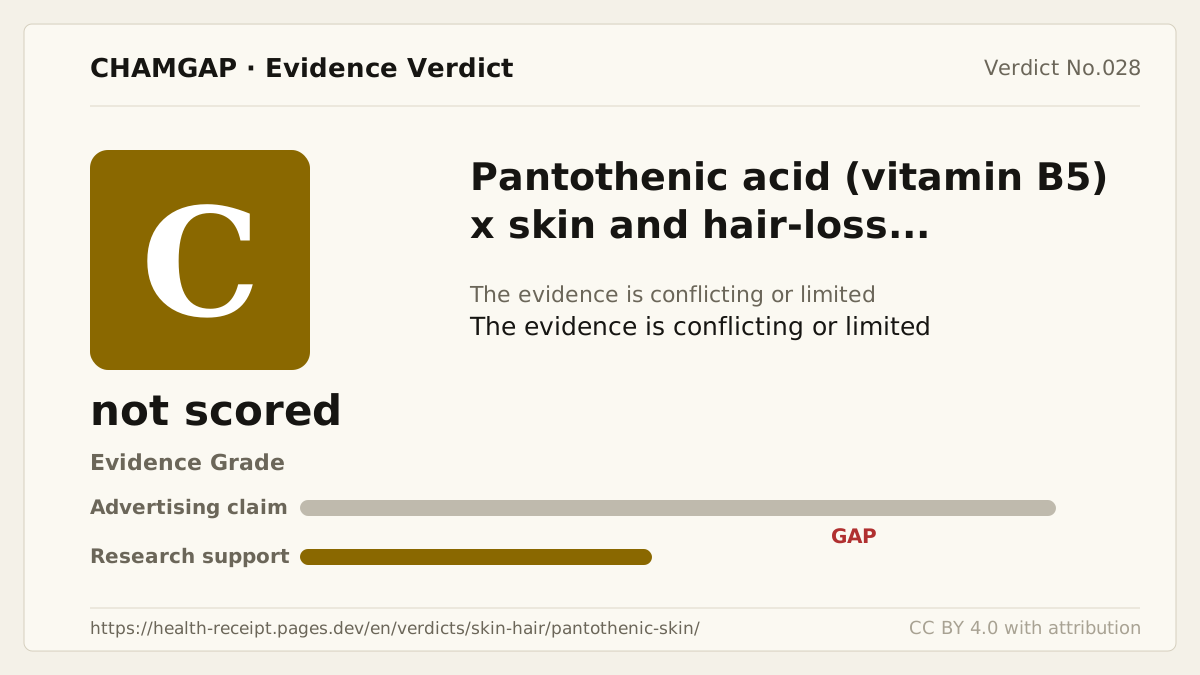
[Chamgap] Pantothenic acid x skin and hair loss — Evidence Grade C. 6 cited sources checked. Source: https://chamgap.com/en/verdicts/skin-hair/pantothenic-skin/ · CC BY 4.0CC BY 4.0 — free to use with attribution; do not distort grades, numbers, or verdict meaning.
What this document does and does not do
Chamgap is an information source. It reports what research has and has not confirmed; it does not tell readers what to take or buy. That decision belongs to readers and, when needed, medical or legal professionals. This verdict reflects literature available up to the search date and may change as new research appears. Nothing here is medical advice.