
Low-molecular-weight collagen,
does it really help with Skin hydration and elasticity?
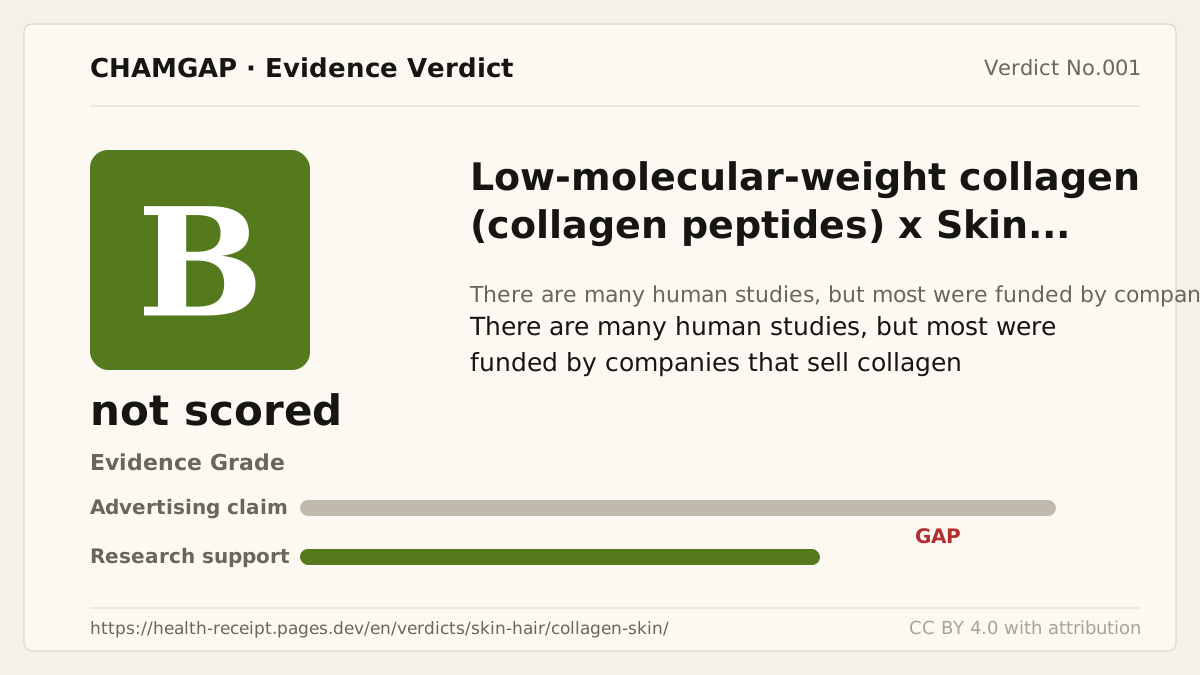
research showsThere are several human studies showing that skin hydration and elasticity improve slightly when measured by instruments. However, when independent studies with no company funding and higher-quality studies are examined separately, the effect was not confirmed (the most recent independent analysis, 2025). Readers can make their own judgment after seeing this fact.
ads claimCommercial advertisements talk about "wrinkle improvement," "enhanced elasticity," and "large effects." What has been repeatedly confirmed in studies extends only to small changes in hydration and elasticity indicators, and in this review we did not find independent evidence supporting the claim that wrinkles visibly smooth out.
Useful facts when choosing a product
- The dose is generally adequate. The low-molecular-weight collagen dose range in which effect signals appeared in studies is 1.0-2.5 g/day, and major products sold in Korea are roughly 1-3 g, so they generally meet this range. (This ingredient is rarely something to worry about because the "dose is too low.")
- "Whitening" is unrelated to collagen. The functions recognized by the MFDS for oral collagen are "skin hydration" and "maintenance of skin health against skin damage caused by ultraviolet rays." Whitening has never been recognized. If "whitening" appears on a product detail page, that phrase is not evidence for collagen.
- Advertisements that put "wrinkle improvement" and "lifting" in front run ahead of the evidence. The studies that reported improvement in that direction were mostly manufacturer-funded studies, and independent studies did not confirm it.
What the research actually shows
On the surface, the evidence points in one direction. Meta-analyses reported that intake of hydrolyzed/low-molecular-weight collagen statistically significantly improves skin hydration and elasticity indicators (Pu 2023: hydration Z=4.94, elasticity Z=4.49; Dewi 2023: hydration effect size 0.58, elasticity 0.65). Individual RCTs also point in the same direction (Kim 2018: low-molecular-weight collagen 1 g/day for 12 weeks improved hydration and the R5 elasticity indicator).
However, there is an analysis that divided the evidence again by funding source. The most recent independent and critical meta-analysis (Myung & Park, 2025, Am J Med, 23 RCTs and 1,474 participants) reported in subgroup analysis that the improvement effect was significant in "manufacturer-funded studies," but was not confirmed for hydration, elasticity, or wrinkles in studies without funding support and in high-quality studies. The conclusion the authors wrote was that "there is currently no clinical evidence to support the use of collagen supplements for skin aging." In addition, all 6 RCTs whose existence we confirmed in this review were linked to manufacturers (Newtree, Geltech, Nong Shim ×2, Quiris, GELITA). We present these two facts as they are. Interpretation is up to the reader.
Why this is classified as C (50)
Why it is C: Low-molecular-weight collagen has a hydration and elasticity signal, but the evidence is confined to surrogate outcomes and developer-linked research, capping the grade at C. · Endpoint: Corneometer hydration and Cutometer elasticity coefficients are surrogate measures, so this axis is S. · Replication and independence: There is one confirmatory trial, giving R1. The representative trial used a Newtree product and included two company-affiliated authors, so independence is I0. · Effect: At 12 weeks, hydration was 61.14 versus 53.02 AU, a +8.12-AU between-group difference (P=0.003), giving E+. · Design: The sample of 64 creates one listed flaw, total enrollment below 200, giving B1. Why it is not A or B: There is no independent replication, positive evidence is concentrated in industry-supported research, and outcomes remain surrogate measures. Why it is not D or F: A placebo-controlled human RCT produced a significant positive signal, so the evidence is neither unconfirmed nor repeatedly refuted. → Under the Chapter 2 ceiling rules, endpoint S and independence I0 cap the evidence at C; with one strength axis in the Chapter 3 baseline table, the result is C with 50 points.
Counterpoint. This verdict also records opposing views. The view that "because many meta-analyses reported improvement, the grade should be higher" and the view that "because the effect appears only in funded studies, the grade should be lower" are both possible. If new independent studies appear, the grade will change.
| Endpoint | S | Surrogate marker - laboratory or imaging measures |
| Replication | R1 | Single confirmatory trial |
| Independence | I0 | Evidence comes only from manufacturer studies |
| Effect size | E+ | Meets the clinically important threshold |
The scoring table and the verdict agree (C).
Cross-check — Codex and Claude
Evidence Table
| Study | Design | Sample | Funding | Endpoint | Result | Weight |
|---|---|---|---|---|---|---|
| Myung SK, Park Y 2025 | Meta-analysis/RCT | 23 | Meta-analysis, 23 RCTs and 1,474 participants. The pooled analysis showed improvement, but it was significant only in manufacturer-funded studies and was not confirmed in unsupported or high-quality studies. | Key | ||
| Pu SY et al. 2023 | Meta-analysis/RCT | 26 | Hydration and elasticity | Meta-analysis, 26 RCTs and 1,721 participants. Reported significant improvement in hydration and elasticity. The authors also mentioned bias in the included studies and the need for large-scale RCTs. | Key | |
| Dewi DAR et al. 2023 | Meta-analysis/RCT | 14 | Hydration, elasticity, and wrinkles | Meta-analysis, 14 RCTs and 967 participants. Reported improvement in hydration (0.58), elasticity (0.65), wrinkles, and TEWL. There was no subgroup analysis by funding source. | Key | |
| Kim DU et al. 2018 | RCT | 64 | Hydration and elasticity | RCT, 64 participants, low-molecular-weight collagen 1,000 mg/day for 12 weeks. Improved hydration and R5 elasticity indicators. Product provided by Newtree; many authors affiliated with Newtree. | Key | |
| Kim J et al. 2022 | RCT | 84 | Hydration, elasticity, and wrinkles | RCT, 100 enrolled and 84 completed participants, 12 weeks. Improved wrinkle, elasticity, hydration, and TEWL indicators. Author affiliations included Geltech (manufacturer). | Supporting | |
| Lee M et al. 2023 | RCT | 100 | Hydration, elasticity, and wrinkles | RCT, 100 women, CPNS 1,650 mg/day for 12 weeks. Improved hydration, wrinkle, and elasticity indicators. Some authors were affiliated with Nong Shim R&D. | Supporting | |
| Lee E et al. 2025 | RCT | 3 | Hydration, elasticity, and wrinkles | RCT, 70 participants, low-molecular-weight collagen 1,650 mg/day for 8 weeks. Improved hydration, elasticity, and wrinkle indicators, and the improvements were maintained even after discontinuation. Three authors were affiliated with Nong Shim. | Supporting | |
| Bolke L et al. 2019 | RCT | 72 | Hydration and ALT | RCT, 72 women, collagen peptides 2.5 g/day for 12 weeks. Hydration indicator: test group +28% vs placebo +9%. Funded by Quiris Healthcare (Germany). | Supporting | |
| Proksch E et al. 2014 | RCT | Elasticity and skin | RCT, VERISOL 2.5 or 5.0 g/day for 8 weeks. Improved skin elasticity indicators. Product provided by GELITA AG; coauthor Oesser was linked to GELITA. | Supporting |
Receipt — 9 References
All 9 cited sources were verified for existence at the original page (as of 2026-07-06).
Reviewed and approved: Chamgap Editorial Team · Approval date: 2026-07-06 · Corrections: 1
Correction log — 1
Corrections applied to this verdict, in chronological order. Changes are logged, not erased.
- 2026-08-19 · Methodology v0.7 migration (axes recorded, score derived) — Applied the seven axes and anchor table published in methodology v0.7 to this verdict. It had been graded under the pre-axis method and carried no score. The representative trial was re-established from the source, axes 1-6 recorded, and the score derived from the published anchor table. The old grade was less wrong than assigned before the rule was fully specified; the full rule is in section 2-3 of /methodology/. (grade B→C)
Cite this verdict
[Chamgap] Oral low-molecular-weight collagen × skin hydration and elasticity — Evidence Grade C·50. 9 cited sources checked. Source: https://chamgap.com/en/verdicts/skin-hair/collagen-skin/ · CC BY 4.0CC BY 4.0 — free to use with attribution; do not distort grades, numbers, or verdict meaning.
What this document does and does not do
Chamgap is an information source. It reports what research has and has not confirmed; it does not tell readers what to take or buy. That decision belongs to readers and, when needed, medical or legal professionals. This verdict reflects literature available up to the search date and may change as new research appears. Nothing here is medical advice.