
Elastin,
does it really help with skin elasticity and wrinkles?
research showsHuman trials exist reporting that oral elastin (hydrolyzed elastin peptides) improved skin elasticity and wrinkle indicators. However, three features overlap in the evidence. (1) The clinical endpoints reporting effects are all instrument-measured surrogate indicators (PRIMOS wrinkle roughness, elasticity, hydration measurements), not endpoints that primarily measured perceived effects or real-use results. (2) The two RCTs clearly reporting efficacy are both connected to ingredient manufacturers (Shiratsuchi 2016, which examined fish cells and small human data, is excluded from this judgment because funding is unconfirmed). The representative 12-week RCT (bonito-derived VGPG Elastin, 100 mg) included an author affiliated with the company that supplied the ingredient (Daehan Chemtech), yet declared “no conflicts of interest,” and the 8-week porcine elastin trial was conducted by the laboratory of a meat-processing ingredient company (Nippon Meat Packers). No replication trial of elastin alone with independent funding unrelated to manufacturers was confirmed. Nor was definitive higher-level meta-analytic evidence including elastin confirmed: the 2026 systematic review/meta-analysis of peptides and skin aging (general peptides, not elastin-specific) included no oral elastin-alone studies at all (absence of higher-level evidence), and the overall elasticity effect for peptides was also assessed as inconsistent, with pooled effect size MD 0.09 and p=0.15. (3) The absorption studies showing that “elastin peptides are absorbed and appear in blood” and the efficacy studies showing that “skin elasticity improves” are separate, and no human proof was confirmed that connected absorption amount to elasticity improvement in the same participants/same clinical group. Thus the causal chain “because it is absorbed -> therefore it affects skin” was not connected within a single human study. Safety is good because it is food-derived and no repeated serious harm signal exists, but because ingredients derive from fish or porcine skin, they may be relevant for people with fish or pork protein allergy.
ads claimKorean market advertisements and informational articles repeatedly use frames such as “elastin is more central to skin elasticity than collagen,” “the smaller the molecular weight (e.g., 177 daltons), the better the absorption,” “emphasizing at least 200 mg/day,” and “distinguishing genuine products from imitations.” Clinical numbers often cited include the 2011 porcine-skin study’s “100 mg=118% increase in elasticity and 200 mg=125% increase,” and the small 4-week study’s “6.1% decrease in eye wrinkles.” Some articles state a molecular-weight absorption superiority claim that “in a 2016 study, 300 daltons had 200-fold absorption versus 5000 daltons,” but the original text for this 200-fold and molecular-weight figure was not confirmed in this verification, so it was not adopted (recorded only as an advertising claim). Advertising generally transfers collagen absorption/molecular-weight marketing language to elastin.
Useful facts when choosing a product
- Nearly all Korean marketed “oral elastin” products are combination products with collagen: Dongkook Pharmaceutical (elastin + Centella extract + low-molecular fish collagen), Huons Taengtaeng Elastin Collagen, BB Lab The Elastin (elastin + fish collagen + hyaluronic acid + vitamin C), Jayeonjiae, and Umeken Elastin Beauty.
- The Umeken product presents “elastin:collagen = 1:50 ratio” as a patent-related expression, showing that elastin is often a small-amount component in combination products.
- Ingredient sources are mainly fish such as bonito, and some are porcine skin. Safety is generally good, but fish-derived ingredients may relate to fish allergy and porcine-derived ingredients to pork protein allergy.
- The elastin-alone doses used in clinical trials were 100~200 mg/day (bonito 100 mg for 12 weeks; porcine skin 100 and 200 mg for 8 weeks). The actual elastin content of combination products differs by product, and labeled content may also differ.
- Many products are sold as ordinary foods/other processed products, and whether they are labeled with MFDS-recognized individually recognized functionality “elastin -> skin elasticity” differs by product (many are not functional labels).
What the research actually shows
The literature divides into absorption studies and efficacy studies. [Absorption, humans] After intake of elastin hydrolysate, Pro-Gly (prolyl-glycine) reached a blood peak about 30 minutes later (about 18 μM) (Shigemura 2012), and linear/cyclic di- and tripeptides such as Gly-Pro and Pro-Ala also increased in blood (Iwasaki 2024). These two studies measured only absorption and had no skin efficacy endpoints. [Efficacy, humans] Trials exist testing elastin alone for skin elasticity/wrinkle improvement: a 12-week RCT of bonito-derived VGPG Elastin 100 mg (N=100, per-protocol 84) reported significant improvements versus placebo in wrinkle-roughness indicators (Ra, Rmax, Rz, etc.) and hydration (Seong 2024). This study did not measure blood absorption. In an 8-week trial of porcine aorta elastin 100 and 200 mg (39 participants), elasticity also significantly increased and the 200 mg group was larger (Sato 2011); this paper includes an absorption part (5 participants, blood amino acids/peptide forms measured) and an efficacy part (39 participants, elasticity measured), but the two parts were separate subgroups/separate phases, so it does not connect absorption and efficacy in the same people. Fish elastin promoted fibroblast proliferation and elastin synthesis in cells and reported wrinkle reduction in a small 4-week human study (Shiratsuchi 2016, original text not read). [Limitations] Three points recur. First, all efficacy endpoints are instrument surrogate indicators. Second, the two RCTs clearly reporting efficacy were both connected to manufacturers (VGPG=Daehan Chemtech-affiliated author; porcine=Nippon Meat Packers laboratory; Shiratsuchi 2016 excluded because funding source unconfirmed). Third, no human proof connects absorption amount and elasticity improvement in the same participants/same clinical group, and the mechanistic evidence connecting absorption and efficacy (Pro-Gly promoting elastin synthesis) is a cell experiment. The higher-level 2026 systematic review/meta-analysis (general peptides) included no oral elastin-alone studies (19 RCTs, mostly collagen), and the overall elasticity effect for peptides was assessed as inconsistent, with pooled effect size MD 0.09 and p=0.15.
Why this is classified as C (44)
Basis for C: it is not D because human RCTs directionally exist that examined skin elasticity and wrinkles for elastin alone. Factors preventing A/B overlap. (1) All efficacy endpoints are instrument surrogate indicators, with no proof on perceived or real-use endpoints (borderline ①: surrogate-only significance -> maximum C). (2) The two RCTs clearly reporting efficacy are both connected to ingredient manufacturers (Shiratsuchi 2016 excluded because funding is unconfirmed), and the representative RCT declared “no conflicts of interest” despite having a manufacturer-affiliated author (undisclosed conflict); no independent-funded replication unrelated to manufacturers is confirmed (borderline ②-b: absence of independent replication + all positives from manufacturers -> maximum C). (3) There is no human proof connecting absorption amount and elasticity improvement in the same participants/same clinical group, and mechanistic evidence is from cell experiments. (4) No higher-level meta-analysis evidence including elastin exists (0 oral elastin-alone studies in the 2026 general peptide meta-analysis = absence of higher-level evidence), and the overall elasticity effect for peptides was inconsistent at MD 0.09 and p=0.15. When these four factors overlap, the methodological maximum is C, and because human RCTs exist directionally despite being small and industry-funded, C is more appropriate than D. Score 44 is at the lower end of the C band (40~59), reflecting simultaneous penalties for surrogate indicators, industry funding, and no absorption-efficacy connection, plus the representative RCT carrying both undisclosed conflict and endpoints where data and conclusion point in inconsistent directions, making the substance close to the D band.
Counterpoint. Elastin-supportive argument: “In a 100-participant, 12-week double-blind RCT, bonito elastin significantly improved wrinkles and hydration versus placebo, and the 8-week porcine-skin trial also increased elasticity in a dose-response pattern. Absorption was also confirmed in human blood.” Counterevidence/limitations: significance and evidence grade are different layers. That RCT included a manufacturer-affiliated author yet declared “no conflicts of interest” (undisclosed conflict), used instrument surrogate endpoints, and did not measure blood absorption. The fact that absorption is confirmed and the claim that this absorption produces skin effects are separate; no human proof connects them in the same participants/same clinical group. Combination-product evidence also cannot be treated as elastin-alone evidence: Lu 2024 combination-product RCT (fish collagen tripeptide + elastin peptide combination formulation, 8-week double-blind) reported improvements in hydration, elasticity, dermal collagen, and wrinkle length, but the effect/bioavailability description centers on collagen tripeptide and there is no elastin-alone control group, so elastin’s unique effect cannot be separated. Skeptical argument: “All are industry-funded, only cells/surrogate indicators, and elastin is 0 studies in higher-level meta-analysis, so D is possible due to lack of higher-level evidence.” Limitation of that argument: elastin-alone human RCTs directionally exist and the safety signal is good, so this corresponds to C rather than F/D. The issue is not “effect zero,” but that independent replication, perceptible endpoints, and a human absorption-efficacy connection remain empty.
Rejudgment record. Unanimous grade C across 8 perspectives (draft 44, independent 46, Codex blind 45/48/45, adversarial 2 maintained C, Claude adversarial maintained C); not non-convergent — Although the Codex blind average was 46, lower-end 44 is retained because adversarial 2 said “44 is generous” and Claude adversarial said “lower-end 44 reflects how precariously close to practical D it is.”
Cross-check — Codex and Claude
Evidence Table
| Study | Design | Sample | Funding | Endpoint | Result | Weight |
|---|---|---|---|---|---|---|
| Seong SH et al. 2024 | double-blind randomized controlled trial | 100, | manufacturer/industry involvement possible | hydration, wrinkles, cognition, and absorption | Role: efficacy (human). Elastin alone (bonito 100 mg, no collagen), 12-week RCT (N=100, PP 84), reported significant improvements versus placebo in instrument surrogate indicators for wrinkle roughness and hydration. Blood absorption was not measured in this study. Author Jinhak Kim from the ingredient supplier Daehan Chemtech R&D participated, but the paper declared “no conflicts of interest” (undisclosed conflict). Eye wrinkle volume (test group 11.12±3.58 -> 15.22±4.79, p<0.0001) was reported as an increase, while the text described improvement, so data-conclusion direction conflicts; because there is no author correction, whether it is a notation error or real contradiction cannot be determined, and this endpoint is not adopted as evidence. | core |
| Sato M et al. 2011 | not specified | 5 | manufacturer/industry involvement possible | elasticity and absorption | Role: efficacy (human). Elastin alone (porcine aorta-derived, no collagen), 100 or 200 mg for 8 weeks in 39 participants; elasticity significantly increased and was greater in the 200 mg group. The same paper includes an absorption part (5 participants) and efficacy part (39 participants), but they are separate subgroups/separate phases, not an absorption<->efficacy connection in the same participants/same clinical group. Author affiliation Nippon Meat Packers = ingredient-company industry funding. | core |
| Shiratsuchi E et al. 2016 | preclinical study | manufacturer/industry involvement possible | wrinkles and absorption | Role: mechanism (cells)+small human study. Fish elastin promoted fibroblast proliferation and elastin synthesis (cells) and reported wrinkle reduction in a small 4-week human study. Main evidence is cellular, and there is no same-participant absorption<->efficacy connection. Used only as supporting evidence. [Original text not read flag — Wiley 402; bibliography/core confirmed by search summary; human-part sample size/design/funding source unconfirmed, industry linkage unconfirmed assumption] | supporting | |
| Shigemura Y et al. 2012 | preclinical study | hydration, skin, and absorption | Role: absorption (human)+mechanism (cells). After elastin hydrolysate intake, blood Pro-Gly peaked at about 18 μM at 30 minutes. No skin efficacy endpoint; efficacy suggestion is cellular. Core evidence showing absorption and efficacy were not connected in the same clinical group. | supporting | ||
| Iwasaki Y, Sato M, Katakura Y, Sugawara Y, Shigemura Y 2024 | not specified | skin and absorption | Role: absorption (human). First report of increased linear/cyclic dipeptides in blood, including Pro-Gly (Cmax 14.63 nmol/mL). No skin efficacy endpoint; only “candidate bioactivity” level. Used only as supporting evidence. [Original text not read flag — ScienceDirect 403; bibliography/core confirmed by search summary] | supporting | ||
| Nukaly HY et al. 2026 | meta-analysis and RCTs | 0 | elasticity and skin | Role: meta (general peptides, not elastin-specific). Peptides x skin-aging systematic review/meta-analysis (19 RCTs, 1,341 participants, oral arms ≈92% collagen). Zero oral elastin-alone studies = basis for absence of elastin-specific higher-level evidence (not meaning elastin RCTs themselves do not exist). Overall peptide elasticity effect was non-significant/inconsistent with pooled MD 0.09 and p=0.15. Independent review with no funding/no conflicts of interest. | supporting | |
| Lu S, Zhang S, Wang Y, Ni J, Zhao T, Xiao G 2024 | randomized controlled trial | hydration, elasticity, and wrinkles | Role: counterevidence (combination product). Eight-week RCT of fish collagen tripeptide + elastin peptide combination formulation (young and middle-aged women), reporting improvements in hydration, elasticity, dermis, and wrinkles. Effect and bioavailability descriptions center on collagen tripeptide, and there is no elastin-alone control group, so elastin-specific effect cannot be separated. Evidence that combination-product results cannot be treated as elastin-alone evidence. Bibliography confirmed by Crossref. | supporting |
Receipt — 7 References
Of 7 cited sources, 2 had limited original-page access (blocked or summary-only) and were verified via index/summary, marked partial; the rest were verified at the original page. As of 2026-07-07.
Reviewed and approved: Chamgap Editorial Team · Approval date: 2026-07-07 · Corrections: none
Cite this verdict
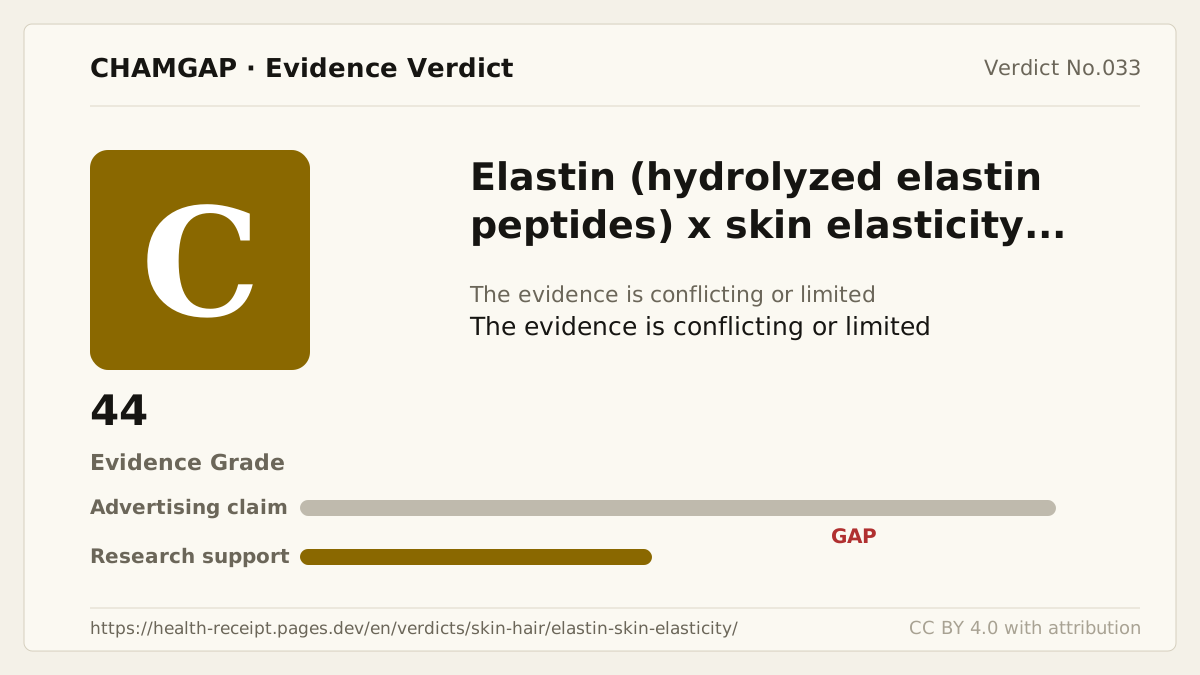
[Chamgap] Elastin x skin elasticity and wrinkles — Evidence Grade C·44. 7 cited sources checked. Source: https://chamgap.com/en/verdicts/skin-hair/elastin-skin-elasticity/ · CC BY 4.0CC BY 4.0 — free to use with attribution; do not distort grades, numbers, or verdict meaning.
What this document does and does not do
Chamgap is an information source. It reports what research has and has not confirmed; it does not tell readers what to take or buy. That decision belongs to readers and, when needed, medical or legal professionals. This verdict reflects literature available up to the search date and may change as new research appears. Nothing here is medical advice.