
Aquaporin,
does it really help with Skin moisture?
research showsBottom line: the causal claim that “if aquaporin increases, skin becomes moisturized” has not yet been directly tested within human individuals. “Aquaporin” is not an ingredient applied to or ingested by the body, but a water-channel protein (AQP3) in the skin cell membrane, and advertising says that “ingredient XX increases this channel, so moisture moves smoothly and the skin becomes moisturized deep inside.” Looking at the evidence status, there is mechanistic evidence that an ingredient increased AQP3 expression and efficacy evidence that surrogate markers in human skin (transepidermal water loss, TEWL/barrier) or moisture markers improved. However, in most cases these two are shown in separate experiments, and within the confirmed range, no study has yet directly connected “the degree to which AQP3 increased” with “the degree to which moisture increased” in the same person by causal regression. Meanwhile, this verification confirmed one independent government-funded (non-industry) study (Samadi 2021) that reported both improved stratum-corneum hydration (corneometry, P<.01) and a 4.84-fold increase in AQP3 mRNA (P=.048) in the same 3-week topical-application trial and the same cohort. In other words, there is a case in which the two endpoints were observed together in the same trial, but the authors did not test “AQP3 increase amount ↔ moisture increase amount” by individual-level regression. Therefore, both mechanism and efficacy are observed, but the causal link itself that the skin becomes moisturized “by increasing aquaporin” has not yet been established in humans. For reference, within the confirmed range this claim is virtually entirely for “topical” cosmetics, and the oral claim that “eating it increases aquaporin and moisturizes the skin” has no supporting evidence identified (oral use separately lacks evidence).
ads claimAdvertising generally speaks in a chain of causation: “aquaporin is a moisture channel inside the skin, and ingredient XX (mainly glyceryl glucoside) activates or promotes the generation of this aquaporin, allowing moisture to move smoothly and making the skin moisturized deep inside” (within the confirmed range: inner-beauty/cosmetic line descriptions and influencer posts). In other words, it links “ingredient -> AQP3 increase -> skin moisture improvement” as if it had already been proven in humans. This expression presents mechanistic proof (AQP3 increase in cells/reconstructed epidermis) and efficacy proof (improvement in human skin moisture/surrogate markers) as if they were causally connected within one person, but within-individual causal regression has not yet been tested. However, advertising that uses aquaporin as an “inner beauty (oral)” claim is not the target of this verdict (topical C), because no human evidence supporting skin-moisture improvement through aquaporin by the oral route was identified. There are also expressions that call “aquaporin” itself an ingredient/main ingredient, for example “aquaporin cream” or “contains aquaporin,” but aquaporin is not a raw material; it is a protein channel in the skin.
Useful facts when choosing a product
- “Aquaporin” is not an ingredient in the product, but a water/glycerol channel protein in skin cells (mainly AQP3). “Aquaporin” on a label is not an ingredient name but a mechanism name used for claims, and the actual composition of the product differs depending on the ingredient actually blended into it, such as glyceryl glucoside, glycerin, niacinamide, or aloe extract.
- Within the confirmed range, aquaporin-claim products are virtually all “topical” cosmetics (creams, essences, ampoules, mask packs). Confirmed domestic examples include the Eucerin Aquaphorine Active line, Derma Factory Aquaporin Moisture Cream, and HwasSa Squalane Aquaporin Active Cream.
- Oral products claiming “edible aquaporin” have not, within the confirmed range, become a separate category, and the main ingredients in actual inner-beauty products are collagen, hyaluronic acid, and similar ingredients. No human study was identified to support the oral claim that “eating it increases aquaporin and makes skin moisturized.”
- Glyceryl glucoside, the representative claimed ingredient, is an ingredient discovered and studied by Eucerin (Beiersdorf) as evidence for its own line, and the core industry evidence for this claim (Schrader 2012) is a study by researchers affiliated with the company selling the product. However, in an independent government-funded study (Samadi 2021) on the same ingredient (product B), moisture improvement and AQP3 increase were also observed together.
- In the most commonly cited industry human evidence (Schrader 2012), the significant marker was the surrogate marker transepidermal water loss (TEWL). Direct stratum-corneum hydration (corneometry) was significant versus untreated control (p<0.05) and non-significant only in the comparison versus vehicle. Separately, in an independent government-funded study (Samadi 2021), corneometry moisture was significant versus untreated control (P<.01). Whether the phrase “moisture increased” refers to the surrogate marker (TEWL) or direct moisture (corneometry) involves different markers.
What the research actually shows
The research status can be organized along mechanism and efficacy axes as follows. (1) Mechanistic evidence exists — AQP3 is a water/glycerol channel in epidermal keratinocytes and participates in maintaining skin moisture (Boury-Jamot 2006 review), and glyceryl glucoside, Ajuga extract, aloe plus trimethylglycine, and similar ingredients increase AQP3 expression in cultured cells or reconstructed epidermis (Dumas 2007; the cell part of Filatov 2024). (2) Significant endpoints in humans are mainly surrogate markers (TEWL/barrier) — applying glyceryl glucoside reduces TEWL in human skin (Schrader 2012), and human skin moisture conductance increased with an aloe plus trimethylglycine shower gel (Filatov 2024). (3) There is a case in which direct moisture (corneometry) and AQP3 were measured together in the same trial and same cohort — Samadi 2021 reported that in a 3-week topical-application trial with 20 participants, stratum-corneum hydration significantly improved versus untreated control (P<.01), and among 5 of them, AQP3 mRNA for the glyceryl glucoside product (product B) increased 4.84-fold (P=.048). This study is a non-industry academic study funded by an Iranian government agency (NIMAD). (4) However, no study directly tested “the relationship between the amount of AQP3 increase and the amount of moisture increase in one person” by causal regression. Schrader 2012 measured AQP3 mRNA increase (a trial in 20 volunteers) and TEWL/moisture improvement (a separate trial in 23 dry-skinned women in their 50s to 70s) in different human groups. In comparison with the original text (Karger), stratum-corneum hydration (corneometry) was significant versus untreated control (p<0.05), and non-significant only in the comparison versus vehicle. Filatov 2024 measured AQP3 in cells (HaCaT) and moisture in humans, meaning different tissues, and the human moisture increase at 5 minutes after application may reflect a humectant surface effect rather than an aquaporin pathway. In summary, no study has yet directly tested AQP3 increase and moisture improvement within individuals by causal regression, and many positive lines of evidence (Dumas 2007, Schrader 2012, Filatov 2024) are industry-funded studies by researchers affiliated with ingredient manufacturers, although Samadi 2021 identified in this verification is a non-industry independent study.
Why this is classified as C (47)
Final grade C, score 47. The reason it is summarized this way is as follows. There is mechanistic evidence that ingredients increase AQP3 expression, and there is also efficacy evidence that surrogate markers in human skin (TEWL/barrier) or moisture markers improved, but within the confirmed range, no study has yet directly linked “the degree to which AQP3 increased” with “the degree to which moisture increased” in the same person by causal regression. The representative industry evidence, Schrader 2012, measured AQP3 and moisture markers in different human groups, and the significant endpoints were mainly surrogate markers (TEWL); Filatov 2024 measured AQP3 in cells and moisture in humans, therefore in different tissues. The government-funded (NIMAD) independent study Samadi 2021 identified in this verification reported both corneometry moisture improvement in the same 3-week topical-application trial and the same cohort (P<.01, n=20) and a 4.84-fold increase in AQP3 mRNA (P=.048, among 5 of them), but the samples for the two endpoints only partially overlapped (moisture 20 people, AQP3 5 people), and individual-level AQP3-moisture correlation was not tested by regression. In other words, mechanism and surrogate-marker signals exist, but the causality that skin becomes moisturized through aquaporin has not been directly confirmed in humans, and there is also no independently replicated causal evidence, so it is difficult to rate higher than C. Within that, the significant endpoints lean toward surrogate markers and the sample size of the concurrent observation study is small, so the score is 47, the lower-middle part of the C range (40-59 points). The oral route has no identified human evidence supporting skin-moisture improvement through aquaporin, so it separately lacks evidence (D/ungradable), and this C grade is based on the transdermal/topical (cosmetic) route.
Counterpoint. The evidence that can view this claim more generously and the evidence that can view it more strictly can be summarized together as follows. Generous direction: the involvement of AQP3 in skin moisture is mechanistically well established, and the fact that human data from both industry and non-industry sources observed glyceryl glucoside increasing AQP3 expression and improving surrogate markers is different from “no evidence at all.” In particular, the fact that moisture (corneometry) and AQP3 were both significant in the same trial and same cohort in a non-industry independent study (Samadi 2021) shows that this claim has a certain degree of experimental support. Strict direction: nevertheless, no study connected “AQP3 increase amount ↔ moisture increase amount” at the individual level by regression, significant endpoints in industry human evidence are mainly surrogate markers (TEWL), and the significance of direct moisture endpoints differs depending on the control setting. In other words, the core causal claim that the skin becomes moisturized “by increasing aquaporin” has not yet been directly tested in humans.
Cross-check — Codex and Claude
Evidence Table
| Study | Design | Sample | Funding | Endpoint | Result | Weight |
|---|---|---|---|---|---|---|
| Boury-Jamot M, Sougrat R, Tailhardat M et al. 2006 | preclinical | possible manufacturer/industry involvement | moisture/skin/gut | Mechanistic review. Summarizes that AQP3 participates in skin moisture as a water/glycerol channel in epidermal keratinocytes (cell/literature based, not a human efficacy trial). This literature itself does not claim human causality that “increasing it makes skin moisturized.” | supporting | |
| Dumas M, Sadick NS, Noblesse E, Juan M et al. 2007 | preclinical | possible manufacturer/industry involvement | moisture/skin | Mechanistic study. Ajuga turkestanica extract significantly increased AQP3 expression in human reconstructed epidermis. It is at the cell/reconstructed-epidermis level, and human skin-moisture efficacy was not measured or linked in the abstract. This corresponds to E4 “mechanism only.” | supporting | |
| Schrader A, Siefken W, Kueper T et al. 2012 | not specified | 23 | possible manufacturer/industry involvement | moisture | Representative industry human evidence for this claim. Topical trial. AQP3 mRNA increase was measured in one trial of 20 volunteers, and TEWL reduction was measured separately in another trial of 23 dry-skinned women aged 50-70; the two markers were not linked in the same people. The significant endpoint was the surrogate marker TEWL. Direct stratum-corneum hydration (corneometry) was significant versus untreated control (p<0.05) and non-significant only in the comparison versus vehicle. | core |
| Filatov V, Patruseva A, Yunusova M et al. 2024 | preclinical | 59 | possible manufacturer/industry involvement | moisture/skin | Mechanism plus human study in parallel, but with mismatched tissue connection. Topical (shower gel). AQP3 380% increase was measured in a human keratinocyte cell line (HaCaT) cell experiment, while skin moisture (conductance) increase was measured in 59 volunteers (28 days); AQP3 was cells, moisture was humans. AQP3 was not directly measured in humans. The 5-minute moisture increase may be a humectant surface effect. | supporting |
| Study 5 | not specified | not reported | moisture/skin/gut | Recent review. Summarizes the AQP3 mechanism and cosmetic ingredients targeting it. Caution: this review tends to compress the separate trial structure of the original study by summarizing Schrader 2012 as if moisture improvement and TEWL reduction appeared together with AQP3 increase, so comparison with the original article is needed. No human study proving skin moisture through AQP3 by the oral route is presented. | supporting | |
| Samadi A, Nasrollahi SA, Nateghi Rostami M, Rezagholi Z, Abolghasemi F, Firooz A 2021 | double-blind RCT | 5 | possible manufacturer/industry involvement | moisture/ALT | Decisive counterexample. Measured both endpoints together in the same cohort, government-funded and non-industry. Randomized, controlled, within-individual, double-blind 3-week topical-application trial (forearm, 20 participants). Stratum-corneum hydration (corneometry) significantly improved versus untreated control (P<.01, n=20), and among 5 from the same cohort, the glyceryl glucoside product (product B) increased AQP3 mRNA 4.84-fold (P=.048). This was a non-industry academic study funded by an Iranian government agency (NIMAD, Elite Researcher Grant 977062). However, the moisture (20 people) and AQP3 (5 people) samples only partially overlapped, and individual-level AQP3-moisture correlation was not tested by regression, so it does not establish within-individual causality. This is key evidence refuting both blanket statements that “all positive evidence is manufacturer-funded” and “there is no study measuring AQP3 and moisture together in the same people.” | supporting |
Receipt — 6 References
Of 6 cited sources, 1 had limited original-page access (blocked or summary-only) and were verified via index/summary, marked partial; the rest were verified at the original page. As of 2026-07-06.
Reviewed and approved: Chamgap Editorial Team · Approval date: 2026-07-06 · Corrections: none
Cite this verdict
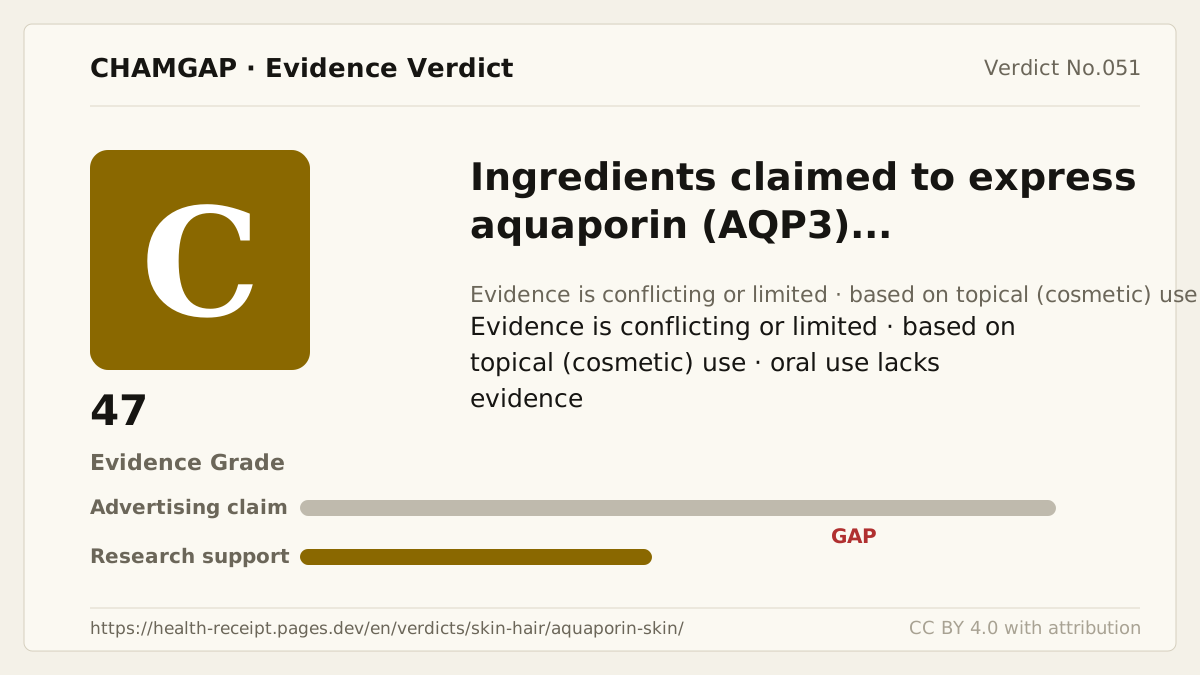
[Chamgap] Aquaporin x skin moisture — Evidence Grade C·47. 6 cited sources checked. Source: https://chamgap.com/en/verdicts/skin-hair/aquaporin-skin/ · CC BY 4.0CC BY 4.0 — free to use with attribution; do not distort grades, numbers, or verdict meaning.
What this document does and does not do
Chamgap is an information source. It reports what research has and has not confirmed; it does not tell readers what to take or buy. That decision belongs to readers and, when needed, medical or legal professionals. This verdict reflects literature available up to the search date and may change as new research appears. Nothing here is medical advice.