
Glutathione,
does it really help with Whitening and skin tone?
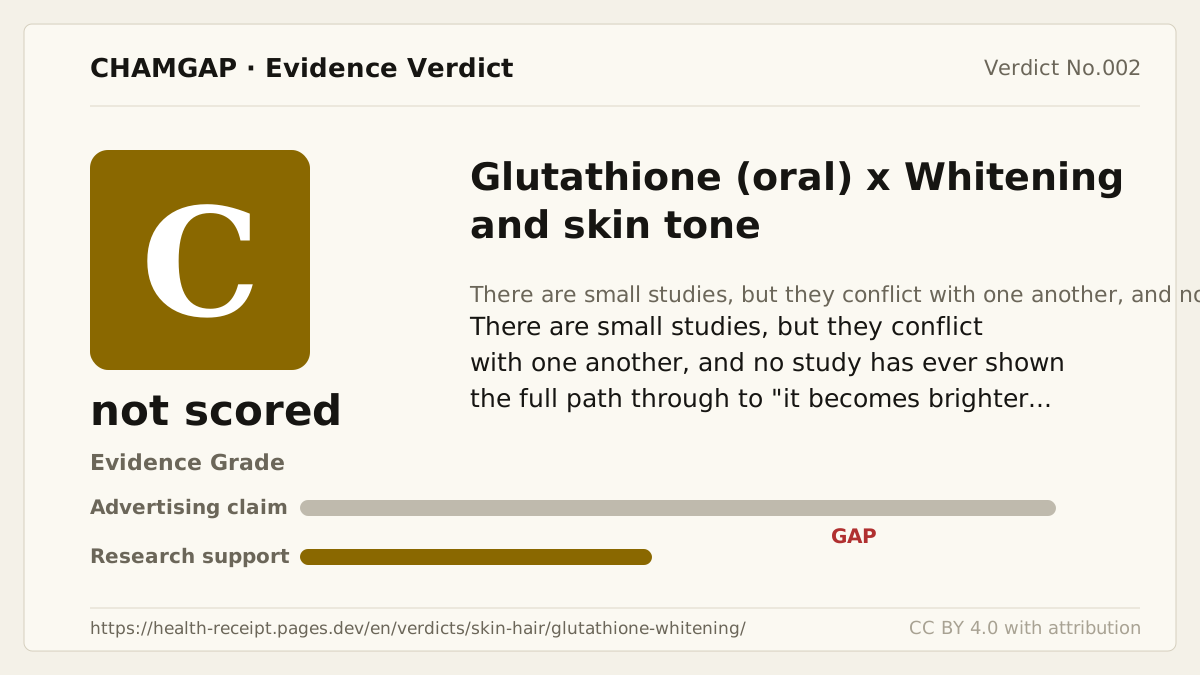
research showsThere are a few human studies on whitening with oral glutathione, but most are small and short-term (4-12 weeks), and on instrument-measured skin-brightness indicators (melanin index), the results were either not significant overall or improved only in some sites or in a specific age group. Crucially, the studies that examined whitening did not measure blood glutathione, so those studies did not confirm within the study itself "whether what was taken orally was actually absorbed and acted."
ads claimAdvertisements talk about "skin whitening," "tone-up," and "glass-bead glow after one use." What the studies showed extends only to small indicator changes under some conditions, and in this review we did not find evidence supporting "definite whitening." In addition, whitening is not a function recognized by the MFDS for glutathione.
Useful facts when choosing a product
- "Adhesive or dissolving films" and "oral (swallowed) products" have different evidence. Films applied to the skin or dissolved in the mouth have absorption routes different from swallowed capsules, so studies on one side cannot be used as evidence for the other side. Advertisements often mix the two.
- The labeled amount and the actual amount may differ. In a 2024 Korea Consumer Agency survey, among 7 products that displayed glutathione content, 5 had actual glutathione at about half of the labeled or advertised amount. In some cases, the total amount of "yeast extract" was written as if it were pure glutathione.
- "99% purity" is not evidence of effect. Purity is only raw-material quality; it is a different matter from evidence that there is a whitening effect in humans.
- "Whitening" is not a function recognized by the MFDS for glutathione. Commercial oral glutathione is classified as a general food, not as a health functional food. (In a 2024 Korea Consumer Agency and MFDS survey, 59 out of 100 online advertisements were detected as improper advertisements.)
- Injection (IV) and taking it orally are different. Studies of intravenous glutathione cannot be used as evidence for oral products. Injectable products are not approved for whitening purposes.
What the research actually shows
Randomized controlled trials (RCTs) of oral glutathione for whitening do in fact exist. However, they are small and short, and most are surrogate indicators in which skin brightness is measured by a machine.
Separately, there are studies that examined whether it is absorbed when taken orally (Richie 2015: oral intake increased body glutathione stores by 30-35%). However, this study did not measure whitening. The most recent absorption study (2026) reported that absorption of ordinary swallowed oral formulations was low and that only a special formulation was better. In summary, the studies that showed absorption did not look at whitening, and the studies that looked at whitening did not look at absorption, so "it becomes brighter because you take it orally" has never been connected within one study. We present these two facts as they are. Interpretation is up to the reader.
Arjinpathana 2012 — oral 500 mg/day for 4 weeks, 60 participants. Among melanin-index measurements at 6 sites, only 2 sun-exposed sites were significant versus placebo (face p=0.021, left forearm p=0.036), and the rest showed no significant difference. Blood glutathione was not measured.
Weschawalit 2017 — 250 mg/day for 12 weeks. It was not statistically significant in the full participant group (p>0.05), and was significant only in a subgroup over 40 years old and at a specific site (p=0.031). Funding and the test product were provided by the glutathione manufacturer Kyowa Hakko Bio.
Sitohang 2021 — glutathione + vitamin C + alpha-lipoic acid + zinc combination capsule for 12 weeks. There was a magnitude of improvement, but it was not statistically significant. Manufacturer (Mazta Farma) funding. Because it was a combination product, the effect cannot be attributed to glutathione alone.
Why this is classified as C (46)
The TrueValue grade does not mean whether an effect is "good" or "bad"; it indicates how high the evidence reaches in the evidence hierarchy and how independently it exists.
Why it is not D or F. Several actual double-blind RCTs exist, and directional signals are repeatedly observed under some conditions. This is not a level with no evidence at all.
Why it is not B. That signal is (1) based on surrogate indicators and small effect sizes, (2) seen only in subgroups and some sites rather than overall, (3) not closed from absorption to effect within a single study, (4) all verified whitening RCTs were manufacturer-funded, and (5) whitening is not a regulatorily recognized function. Beyond "human RCTs exist, but the share of industry funding is high" (B), this corresponds to C, where the evidence is conflicting and limited.
| Endpoint | S | Surrogate marker - laboratory or imaging measures |
| Replication | R1 | Single confirmatory trial |
| Independence | I1 | Mixed funding sources |
| Effect size | E~ | Statistically positive but below the threshold |
The scoring table and the verdict agree (C).
Cross-check — Codex and Claude
Evidence Table
| Study | Design | Sample | Funding | Endpoint | Result | Weight |
|---|---|---|---|---|---|---|
| Arjinpathana N, Asawanonda P 2012 | Double-blind/RCT | 60 | Absorption | Oral RCT, 500 mg/day for 4 weeks, 60 participants. Only 2 sun-exposed sites were significant for the melanin index. Blood GSH not measured. Flags B1 (surrogate indicator) and D1 (absorption not confirmed). Initial AI-proposed DOI error corrected against the original source. | Key | |
| Weschawalit S et al. 2017 | RCT | Oral RCT, 250 mg/day for 12 weeks. No overall significance (p>0.05), only subgroup p=0.031. Flags A1 (manufacturer Kyowa Hakko funding and product, inconsistent with the "no conflicts of interest" declaration), A2, and B1. | Key | |||
| Sitohang IBS et al. 2021 | RCT | Oral RCT, combination capsule for 12 weeks. Not statistically significant. Flags A1 (Mazta Farma funding), B2 (RCT but failed to prove efficacy), and D1 (combination product; cannot attribute to glutathione). | Key | |||
| Wahab S et al. 2021 | RCT | Oral + topical combination RCT. Reported improvement in surrogate indicators. Flags E3 (mixed formulations — cannot isolate oral-only effect) and B1. | Key | |||
| Richie JP Jr et al. 2015 | RCT | 54 | Intestine and absorption | Oral RCT, 250/1000 mg for 6 months, 54 participants. Body GSH stores increased by 30-35%. Whitening not measured. Flags E4 (proves absorption only; must not be repurposed as whitening evidence) and A1 (Kyowa Hakko/Setria). | Supporting | |
| Study 6 | RCT | 14 | Absorption | Oral absorption RCT, 14-participant crossover. The standard swallowed formulation had low absorption and only the special formulation was superior. Whitening not measured. Flags E4, A1 (ISURA/Factors Group), and B1. | Supporting | |
| Buonocore D et al. 2016 | Absorption | Oromucosal formulation absorption study. Whitening not measured. Flags E3 (oromucosal ≠ swallowed oral) and E4. | Supporting | |||
| Sitohang IBS, Ninditya S 2020 | Systematic review | Absorption | Review. Oral results were only partly significant in subgroups, and IV (Zubair 2016) had poor results (no significant difference from placebo). Explicitly states that "oral GSH is broken down into amino acids before absorption." Flags B2 (secondary literature) and route (oral/IV distinction). | Supporting | ||
| Sharma DK, Sharma P 2022 | Absorption | Review. Summarized that "swallowed oral bioavailability is low, and oromucosal absorption is high." Flags E3 (do not misuse the oromucosal 80% figure as swallowed oral evidence) and B2. | Supporting |
Receipt — 9 References
All 9 cited sources were verified for existence at the original page (as of 2026-07-06).
Reviewed and approved: Chamgap Editorial Team · Approval date: 2026-07-06 · Corrections: none
Cite this verdict
[Chamgap] Oral glutathione × whitening — Evidence Grade C·46. 9 cited sources checked. Source: https://chamgap.com/en/verdicts/skin-hair/glutathione-whitening/ · CC BY 4.0CC BY 4.0 — free to use with attribution; do not distort grades, numbers, or verdict meaning.
What this document does and does not do
Chamgap is an information source. It reports what research has and has not confirmed; it does not tell readers what to take or buy. That decision belongs to readers and, when needed, medical or legal professionals. This verdict reflects literature available up to the search date and may change as new research appears. Nothing here is medical advice.