
Oral hyaluronic acid,
does it really help with skin moisturization?
research showsThe claim that oral (ingested) hyaluronic acid helps “skin moisturization” has human evidence, but because it has not been independently replicated, the evidence is limited (C). Double-blind placebo-controlled RCTs exist that measured moisturization directly as stratum-corneum hydration (corneometer), not as a surrogate, and trials in four different countries (Czech Republic, China, Spain, Taiwan) converge in the same direction (increased hydration). A 2025 meta-analysis (7 RCTs) also pooled significant improvements in moisturization, elasticity, and wrinkle depth. The existence of such human signals measured by direct indicators is why this claim is not graded D (no human evidence). The key reason the grade cannot rise above C is that all positive evidence is concentrated in conflicted studies. The confirmed human studies are effectively all tied to funding, author affiliation, or test products from hyaluronic-acid manufacturers (Contipro, Bloomage, Bioiberica, Kewpie), and no zero-conflict independent replication RCT unrelated to manufacturers was found in this search scope. One trial declared that it “received no funding,” but many authors were manufacturer employees and the test beverage was also provided by the manufacturer, creating a conflict between the declaration and the facts. In addition, the improvement size in the Contipro trial was about 9~11% versus placebo, so it is not confirmed whether statistical significance means a perceptible change; and the mechanism that “it is absorbed when eaten and reaches the skin” remains unresolved. Systemic bioavailability of about 0.2% in an animal mechanistic study conflicts with the Kewpie review’s statement of “about 90% absorbed,” and the efficacy studies did not measure absorption in the same experiment. In short, within the confirmed scope, there is no clear safety signal and there are human signals measured by direct indicators, but because all positive results are concentrated in manufacturer studies and independent replication is absent, the evidence is limited. Advertising phrases such as “1,000 times its own weight in moisture” describe in-vitro hygroscopicity and are on a different level from the size of skin effects after oral intake.
ads claimAdvertising products are distributed not as cosmetics but as “health functional foods,” and based on public materials, the label “may help skin moisturization” is known to be within MFDS notified-type functionality (daily 120~240 mg) (Jongkundang, Esther Formula, Nutrione/BB Lab, etc.). However, individual product detail pages and regulatory originals were not cross-checked as separate sources in this citation list, so the following descriptions are observations within the confirmed scope and details remain follow-up targets. (1) For the Jongkundang product, within the confirmed labeling scope only “capsule total weight 950 mg” is presented, and the pure hyaluronic-acid content (mg) was not confirmed on the detail page, making it difficult for consumers to judge whether the functional daily intake is met (E2 flag). (2) Nutrione magazine’s descriptions such as “regulation of skin barrier function / cellular matrix hydration / improvement of skin condition” appear to expand the mechanism beyond the MFDS-recognized wording (“may help skin moisturization”) (D2 flag). (3) The phrase “1,000 times its own weight in moisture” describes physicochemical hygroscopicity (test tube) and is a different level from the size of human skin effects after oral intake (B1/E4 flags). Within the confirmed scope, the fact that the evidence studies likely to be cited by advertisements are effectively all manufacturer-funded/affiliated is observed not to be separately disclosed to consumers.
Useful facts when choosing a product
- Based on public materials, oral hyaluronic acid’s “may help skin moisturization” is known as MFDS notified-type functionality, and daily intake is guided as 120~240 mg as hyaluronic acid (transitioned from individually recognized to notified type). The regulatory original text was not cross-checked in this citation list, so detailed effective date and wording remain follow-up confirmation targets.
- For the Jongkundang product, within the confirmed labeling scope only capsule total weight 950 mg is presented, and pure hyaluronic-acid content (mg) was not confirmed on the detail page, so whether the functional daily intake is met cannot be judged (E2 flag; product source follow-up target).
- The Esther Formula (Esther Mall) product is observed within the confirmed scope to label hyaluronic acid 120 mg, corresponding to the functional lower limit (120 mg) (product source follow-up target).
- The phrase “1,000 times its own weight in moisture” is a test-tube hygroscopicity expression, on a different level from the size of human skin-moisturizing effect after oral intake (B1/E4).
- Nutrione magazine’s descriptions of “regulation of skin barrier function / cellular matrix hydration” appear to expand the mechanism beyond the MFDS-recognized wording (D2; advertising original follow-up target).
- The confirmed human studies (4 original-text-cross-checked RCTs, review, and meta-analysis) were effectively all tied, within this search scope, to funding, affiliation, or test products from hyaluronic-acid manufacturers (Contipro, Bloomage, Bioiberica, Kewpie), and no manufacturer-independent replication RCT was confirmed.
- The Bioiberica trial (Dermial) test substance was not pure HA but a complex “HA matrix” ingredient (HA>60%, sulfated GAG>5%, collagen>5%), so the effect of HA alone cannot be separated (E1/E3).
- Systemic bioavailability of oral hyaluronic acid was reported as about 0.2% in an animal mechanistic study, conflicting with the Kewpie review’s statement of “about 90% absorption,” leaving the absorption -> efficacy mechanism unresolved (E4).
- Integrated adverse-event data from each RCT are outside the scope of this verification, and safety statements are limited to the range in which no clear signal was reported in individual trials (follow-up target).
What the research actually shows
The confirmed literature within this verification consists of four human RCTs (skin hydration measured with corneometer), one review, one systematic review/meta-analysis, and one animal absorption-mechanism study (the meta-analysis integrated 7 RCTs in a separate search; the RCTs cross-checked by original text in this judgment are four). The RCTs commonly reported statistically significant increases in stratum-corneum hydration with oral 60~200 mg/day for 8~12 weeks (for example, the Contipro 150-participant trial found cheek hydration versus placebo +9.1% with 60 mg and +11.5% with 120 mg; the Kewpie 40-participant trial found facial hydration p=0.02, and wrinkle volume and transepidermal water loss were also significant). This indicator (stratum-corneum water content, corneometry) is not a blood-index-like surrogate but directly measures “skin moisturization” with an instrument; the existence of a human signal measured by a direct indicator is why this judgment is not D. However, because all positive signals came from studies tied to manufacturer funding, affiliation, or test products (Contipro, Bloomage, Bioiberica, Kewpie), and zero-conflict independent replication is absent, the evidence grade remains C (limited). The 2025 J Drugs Dermatol meta-analysis (Amin et al., 7 RCTs, PMID 40911749) pooled significant improvements in moisturization, elasticity, and wrinkle depth, but firmness, wrinkle volume, and transepidermal water loss only showed non-significant “improvement trends,” and pooled effect size, 95% CI, heterogeneity (I²), and sensitivity analysis by funding source were not presented in the public abstract, so whether the effect remains when limited to independent/high-quality studies is unconfirmed. The absorption-measuring study (Šimek et al., Carbohydr Polym 2023, animal model) reported oral HA bioavailability of about 0.2%, conflicting with Kawada 2014 (Kewpie review)’s statement of “about 90% absorption,” and does not support the link from “absorption -> skin efficacy.” Thus the efficacy signal is consistent and the indicator is direct, but constraints remain: absence of independent replication, unconfirmed perceptibility, and unresolved mechanism.
Why this is classified as C (50)
C judgment (final editorial decision: downgraded from B to C). Under methodology v0.5, C is the place for “there is a human signal (so not D), but it has never been independently replicated (so not B).” (1) Why not D: double-blind placebo-controlled RCTs exist that measured the primary endpoint, stratum-corneum hydration (corneometry), directly with devices rather than as a surrogate, trials from four countries converge in the same direction, and a 2025 meta-analysis also confirmed pooled significance. Because there is not an independent RCT proven null but rather a real positive human signal on a direct indicator, this is not finalized as D, where human evidence is absent. (2) Why not B: all positive evidence is tied to manufacturer funding, author affiliation, or test products (Contipro, Bloomage, Bioiberica, Kewpie), and zero-conflict independent replication RCTs unrelated to manufacturers are absent (A1). In the Bloomage trial, the “no funding” declaration conflicts with author affiliations and test-beverage provision, and even the meta-analysis lacks publicly available sensitivity analysis by funding source, making independence verification impossible (A2). Under methodology v0.5, “if there is no independent RCT proven null, but all positives are concentrated in conflicted studies and independent replication is absent, do not finalize as D but do not give B (maximum C),” so C is the upper bound. Additional constraints remain: it is unconfirmed whether statistical significance at about 9~11% improvement versus placebo (Contipro) automatically converts into perceived benefit (B1), and the connection from “absorption -> efficacy” is unresolved because oral bioavailability of about 0.2% (animal) conflicts with the review’s “90% absorption” (E4). Regulatory recognition is treated as neutral metadata under Methodology chapter 2-1 item ④ and is not used as an upward factor.
Counterpoint. Reason to view it more favorably than C (B): the measured endpoint is a direct primary endpoint (“moisturization” itself), not a surrogate, and the direction converges across different manufacturers, countries, and research teams; if direct primary-endpoint satisfaction and multinational convergence are weighted heavily, it could be seen as “human evidence with clear limitations,” i.e., B (in fact, during the draft and original-text cross-check stages borderline B was maintained, and the borderline question divided on wording: “independent RCT null” vs “independent RCT absent”). Reason to view it more harshly than C (D): if one weights that all confirmed human studies are industry-funded, that the absorption mechanistic study’s 0.2% bioavailability is strongly disconfirming in context, and that all improvement indicators are instrumental measurements, it is hard to say it has been independently established (in this re-judgment, Codex blind A gave D, and adversarial audit also presented D as the worst case). The final editorial decision resolved the fork using methodology v0.5: because a positive human signal on direct indicators exists, it is not D, but because all positives are concentrated in conflicted studies and zero-conflict independent replication is absent, B is impossible; therefore C (maximum) is confirmed. If a manufacturer-independent institution later replicates results using patient-perceived indicators (self-assessment, roughness, etc.), there is room to upgrade to B or higher; if independent replication fails or the mechanism is disconfirmed, it may be adjusted to D.
| Endpoint | S | Surrogate marker - laboratory or imaging measures |
| Replication | R1 | Single confirmatory trial |
| Independence | I0 | Evidence comes only from manufacturer studies |
| Effect size | E+ | Meets the clinically important threshold |
The scoring table and the verdict agree (C).
Cross-check — Codex and Claude
Evidence Table
| Study | Design | Sample | Funding | Endpoint | Result | Weight |
|---|---|---|---|---|---|---|
| Dolečková I, Kušnierik P, Berka V et al. 2025 | double-blind randomized controlled trial | 150 | manufacturer/industry involvement possible | hydration and absorption | Double-blind placebo-controlled RCT in 150 healthy adults (50 per group): oral sodium hyaluronate 60 or 120 mg/day for 12 weeks. The primary endpoint, cheek stratum-corneum hydration, increased significantly versus placebo by +9.1% (60 mg) and +11.5% (120 mg). Funding source was manufacturer Contipro a.s. | core |
| Gao YR, Wang RP, Zhang L et al. 2023 | double-blind randomized controlled trial | 129 | manufacturer/industry involvement possible | hydration, skin, gastrointestinal, and absorption | Double-blind RCT in 129 healthy women (young and middle-aged/older): oral HA (300 kDa) 100 or 200 mg/day. Skin hydration (corneometer) significantly increased in both age groups at 2~8 weeks. The abstract did not present quantitative effect size or CI. | core |
| Montero-Vilchez T, Gálvez-Martín P, Sanabria-de la Torre R et al. 2025 | double-blind randomized controlled trial | 60 | manufacturer/industry involvement possible | hydration and absorption | Double-blind placebo-controlled RCT in 60 enrolled women with signs of aging (50 completed): oral 60 mg/day for 12 weeks. Eye-area and cheek stratum-corneum hydration significantly increased versus placebo at 6 and 12 weeks. However, the test material was not pure HA but a complex “HA matrix” ingredient (HA>60%, sulfated GAG>5%, collagen>5%). | core |
| Hsu TF, Su ZR, Hsieh YH et al. 2021 | double-blind randomized controlled trial | 40 | manufacturer/industry involvement possible | hydration, wrinkles, and absorption | Double-blind placebo-controlled RCT in 40 Asian participants (HA 20, placebo 20): oral HA 120 mg/day for 12 weeks. Facial stratum-corneum hydration was significant versus placebo (p=0.02; 8- and 12-week change rates p=0.01 and 0.0003), and wrinkle volume (p=0.01) and transepidermal water loss (p=0.009) also significantly improved. Funding source: Kewpie. | core |
| Study 5 | review/preclinical | manufacturer/industry involvement possible | hydration, skin, and absorption | Review: summarized that intake of 120~240 mg/day for 3~6 weeks significantly improved skin hydration. Most authors were affiliated with Kewpie R&D. The text states that oral HA is “about 90% absorbed” and that low-molecular-weight HA passes through Caco-2 cells. | supporting | |
| Study 6 | preclinical study | mixed/partly industry-related | skin, gastrointestinal, and absorption | Animal (germ-free and normal mice) mechanistic study: systemic bioavailability of oral HA was about 0.2% (poor bioavailability); gut Bacteroides degrade it into <3 kDa oligosaccharides, only some is absorbed, and the rest is converted to short-chain fatty acids. Skin efficacy was not measured. Many authors were affiliated with Contipro. | supporting | |
| Amin P, Sarabi A, Choe S, Scott S, Suh S, Mesinkovska NA 2025 | meta-analysis and RCTs | 7 | manufacturer/industry involvement possible | hydration, elasticity, wrinkles, and skin | Systematic review and meta-analysis of 7 RCTs: skin moisturization, elasticity, and wrinkle depth were pooled as statistically significant improvements. By contrast, firmness, wrinkle volume, and transepidermal water loss showed only “improvement trends” without significance. | supporting |
Receipt — 7 References
All 7 cited sources were verified for existence at the original page (as of 2026-07-06).
Reviewed and approved: Chamgap Editorial Team · Approval date: 2026-07-06 · Corrections: none
Cite this verdict
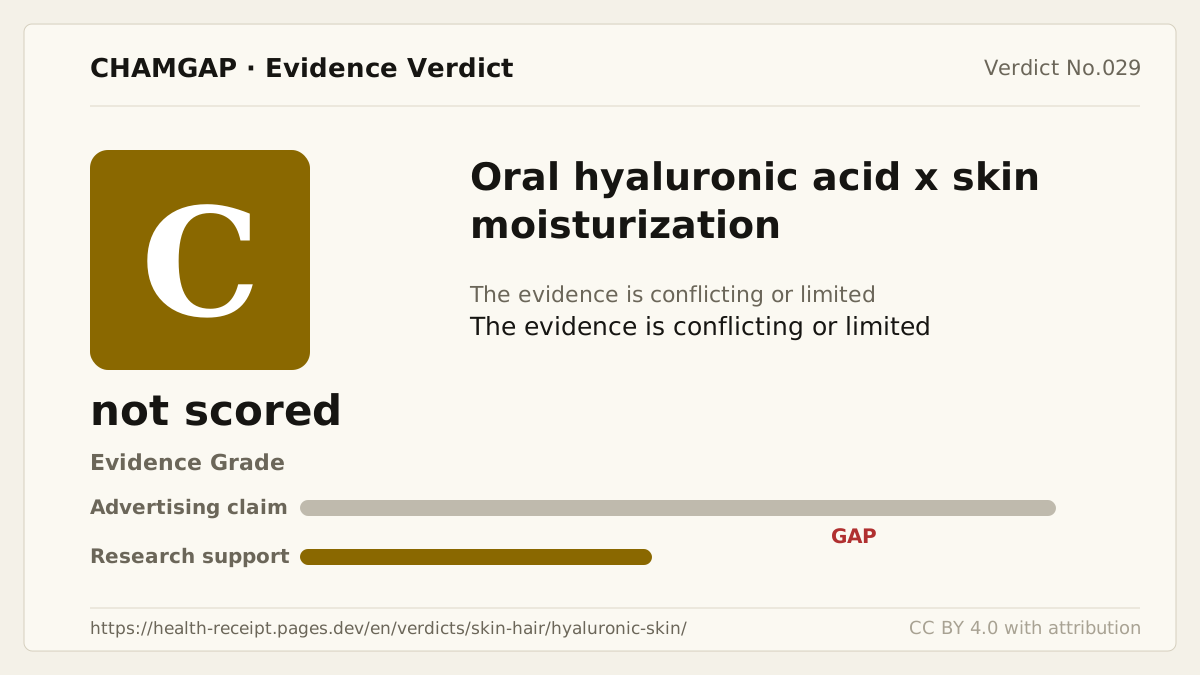
[Chamgap] Oral hyaluronic acid x skin moisturization — Evidence Grade C·50. 7 cited sources checked. Source: https://chamgap.com/en/verdicts/skin-hair/hyaluronic-skin/ · CC BY 4.0CC BY 4.0 — free to use with attribution; do not distort grades, numbers, or verdict meaning.
What this document does and does not do
Chamgap is an information source. It reports what research has and has not confirmed; it does not tell readers what to take or buy. That decision belongs to readers and, when needed, medical or legal professionals. This verdict reflects literature available up to the search date and may change as new research appears. Nothing here is medical advice.