
Oral ceramides,
does it really help with skin moisturization and barrier?
research showsFor oral ceramides (rice- and wheat-derived), the claim of “helping skin moisturization/barrier” has real human signals: randomized controlled trials (RCTs) and meta-analysis in humans report statistically improved hydration indicators and transepidermal water loss (TEWL) indicators. However, within the confirmed scope, (1) the direct wheat- and rice-derived trials with positive results were all studies funded or led by ingredient companies/manufacturers, (2) the confirmed improvements were not the “feeling of being moisturized after applying something to the skin” but surrogate indicators such as instrument-measured hydration and TEWL, (3) the rice-derived evidence is close to an open-label study without a placebo group, and (4) no case was confirmed in this verification in which an independent research team with no conflicts of interest replicated the same result. The fact that a human signal exists and the fact that the signal has been independently replicated outside industry interests are different layers of information; because the latter is not confirmed, the evidence for this claim is limited.
ads claimAdvertisements (CosmaxNBT/Greenstore, Ceramosides™ wheat-germ extract) state “skin moisturization (water content) and wrinkle improvement in 14 days by 16-fold and 5-fold, respectively, versus control,” and media/ingredient-company materials further use expressions such as “1,525% improvement in water content, 1,543% decrease in TEWL, 867% increase in elasticity,” and “fundamentally reconstructs the skin barrier itself” (reported as promotional expressions from ingredient companies/sales media; this verification could not confirm a specific primary source). These numbers are relative-change rates versus control (multiplicative expressions of surrogate indicators such as hydration and TEWL), and they are different information from absolute effect size or perceptibility. The original human-application-test report (MFDS individual-recognition report) was not directly accessed in this verification. “14 days” is likely the time point at which an effect was first observed (week 2), not the total trial duration (“from day 14 of intake” in EBN reporting), and media reports differ in trial duration and wording. Many efficacy numbers cited in advertisements come from ingredient-company, seller, or industry-media reports; independent original-text cross-checking is outside the scope of this verification (follow-up target). Also, based on public materials, some market products sold as “oral ceramide” derive from sources other than wheat or rice (e.g., konjac potato extract), so products with ingredient origins different from the target claim (rice/wheat) require separate confirmation.
Useful facts when choosing a product
- Research dose range: direct wheat-derived evidence: Bizot 2017 used glucosylceramide 1.7 mg + DGDG 11.5 mg/day for 60 days; Guillou 2011 used wheat extract oil 350 mg/day for 3 months. Rice-derived: Leo 2022 used rice ceramide 40 mg/day for 3 months (but open-label without placebo group). Ceramide studies included in the Sun 2022 meta-analysis vary in labeling standards from low-dose pure ingredients (mg units) to total ingredient amount (hundreds of mg).
- The recognized daily intake of Korean marketed individually recognized products (CosmaxNBT subsidiary Cosmax NS/Greenstore Ceramosides™ wheat-germ extract) is reported by public media as 30 mg/day. Because the pure-component dose range in wheat RCTs (glucosylceramide about 1~2 mg) and total ingredient amount (hundreds of mg) differ depending on labeling basis (pure component vs total extract), whether the marketed 30 mg refers to which standard is outside this verification scope (ingredient specification follow-up target, E1/E2 unconfirmed).
- The administration route in all confirmed citations is oral (ingested ceramide), matching the target claim, with no route confusion (E3 passed).
- MFDS regulatory status: within the confirmed scope, “may help skin moisturization” is within individually recognized (not notified-type) functionality. Several media reports (EBN, etc.) stated that the Ceramosides™ case was recognized as dual functionality for “skin moisturization” plus “protection from UV-induced skin damage,” but this was not directly confirmed with MFDS primary materials in this verification and is based on media reports. Recognition number 2025-10 was not reconfirmed in any MFDS primary material or media (the originally cited ingredient-company page is currently inaccessible), so MFDS primary-material confirmation remains a follow-up target.
- Based on public materials, some “oral ceramide” products on the market derive from sources other than wheat or rice (e.g., konjac potato extract), so products with origins different from the target claim (rice/wheat) exist; source labeling must be checked product by product.
- Safety: serious adverse-event reports at study doses were rare within the confirmed scope (good). Wheat-allergy information for wheat-derived products and long-term safety data require separate confirmation.
What the research actually shows
Human evidence does exist. Wheat-derived oral ceramide RCTs (Bizot 2017, n=60, 60 days; Guillou 2011, wheat extract oil 350 mg/day, 3 months, n=51) showed significant increases in skin hydration versus placebo (Guillou: arm p<0.001, leg p=0.012), and a meta-analysis in healthy adults (Sun 2022, Front Nutr, PMID 35719159) reported significant improvement in moisturization with ceramide-only intake (SMD 0.40, 95% CI 0.04~0.76, p=0.03) and significant decrease in TEWL (SMD -0.29, p=0.003). TEWL reduction was reported in Sun 2022 and Bizot 2017, while the confirmed result for Guillou 2011 is increased skin hydration. The ingredients include wheat and rice polar lipids and match the target claim, and all are oral routes. However, (a) the meta-analysis did not conduct subgroup analyses by funding source or ingredient source and pooled ceramides overall, so whether the effect remains after excluding industry funding or whether rice/wheat direct evidence alone has independent replication cannot be confirmed from this result alone (ceramide-only subgroup I²=64%, high heterogeneity); (b) improvement indicators are surrogate indicators (Corneometer hydration and TEWL); (c) combination formulations were not significant (p=0.34); and (d) the confirmed rice-derived direct evidence is an open-label single-arm observational study without a placebo group (Leo 2022, PMID 35807914, 40 mg/day, n=50), so causality and placebo effects cannot be separated. Studies using sources different from the target claim (milk, wine pomace, konjac) are considered reference only.
Why this is classified as C (50)
Grade C: because placebo-controlled human RCTs (Bizot 2017, Guillou 2011) and a healthy-adult meta-analysis (Sun 2022) show significant improvement signals in surrogate indicators (hydration and TEWL), this is not D, where human evidence itself is absent or null (methodology v0.5: “no independent RCT proven null”). However, it does not reach B because of the independence principle in methodology v0.5: the positive direct evidence (two wheat RCTs and one rice open-label study) is entirely industry-led, either manufacturer-funded (Guillou: Hitex S.A.S. sponsorship, PubMed original checked) or designed/written under the lead of the ingredient manufacturer (Bizot: first author affiliated with E.P.I. France, which makes the test material WPLC; A1 trap despite “no conflicts of interest” declaration); the confirmed improvements center on surrogate indicators such as TEWL; the rice-derived evidence is close to an open-label study without a placebo group (Leo 2022); and zero-conflict independent replication is absent within this verification scope. Methodology v0.5 principle: “if there is no independent RCT proven null, but all positives are concentrated in conflicted studies and independent replication is absent, do not finalize as D but do not give B (maximum C).” This judgment exactly fits that situation (positive=industry-concentrated, surrogate-centered, independent replication absent), so the upper bound is C; the meta-analysis (Sun 2022) lacks funding-source and ingredient-source subgroup analyses and cannot be read as independent replication evidence excluding industry funding (A2 subgroup absence). Under methodology v0.4 rule ④, the MFDS individually recognized status (wheat-germ extract) is separately stated as neutral metadata, not an upward grading factor (recognition number 2025-10 was not reconfirmed in this verification and remains unconfirmed). Safety: at study doses (30~40 mg range for the target claim, 1~2 mg range as pure components), serious adverse-event reports were rare, so safety remains “good”; long-term safety data and wheat-allergy-related information for wheat-derived products require separate confirmation.
Counterpoint. The argument that this judgment could be B rather than C: small human placebo-controlled RCTs (Bizot 2017, Guillou 2011) and a healthy-adult meta-analysis (Sun 2022) show real and directionally consistent signals for improving moisturization and TEWL, so this is not a situation with only observational studies but a layer where human RCTs exist (chapter 2 B: “human RCTs exist but proportion of industry funding is high”). Information in response: when limited to direct evidence for the target claim (rice/wheat), the confirmed scope includes two wheat RCTs and one open-label rice study; among them, the placebo-controlled direct-efficacy wheat RCTs both involved manufacturer funding/material/design, and the meta-analysis did not conduct subgroup analysis by funding source, so it does not show from this result alone whether the effect remains after excluding industry funding (A2). Conversely, the argument that this could be D: positive evidence is all concentrated in manufacturers, independent replication is absent, and indicators are only surrogate indicators, so independence reservations are large (the D argument in Codex A/B). Information in response: no independent RCT proven null exists, and the human signal itself is real, so the methodological D trigger (independent RCT null or disappearance of significance in high-quality groups) is not met. Under methodology v0.5’s upper-bound rule (if positives are all concentrated in conflicted studies and independent replication is absent, do not finalize as D but do not give B), real human signal excludes D and absence of independent replication/surrogate indicators excludes B, placing this judgment at C.
| Endpoint | S | Surrogate marker - laboratory or imaging measures |
| Replication | R1 | Single confirmatory trial |
| Independence | I1 | Mixed funding sources |
| Effect size | E+ | Meets the clinically important threshold |
The scoring table and the verdict agree (C).
Cross-check — Codex and Claude
Evidence Table
| Study | Design | Sample | Funding | Endpoint | Result | Weight |
|---|---|---|---|---|---|---|
| Qian Sun, Jingping Wu, Guofei Qian, Hongbin Cheng 2022 | meta-analysis and RCTs | mixed/partly industry-related | Meta-analysis of RCTs in healthy adults: ceramide-only intake significantly improved moisturization (SMD 0.40, 95% CI 0.04~0.76, p=0.03) and significantly reduced TEWL (SMD -0.29, 95% CI -0.49~-0.10, p=0.003). A total of 11 ceramide studies were included (9 single-ingredient, 2 combination; including wheat and rice polar lipids). Funding came from a Sichuan provincial public R&D program. | core | ||
| Valérie Bizot, Enza Cestone, Angela Michelotti, Vincenzo Nobile 2017 | randomized controlled trial | 60 | mixed/partly industry-related | wrinkles and gastrointestinal | Oral placebo-controlled RCT of wheat polar lipid complex (glucosylceramide 1.7 mg + DGDG 11.5 mg/day, 60 days): reported increased moisturization, decreased TEWL, and reduced wrinkles versus placebo; it most closely matches the target claim (wheat, oral, direct efficacy). | core |
| S 2011 | double-blind randomized controlled trial | 51, | manufacturer/industry involvement possible | hydration, skin, and gastrointestinal | Oral placebo-controlled double-blind RCT of wheat extract oil (WEO) 350 mg/day for 3 months (women with dry to very dry skin, n=51, age 20~63): skin moisturization significantly increased versus placebo in arm (p<0.001) and leg (p=0.012). | core |
| Teik Kee Leo, Eugenie Sin Sing Tan, Farahnaz Amini, Navedur Rehman, Edmond Siah Chye Ng, Chung Keat Tan 2022 | open-label/single-arm study | 50 | manufacturer/industry involvement possible | gastrointestinal | Oral rice ceramide 40 mg/day (KOMECERA, n=50) for 3 months: TEWL greatly decreased versus baseline (cheek, neck, arm: 36.9%, 47.1%, 39.2%, p<0.001) and moisturization increased (p<0.001). This is direct “rice-derived” evidence for the target claim, but it is an open-label single-arm study without a placebo group. | core |
| Study 5 | not specified | manufacturer/industry involvement possible | wrinkles, skin, and gastrointestinal | Confirmed that the efficacy of oral wheat-derived ceramides for “skin moisturization” is within Korean MFDS individually recognized functionality. The CosmaxNBT case is reported as dual functionality with added “protection from UV-induced skin damage,” daily intake 30 mg, and human-application-test reporting “from day 14 of intake, moisturization and wrinkles improved 16-fold and 5-fold versus control,” respectively. | supporting |
Receipt — 5 References
Of 5 cited sources, 2 had limited original-page access (blocked or summary-only) and were verified via index/summary, marked partial; the rest were verified at the original page. As of 2026-07-06.
Reviewed and approved: Chamgap Editorial Team · Approval date: 2026-07-06 · Corrections: none
Cite this verdict
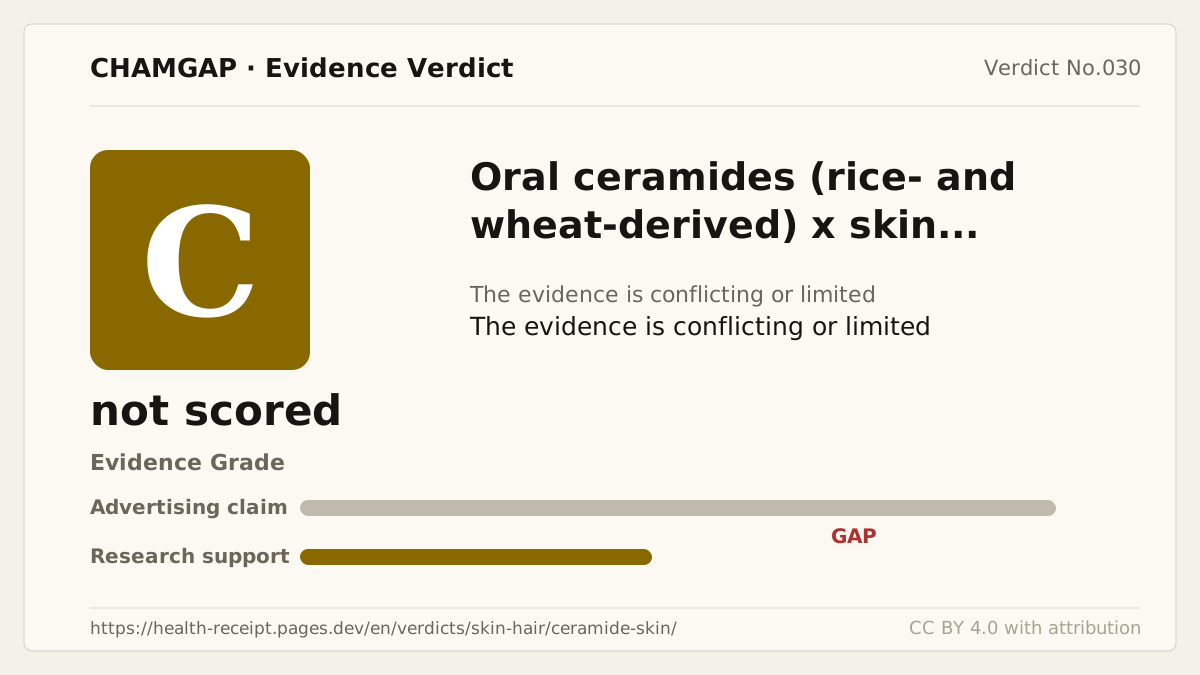
[Chamgap] Oral ceramides x skin barrier — Evidence Grade C·50. 5 cited sources checked. Source: https://chamgap.com/en/verdicts/skin-hair/ceramide-skin/ · CC BY 4.0CC BY 4.0 — free to use with attribution; do not distort grades, numbers, or verdict meaning.
What this document does and does not do
Chamgap is an information source. It reports what research has and has not confirmed; it does not tell readers what to take or buy. That decision belongs to readers and, when needed, medical or legal professionals. This verdict reflects literature available up to the search date and may change as new research appears. Nothing here is medical advice.