
Brewer’s yeast,
does it really help with hair-loss relief and hair?
research showsWithin the scope of this verification, the claim that “taking brewer’s yeast improves hair loss and helps hair” has no confirmed clinical trial in which that ingredient (brewer’s yeast) alone was given to humans to verify hair-loss or hair effects. The clinical trials used in advertising as if they were evidence (1) used not brewer’s yeast alone but multi-ingredient combination products (Pantogar® type) containing L-cystine, pantothenic acid, B vitamins, and dried yeast, (2) enrolled people with “telogen effluvium” or “diffuse hair loss,” not healthy ordinary people, (3) measured surrogate indicators such as “anagen hair ratio,” so it is unclear whether hair actually increased enough to be perceptible, and (4) many were manufacturer product trials (industry-linked). In other words, “a combination product improved indicators in a specific population” is not proof that “brewer’s yeast relieves hair loss in the general population.” The scholarly review Guo & Katta 2017 summarized that evidence for hair-loss effects of nutritional supplementation in people without deficiency is very limited, and that review does not mention brewer’s yeast (it is background evidence for supplementation in non-deficient people generally, not direct evidence for brewer’s yeast itself). In Korea, the Korea Consumer Agency (2025.04) stated that brewer’s yeast is composed mainly of protein, but its association with hair and scalp health has not been scientifically proven, and reported that all 30 foods claiming hair health were advertising without scientific evidence. Based on public regulatory materials, “hair-loss relief/hair” efficacy for brewer’s yeast is not confirmed as MFDS functionality (within the confirmed scope of this verification), and the recognized functionality of biotin often added with it is known to be in a separate scope from “hair health” (separate cross-check against the MFDS original text is outside this verification and remains a follow-up target). In short: as a single ingredient, this claim has no confirmed human evidence, and even the closest evidence is three steps removed: a different product (combination), a different population (people with hair-loss conditions), and surrogate indicators. It does not directly support the target claim. This state is summarized as grade D (human evidence is insufficient or was not confirmed in key trials).
ads claimAdvertisements (Ople.com, Newtree, Biocom “Pungsung Balance,” Hangam Lighthouse, etc.) make definitive efficacy and causal claims such as “brewer’s yeast is rich in biotin and amino acids that help keratin synthesis and is effective for hair-loss improvement/treatment,” and “biotin makes hair thick and strong and prevents hair loss.” However, (1) this leaps from the fact of containing nutrients to proof of efficacy (ingredient specification ≠ efficacy, E1), (2) the actual human evidence consists only of combination-product and patient-population trials, not brewer’s yeast alone, and (3) based on public materials, hair functionality for brewer’s yeast was not confirmed within the MFDS-recognized scope, and biotin’s recognized functionality is also known to be separate from “hair health” (separate cross-check against the MFDS original text remains a follow-up target). The Korea Consumer Agency stated that all 30 products making such claims lacked scientific evidence; 14 misled consumers as medicines/health functional foods, 16 were unfair advertisements with false/exaggerated claims or fabricated testimonials, and some products had measured biotin contents only 1~10% of the labeled amount or undetected.
Useful facts when choosing a product
- Many advertised products are labeled not as brewer’s yeast alone but as combination products that also include biotin, zinc, L-cystine, and similar ingredients (for example, Biocom “Pungsung Balance” is known to label biotin 2000%, zinc 118%, and L-cystine; cross-checking individual product-label originals is outside the scope of this verification and remains a follow-up target).
- The product category is known to mix (a) products recognized as “health functional foods” for biotin or similar ingredients and (b) brewer’s-yeast-centered “ordinary foods (health foods),” but within the confirmed scope neither side had confirmed evidence of recognized “hair-loss relief/hair health” functionality.
- Based on public materials, biotin’s recognized functionality is known to be within the scope of “carbohydrate, fat, and protein metabolism and energy production,” and “hair health” was not confirmed; direct cross-check of the MFDS notification original is outside this verification (follow-up target).
- Hair-related individually recognized ingredients such as “millet extract complex (Keranat)” and “fish collagen peptide” are known to have been recognized within the scope of “may help improve hair condition (gloss/elasticity),” not “hair-loss relief/prevention,” and brewer’s yeast appears not to fall under this, but cross-check against the MFDS recognition-list original remains a follow-up target.
- In the Korea Consumer Agency (2025.04) survey, all 30 online foods claiming hair health advertised without scientific evidence, and 14 were caught as misleading consumers into thinking they were medicines/health functional foods while 16 were caught as unfair advertisements with false/exaggerated claims or fabricated testimonials (based on cited reports).
- The same survey reported that some products had measured biotin content only 1% or 10% of the labeled amount, and one had none detected, confirming a reliability problem in labeled content (based on cited reports).
- Advertising text such as “effective for hair-loss treatment” and “prevents hair loss” asserts definitive causality and treatment efficacy, but no single-ingredient human evidence supporting it was confirmed.
What the research actually shows
The three confirmed human randomized controlled trials (RCTs)—Lengg 2007, Petri 1990, and Budde 1993—all tested combination products (Pantogar® type) containing L-cystine, pantothenic acid, B vitamins, and dried yeast, not brewer’s yeast alone; participants had telogen effluvium, diffuse hair loss, or hair-structure damage (not healthy ordinary people). The results indicate that the combination product significantly improved surrogate indicators such as the anagen hair ratio and trichogram versus placebo (for example, in Lengg 2007, anagen ratio p=0.003, placebo p=0.85), but the independent contribution of the yeast component cannot be separated, and the size of any perceptible improvement in hair count or density is unclear (B1/B4 flags). These positive RCTs are all manufacturer-line product trials, and independent funding sources were not stated in abstracts/texts (funding not specified). Riegel 2020 is a cell (keratinocyte) experiment, not human efficacy, and that formulation did not include yeast. The scholarly review Guo & Katta 2017 (manufacturer-independent) concluded that research on nutritional supplementation effects without deficiency is very limited, but it did not directly evaluate brewer’s yeast and is therefore referenced only as background evidence for supplementation in non-deficient people generally, not as evidence for brewer’s yeast itself. The Korea Consumer Agency 2025 investigation stated that brewer’s yeast has no scientifically proven association with hair/scalp health. Overall, human efficacy evidence for brewer’s yeast alone on hair loss/hair was not confirmed, and all related human evidence is limited to “combination product, patient population, surrogate indicators.”
Why this is classified as D
Basis for D judgment: For the target claim (“brewer’s yeast intake -> hair-loss relief / hair benefit”), (1) within the confirmed scope there are zero human efficacy studies of the ingredient (brewer’s yeast) alone; all three confirmed RCTs used multi-ingredient combinations, so the independent effect of yeast cannot be separated (B4). (2) Even the closest human evidence is at three removes: “different product (combination), different population (people with hair-loss conditions, not healthy ordinary people), and surrogate indicators (anagen ratio/trichogram),” so it does not directly support the claim (B1/B2). (3) Relevant positive RCTs are all concentrated in manufacturer-line product trials, independent RCTs at the zero-conflict layer are absent, and independent funding sources cannot be confirmed from abstracts (A1 flag); Methodology chapter 2-1 item ② independence first. (4) Within the confirmed scope there is no basis for MFDS functional recognition, and the Korea Consumer Agency judged hair association unproven and all 30 products unfair advertising (based on cited reports). Why D rather than C: C requires at least observational/limited human evidence with matching ingredient and population, but here single-ingredient human evidence is absent and positive evidence is concentrated in manufacturers, so independent replication is not confirmed (2-1 items ② and ③). Why not F: combination products have positive results improving indicators in specific populations, so complete disproof of effect cannot be concluded, and it has not been proven that yeast contributes nothing; the state is “failure to prove (evidence absent).” Overall: absence of single-ingredient evidence + mismatch of population/formulation/surrogate indicators + manufacturer concentration of positive evidence and absence of independent replication -> D. (Both blind cross-checks converged on D.)
Counterpoint. The opposing view, taken at its most favorable to the claim: double-blind placebo-controlled RCTs using combination products (Pantogar® type) that contain brewer’s yeast do exist, and they showed statistically significant improvements versus placebo in anagen hair ratio (Lengg 2007, p=0.003) and trichogram indicators, with no adverse reactions reported. Because the MeSH substances of these combinations actually include “dried yeast,” the narrow statement “a yeast-containing formulation may help people with specific hair-loss conditions” has evidence. Also, brewer’s yeast is known to contain protein, B vitamins, and amino acids, so theoretical plausibility (supplying keratin materials) can be posited; however, this mechanistic plausibility is inference, not directly proven by the cited evidence. This opposing view still (a) does not prove the independent contribution of yeast, (b) cannot be extended to prevention/relief in the general population because participants had hair-loss conditions, (c) cannot guarantee perceptible effect because the endpoint is surrogate indicators, and (d) retains industry-funding linkage, making it decisively insufficient to raise the target claim (“brewer’s yeast intake generally relieves hair loss”) to proof.
Cross-check — Codex and Claude
Evidence Table
| Study | Design | Sample | Funding | Endpoint | Result | Weight |
|---|---|---|---|---|---|---|
| Lengg N, Heidecker B, Seifert B, Trüeb RM 2007 | double-blind randomized controlled trial | 30 | manufacturer/industry involvement possible | gastrointestinal, hair loss, and hair | Randomized double-blind placebo-controlled RCT in 30 women with telogen effluvium. A combination product (Pantogar®) containing L-cystine, medicinal yeast, and pantothenic acid was given for 6 months; the anagen hair ratio significantly normalized (p=0.003), the placebo group showed no change (p=0.85), and between-group difference was p=0.008. No funding source/conflict-of-interest independence was specified in the abstract/text. | core |
| Petri H, Pierchalla P, Tronnier H 1990 | double-blind randomized controlled trial | 60 | manufacturer/industry involvement possible | AST, hair loss, and hair | Randomized double-blind placebo-controlled trial (4 months) in 60 patients with diffuse hair loss and hair-structure damage. Pantogar (combination product containing calcium D-pantothenate, L-cystine, dried yeast, etc.) was effective versus placebo on swelling capacity and trichogram, while placebo was ineffective. “Yeast, Dried” was confirmed among MeSH substances. Funding source not stated in abstract. | core |
| Budde J, Tronnier H, Rahlfs VW, Frei-Kleiner S 1993 | double-blind randomized controlled trial | 72 | manufacturer/industry involvement possible | AST, gastrointestinal, hair loss, and hair | Randomized double-blind placebo-controlled trial in 72 female patients with diffuse hair loss and hair-structure damage. A combination product of L-cystine+B vitamins+dried yeast (preparation 1) was statistically significantly superior to placebo on anagen ratio and swelling capacity. “Dried Yeast (oral)” was confirmed in MeSH. Funding source not stated. | core |
| Guo EL, Katta R 2017 | not specified | mixed/partly industry-related | AST and hair loss | Scholarly review (manufacturer-independent). It summarized that evidence for hair-loss effects of nutritional supplementation in people without deficiency is very limited, and that biotin has no clinical trial showing efficacy for hair-loss treatment in non-deficient people. It also warned that some excess supplementation (selenium, vitamin A, vitamin E) may instead carry hair-loss/toxicity risk. This review does not mention “brewer’s yeast” at all. | core | |
| Riegel K, Hengl T, Krischok S, Schlinzig K, Abts HF 2020 | preclinical study | 1 | manufacturer/industry involvement possible | In-vitro cell experiment (human hair follicle keratinocytes, HHFK). Four core ingredients of Pantovigar® (L-cystine, thiamine, calcium D-pantothenate, folic acid) enhanced keratinocyte proliferation, survival, and UV resistance. This is not human efficacy, and this formulation did not include yeast. | supporting | |
| Study 6 | not specified | manufacturer/industry involvement possible | gastrointestinal and hair | Domestic public-agency investigation. Brewer’s yeast has no proven scientific association with hair/scalp health, and biotin has also never had confirmed “hair health” functionality. All 30 online-sold foods claiming hair benefits advertised without evidence (14 misleading as medicines/health functional foods, 16 false/exaggerated or fabricated testimonials); one biotin product had none detected and two contained only 1% and 10% of the labeled amount. | supporting |
Receipt — 6 References
Of 6 cited sources, 1 had limited original-page access (blocked or summary-only) and were verified via index/summary, marked partial; the rest were verified at the original page. As of 2026-07-06.
Reviewed and approved: Chamgap Editorial Team · Approval date: 2026-07-06 · Corrections: none
Cite this verdict
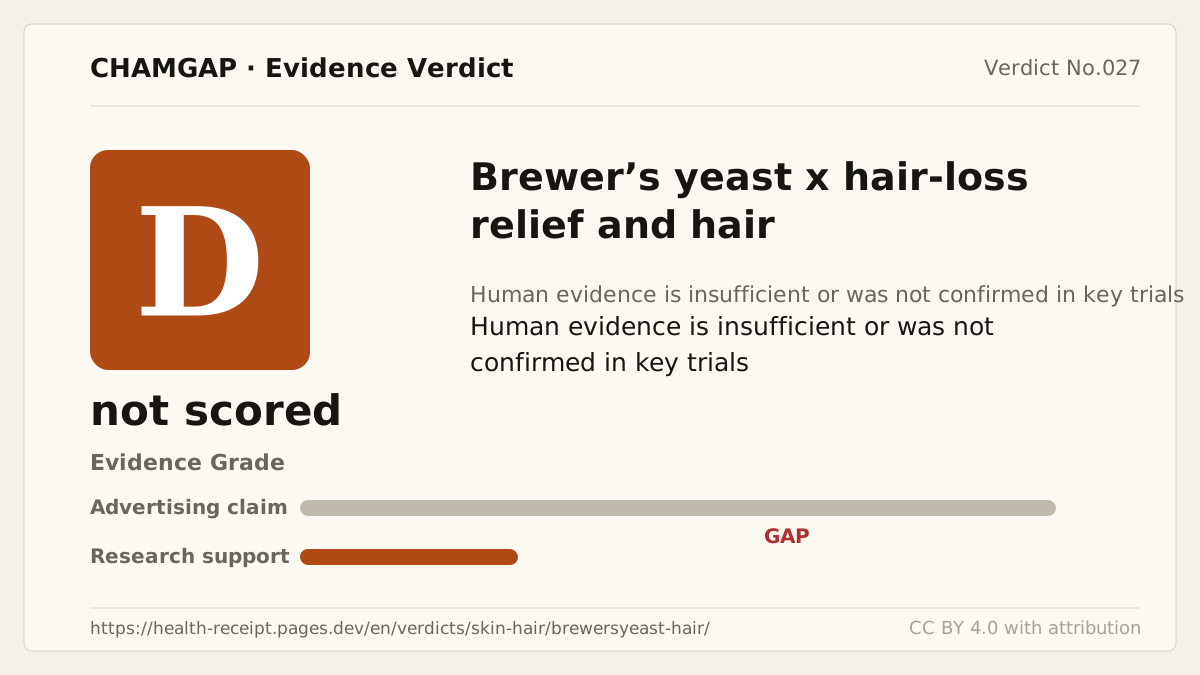
[Chamgap] Brewer’s yeast x hair loss — Evidence Grade D. 6 cited sources checked. Source: https://chamgap.com/en/verdicts/skin-hair/brewersyeast-hair/ · CC BY 4.0CC BY 4.0 — free to use with attribution; do not distort grades, numbers, or verdict meaning.
What this document does and does not do
Chamgap is an information source. It reports what research has and has not confirmed; it does not tell readers what to take or buy. That decision belongs to readers and, when needed, medical or legal professionals. This verdict reflects literature available up to the search date and may change as new research appears. Nothing here is medical advice.