
Biotin,
does it really help with hair-loss improvement and hair growth?
research showsBiotin has hair-related evidence only in people with biotin deficiency, and verified literature did not find randomized controlled trial (RCT) evidence that it improves hair growth or hair loss in ordinary hair-loss patients without deficiency. Rather, two small RCTs in non-deficient people (oral 5mg/day and 10mg/day) produced 'no effect' results with no difference from placebo. The only placebo-controlled positive study that advertisements might cite, Ablon 2015, was not biotin alone but a marine-complex combination product (Viviscal), and it was directly funded by the product manufacturer, so it cannot be viewed as evidence for biotin alone. The functionality the Korean MFDS recognizes for biotin is only 'needed for fat, carbohydrate, and protein metabolism and energy production,' while hair loss and hair growth are outside the recognized scope. For reference, high-dose biotin of 5mg or more, used in hair trials, has been reported to interfere with blood tests such as thyroid and troponin tests and create misdiagnosis risk, so it is safer to tell clinicians about use before testing.
ads claimAdvertisements use expressions that effectively evoke hair growth or hair-loss improvement, such as 'hair-loss care,' 'fullness,' 'increase in hair-growth stimulating factors,' 'hair falling on the pillow after sleep,' and 'helps healthy hair growth by promoting collagen production needed for keratin synthesis.' However, (1) none of the verified literature contains positive RCT evidence that oral biotin alone improves hair loss in non-deficient general adults, and RCTs in general adults were instead null. (2) 'Biotin 3,000%' is a percentage of the daily nutrient reference value, not a measured pure biotin mcg amount (failure pattern E1/E2), and labels such as 'biotin 1500' or '800mg 60 tablets' may differ from pure active ingredient amount. (3) 'contains MFDS-certified ingredient' uses the fact that biotin is listed as a generic ingredient for energy metabolism, but what MFDS recognizes is metabolic functionality, not hair loss or hair-growth efficacy (D2). (4) 'Hair-loss relief shampoo' is a functional cosmetic for topical/external use, not an oral health functional food, so route and category differ from this oral-intake claim (E3).
Useful facts when choosing a product
- Biotin itself is an MFDS generic functional ingredient, but its recognized functionality is only 'needed for fat, carbohydrate, and protein metabolism and energy production' (daily intake 9-900µg), and no 'hair loss/hair growth' functionality exists. The only MFDS-recognized hair-related health functional food functionality is 'improvement of hair condition (shine/elasticity),' a cosmetic concept for already-grown hair texture, excluding hair growth and hair-loss prevention.
- Labels such as 'biotin 3,000%,' 'biotin 1500,' and '800mg 60 tablets' may be percentages of daily value or total tablet weight and differ from measured pure biotin mcg content. The amount should be checked as an actual mcg (µg) value rather than a percentage (E1/E2).
- 'Hair-loss relief shampoos' such as Bioga are not swallowed health functional foods but topical/external functional cosmetics; 'relief of hair-loss symptoms' is a cosmetics-law certification item. Oral intake and external shampoo have different routes, categories, and recognized functionalities (E3).
- High-dose biotin of 5mg or more used in hair-loss trials has been reported to interfere with immunoassay blood tests such as thyroid tests (TSH, FT4, FT3) and troponin, creating misdiagnosis risk for hyperthyroidism or myocardial infarction (2017 FDA warning). If a test is planned, biotin use should be disclosed in advance, and depending on platform, stopping for 8 hours to 2 days is recommended.
What the research actually shows
The 8 verified papers consistently point in the same direction. (1) Evidence limited to deficient patients: Patel 2017 (Skin Appendage Disorders; PMID 28879195) stated that all 18 improvement cases with biotin supplementation had underlying pathology such as biotinidase or holocarboxylase deficiency and that there were 'no' RCTs in healthy people. Soleymani 2017 (J Drugs Dermatol; PMID 28628687) also argued that the only evidence-based indication is 'treatment of biotin deficiency.' (2) Null results in general adults: in Valentim 2024 (Anais Bras Dermatol; PMID 38688776), oral biotin 5mg/day alone in healthy non-deficient adult men had no significant effect on hair growth rate (2.50->2.47mm/week, p=0.53; measured endpoint; no funding declared; n=10 small). Yelich 2024 (JCAD; PMID 39148962) confirmed that the highest-quality double-blind placebo-controlled study (biotin 10mg/day) showed no difference from placebo and that 'high-quality studies do not support usefulness,' with no funding. Moltó-Balado 2026 (Dermato; DOI 10.3390/dermato6020017, MDPI original blocked by 403 so author/sample recheck needed, C1 partial) also found no consistent benefit for biotin alone and improvements mainly in combination products. (3) Positive but combination/manufacturer-funded: Ablon 2015 (Dermatol Res Pract; PMCID PMC4389977) showed significant terminal-hair increase (p<0.0001), but the test product was a combination of AminoMar marine complex + silica + vitamin C + biotin + zinc, biotin amount not specified, and the Viviscal manufacturer Lifes2good directly funded it, so attribution to biotin alone is impossible (strong A1 warning). (4) Safety: Rosner 2019 (Cureus; PMID 31641565) and Zhang 2020 (Medicine Baltimore; PMID 32118725) showed that biotin 5-10mg/day interferes with immunoassays such as TSH, FT4, and troponin, creating risks such as hyperthyroidism misdiagnosis, with normalization after stopping biotin and a 2017 FDA warning; this is risk evidence, not efficacy evidence.
Why this is classified as D (28)
Grade D basis: this claim is not C-level 'conflicting/limited evidence' but D-level 'failed proof, observational level, or not recognized.' It is not A/B because there is no strong independent RCT supporting oral biotin alone in non-deficient people with ordinary hair loss, and instead two RCTs in non-deficient general subjects found no difference from placebo (B2: do not misread failed proof as proof). It is not C because the evidence is not merely conflicting but consistently negative, and the regulatory fact that it is outside MFDS-recognized functionality (D2) overlaps. It is not F because improvement cases and medicines do exist for biotin-deficient people, such as biotinidase deficiency, so the claim is not wholly false if narrowed to deficient patients. The only apparently positive study, Ablon 2015, was a combination product with direct manufacturer funding (A1), so it cannot be adopted as evidence for biotin alone.
Counterpoint. A higher-grade opposing view may argue that biotin is an essential coenzyme involved in keratin synthesis and therefore theoretically helps hair, and that a placebo-controlled RCT such as Ablon 2015 showed significant hair increase. Rebuttal: (1) Ablon 2015 tested not biotin alone but a marine-complex-centered combination product, so the observed effect cannot be attributed to biotin (E1/E4), and it was a single-author, small (n=60), manufacturer-funded study lacking independence (A1). (2) The two RCTs that isolated biotin alone, Valentim 2024 and the Pawlowski double-blind study cited in the Yelich review, were both null. (3) The mechanistic plausibility of being an essential biochemical coenzyme works as correction in deficiency states; it is a different proposition from saying that extra supplementation grows hair in people with enough biotin. Therefore mechanism and combination-product evidence cannot raise the grade.
| Endpoint | S | Surrogate marker - laboratory or imaging measures |
| Replication | R1 | Single confirmatory trial |
| Independence | I1 | Mixed funding sources |
| Effect size | E0 | Null |
| Precision | C0 | The confidence interval leaves room for benefit |
The scoring table and the verdict agree (D).
Cross-check — Codex and Claude
Evidence Table
| Study | Design | Sample | Funding | Endpoint | Result | Weight |
|---|---|---|---|---|---|---|
| Patel DP, Swink SM, Castelo-Soccio L 2017 | randomized controlled trial | 18 | possible manufacturer or industry involvement | hair | Explicitly states that there are 'no' RCTs of biotin hair efficacy in healthy people, and all 18 improvement cases had underlying deficiency pathology; COI declared absent (pure review). | key |
| Soleymani T, Lo Sicco K, Shapiro J 2017 | randomized controlled trial | possible manufacturer or industry involvement | hair loss | Narrative review arguing that there are no human RCTs for any type of hair loss and that the only evidence-based indication is 'treatment of biotin deficiency.' | key | |
| Yelich A, Jenkins H, Holt S, Miller R 2024 | double-blind randomized controlled trial | possible manufacturer or industry involvement | immunity / liver | The highest-quality double-blind placebo-controlled study (biotin 10mg/day) showed no difference from placebo; 'high-quality studies do not support usefulness,' no funding. | key | |
| Study 4 | systematic review | possible manufacturer or industry involvement | hair | Biotin alone has no consistent benefit on objective hair markers; improvements usually occur in combination products, and evidence is mainly limited to deficiency or rare syndromes. | key | |
| Valentim FO, Miola AC, Miot HA, Schmitt JV 2024 | randomized controlled trial | 10 | gastrointestinal / hair | In healthy non-deficient adult men, oral biotin 5mg/day alone had no effect on hair growth rate (2.50->2.47mm/week, p=0.53); funding and COI declared absent. | supporting | |
| Ablon G 2015 | double-blind randomized controlled trial | possible manufacturer or industry involvement | hair | Combination product group (AminoMar + silica + vitamin C + biotin + zinc) had significant terminal-hair increase (p<0.0001), but this was not a biotin-alone effect and was directly funded by manufacturer Lifes2good. | supporting | |
| Rosner I, Rogers E, Maddrey A, Goldberg DM 2019 | gastrointestinal | Biotin 5mg/day (about 167 times the recommended 30mcg) caused false abnormal values for TSH, PTH, and calcium, creating risk of hyperthyroidism and malignancy misdiagnosis; values normalized within 1 month after stopping. | supporting | |||
| Zhang Y, Wang R, Dong Y, Huang G, Ji B, Wang Q 2020 | 10 | mixed or partly industry-related | liver / hair loss | In 10 healthy adults, biotin 5-10mg/day interfered with Roche and Beckman thyroid tests (falsely low TSH and falsely high FT4/FT3/TT3), creating Graves disease misdiagnosis risk; Abbott showed no interference. | supporting |
Receipt — 8 References
Of 8 cited sources, 3 had limited original-page access (blocked or summary-only) and were verified via index/summary, marked partial; the rest were verified at the original page. As of 2026-07-06.
Reviewed and approved: Chamgap Editorial Team · Approval date: 2026-07-06 · Corrections: none
Cite this verdict
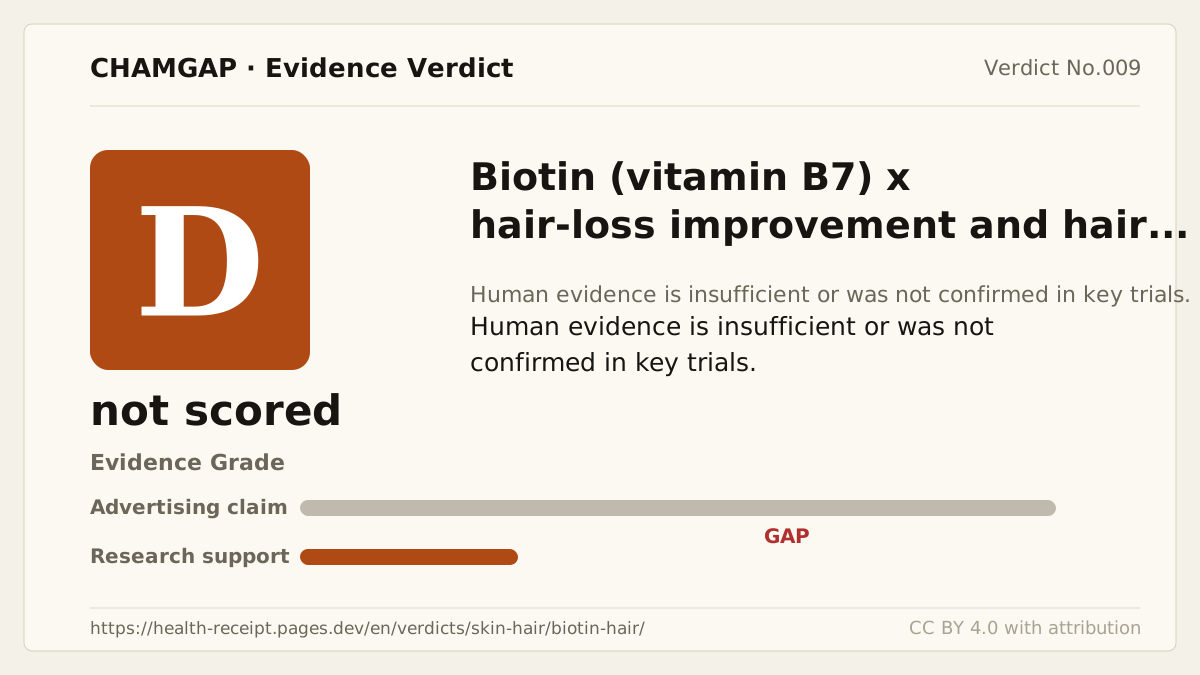
[Chamgap] Biotin x hair loss and hair — Evidence Grade D·28. 8 cited sources checked. Source: https://chamgap.com/en/verdicts/skin-hair/biotin-hair/ · CC BY 4.0CC BY 4.0 — free to use with attribution; do not distort grades, numbers, or verdict meaning.
What this document does and does not do
Chamgap is an information source. It reports what research has and has not confirmed; it does not tell readers what to take or buy. That decision belongs to readers and, when needed, medical or legal professionals. This verdict reflects literature available up to the search date and may change as new research appears. Nothing here is medical advice.