
Policosanol,
does it really help with LDL cholesterol improvement?
research showsThe claim that sugarcane-derived policosanol lowers LDL cholesterol is directly divided. Trials linked to Cuban researchers, Cuban raw material, and manufacturers reported large LDL reductions of up to 20-28%, but trials in which independent research teams without conflicts of interest tested the same Cuban policosanol, such as Berthold 2006 JAMA in Germany and Dulin 2006 AJCN in the United States, found no difference from placebo. A 2018 meta-analysis pooling 22 RCTs also showed an overall LDL reduction, but the authors themselves stated that in regional subgroup analysis, 'Cuban studies showed greater effects than studies outside Cuba,' with high heterogeneity. The Korean MFDS recognized 'policosanol-sugarcane wax alcohol' as an individually recognized ingredient for cholesterol improvement (No. 2006-4), but a substantial part of that recognition evidence is Cuban-line data with reproducibility controversy. In short, institutional recognition exists, but independently reproduced effects have not been confirmed, and the improved marker is LDL level, a surrogate marker, not cardiovascular events.
ads claimAdvertisements and detail pages commonly give the impression that sugarcane policosanol lowers 'bad cholesterol' (LDL) and is natural and safe while being as strong as statins. The source of the strong numbers these phrases cite, such as LDL reductions above 20%, is in effect trials by a single research group connected to the company that makes and sells the product. Advertisements emphasize quantity, such as '20 studies' and 'multiple meta-analyses,' but they do not show that many of these are not independent verification but repeated results from the same interested party, nor that the effect was not reproduced when independent researchers without conflicts of interest ran the same kind of trials. No independent evidence was confirmed to support a frame such as 'natural, so it can replace statins.'
Useful facts when choosing a product
- The policosanol content in domestic and overseas products is usually 5-20mg/day, similar to the doses used in Cuban studies. In other words, this judgment is not about dose insufficiency but about lack of independent replication even at that dose.
- Sugarcane-wax-extracted and rice-bran-derived policosanol have different raw materials, and the core debate over LDL reduction is concentrated on sugarcane, especially Cuban, policosanol.
- In Korea, policosanol may display 'may help improve cholesterol' as an individually recognized functional ingredient, but functionality recognition is ingredient and labeling regulation and does not guarantee independently verified clinical benefit or statin-level effects.
- Checking which study a detail page's effect number came from, including researcher affiliation and funding source, lets consumers compare whether the strong numbers are concentrated among manufacturer/seller-linked researchers.
What the research actually shows
If the evidence is read by the primary endpoint, prespecified LDL reduction, and stratified by conflict-of-interest level, the results divide starkly by funding source. In multiple RCTs by the Cuban Dalmer researchers, the product manufacturer and seller, policosanol 5-20mg/day was reported to lower LDL by about 20-28%, a magnitude comparable to statins. However, the same effect did not appear in independent RCTs without conflicts of interest: the German Berthold group's 143-person high-dose trial up to 80mg and the U.S. Dulin group's trial both found no significant difference from placebo. Thus large independent RCTs were null, and independent replication over 20 years consistently failed. A Korean replication study by Cho and colleagues reported positive results, but that research group was affiliated with Raydel, a policosanol-product-related company, so it is not free of conflicts of interest. Meta-analyses become statistically significant largely because most raw data come from a single interested research group. LDL reduction is not a final clinical benefit such as reduced cardiovascular events but a surrogate marker, and for policosanol the independently measured surrogate marker itself was null.
Why this is classified as D (28)
Why it is D: many human RCTs and meta-analyses exist, but the weight of evidence rests not on the number of trials but on whether there is independent replication. Studies reporting large LDL reductions (about 20~28%) are mostly concentrated in the Cuban Dalmer research group, the product manufacturer/seller, and its affiliates (Korean Cho=affiliated with Raydel), while independent high-quality RCTs without conflicts of interest - German Berthold (up to 80mg, 143 participants), U.S. Dulin - found no significant difference from placebo. In other words, the primary surrogate marker (LDL) in large, independent RCTs was null, and this null finding has been consistent for 20 years. If the primary endpoint of an independent large RCT is null, the grade is downgraded to D (boundary rule ②). Why not A~B: higher grades require strong independent replication, but here independent replication failed and positive evidence is confined to a single interested party. Why not F: this is not a state in which 'no effect has been independently and repeatedly proven,' but rather one in which 'independent replication failed and the independence of positive evidence has not been secured'; the verified literature itself was confirmed to exist and match its content (C1/C2 passed). LDL itself is a surrogate marker, and for policosanol even that surrogate marker was null in independent measurement. Regulatory evidence such as MFDS individual recognition is judged separately from the scientific evidence grade (boundary rule ④). Safety is separately marked as 'caution.'
Counterpoint. Some may argue that this should be B because more than 20 double-blind RCTs exist, multiple meta-analyses are statistically significant, and the direction is consistent. Our answer: the significance of those 20 or so trials and meta-analyses mostly comes from data by a single research group linked to the product manufacturer and seller, Dalmer. Having many RCTs and having results reproduced independently are different issues; when independent researchers without conflicts of interest repeated the trials (Berthold, Dulin), the effect disappeared, and this null result has been consistent for 20 years. The Korean Cho study is also affiliated with Raydel and is hard to count as independent verification. Under rules that prioritize independent replication rather than quantity of evidence, the null result of the largest independent RCT points to D rather than B. Conversely, it is not F because the state is better described as failed independent replication and positive evidence confined to one interested party, not repeated independent proof of no effect.
| Endpoint | S | Surrogate marker - laboratory or imaging measures |
| Replication | R1 | Single confirmatory trial |
| Independence | I0 | Evidence comes only from manufacturer studies |
| Effect size | E0 | Null |
| Precision | C0 | The confidence interval leaves room for benefit |
The scoring table and the verdict agree (D).
Cross-check — Codex and Claude
Evidence Table
| Study | Design | Sample | Funding | Endpoint | Result | Weight |
|---|---|---|---|---|---|---|
| Berthold HK, Unverdorben S, Degenhardt R, Bulitta M, Gouni-Berthold I 2006 | randomized controlled trial | 143 | possible manufacturer or industry involvement | LDL / cholesterol | 143 patients with hypercholesterolemia/mixed hyperlipidemia, Cuban policosanol 10-80mg/day for 12 weeks; no group reduced LDL by more than 10% and there was no difference from placebo. Independent non-manufacturer funding. | key |
| Dulin MF, Hatcher LF, Sasser HC, Barringer TA 2006 | randomized controlled trial | LDL / cholesterol | U.S. adults with mild hypercholesterolemia, policosanol 20mg/day for 8 weeks; LDL change did not differ from placebo. U.S. independent replication failed. | key | ||
| Gong J, Qin X, Yuan F et al. 2018 | meta-analysis of randomized controlled trials | possible manufacturer or industry involvement | LDL | 22 RCTs pooled; LDL decreased by about WMD -0.71 mmol/L (95% CI -1.02~-0.40). However, heterogeneity was high and subgroup analysis found that 'Cuban studies were more effective than non-Cuban studies.' | key | |
| Chen JT, Wesley R, Shamburek RD, Pucino F, Csako G 2005 | meta-analysis of randomized controlled trials | 2,934 | possible manufacturer or industry involvement | LDL | Policosanol section: 29 trials, 2,934 participants; LDL -23.7% vs placebo -0.1% (P<0.0001). However, the authors and DARE/CRD noted that most data came from the same Cuban research group and warned that large independent RCTs were needed. | key |
| Castaño G, Mas R, Fernández L, Illnait J, Gámez R, Alvarez E 2001 | double-blind trial | possible manufacturer or industry involvement | LDL / cholesterol | Patients with type 2 hypercholesterolemia, policosanol 20/40mg/day for 24 weeks; LDL decreased 27.4%/28.1% (p<0.00001). Representative consistently positive large Cuban study. | supporting | |
| Batista J, Stüsser R, Saéz F, Pérez B 1996 | 23 | possible manufacturer or industry involvement | LDL | Small study of 23 hyperlipidemia patients with coronary artery disease, policosanol 2mg/day for 14 months; LDL decreased 15.6% in the treatment group (p<=0.05) vs a nonsignificant 5.5% increase in placebo. | supporting | |
| Kim SJ, Yadav D, Park HJ, Kim JR, Cho KH 2018 | possible manufacturer or industry involvement | LDL / blood pressure / gastrointestinal | Healthy Koreans with prehypertension, Cuban policosanol 10/20mg/day for 24 weeks; the 20mg group had about 20% LDL reduction and the 10mg group about 14% reduction. Positive result relevant to the Korean market. | supporting | ||
| Gouni-Berthold I, Berthold HK 2002 | randomized controlled trial | possible manufacturer or industry involvement | LDL / cholesterol | Review. Until then, 10-20mg/day had been reported to reduce total cholesterol by 17-21% and LDL by 21-29%, but this evidence was effectively based on Cuban single-research-group data, and later independent replication failed. | supporting |
Receipt — 8 References
All 8 cited sources were verified for existence at the original page (as of 2026-07-06).
Reviewed and approved: Chamgap Editorial Team · Approval date: 2026-07-06 · Corrections: 1
Correction log — 1
Corrections applied to this verdict, in chronological order. Changes are logged, not erased.
- 2026-07-11 · Rationale alignment — The rationale described this as a 'typical C', but the final grade was D. Because the primary surrogate (LDL) of the large independent RCTs (Berthold et al.) was null, D is correct under boundary rule 2, so the rationale was rewritten around D. Grade, score, and citations are unchanged. Found in the 2026-07-11 internal audit (Codex/Claude cross-check). (grade D unchanged)
Cite this verdict
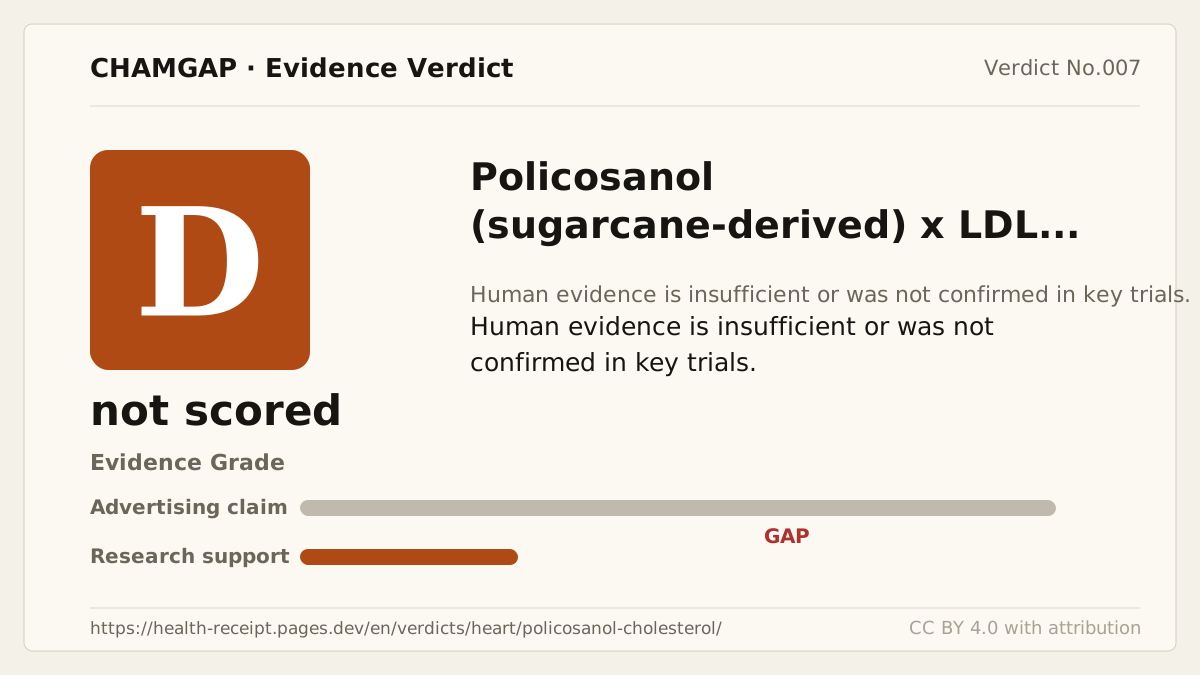
[Chamgap] Policosanol x cholesterol — Evidence Grade D·28. 8 cited sources checked. Source: https://chamgap.com/en/verdicts/heart/policosanol-cholesterol/ · CC BY 4.0CC BY 4.0 — free to use with attribution; do not distort grades, numbers, or verdict meaning.
What this document does and does not do
Chamgap is an information source. It reports what research has and has not confirmed; it does not tell readers what to take or buy. That decision belongs to readers and, when needed, medical or legal professionals. This verdict reflects literature available up to the search date and may change as new research appears. Nothing here is medical advice.