
Omega-3,
does it really help with cardiovascular and blood-flow improvement?
research showsThe 'blood-flow improvement' and 'blood triglyceride improvement' claims for omega-3 (EPA/DHA) are within the health functional food functionality wording recognized by the Korean MFDS. In other words, this advertising expression itself is within the regulatory-recognized scope. However, the evidence has two layers. First, 'blood triglyceride improvement' is a blood-test value, a surrogate marker, and whether improving that value reduces actual cardiovascular events such as myocardial infarction or stroke is a separate question. Second, large trials assessing actual cardiovascular events have mixed results: VITAL and ASCEND in general/primary-prevention populations were null at 1g/day; STRENGTH using high-dose 4g/day EPA+DHA was also null; and the only strongly positive trial, REDUCE-IT, used high-purity EPA 4g/day as a prescription drug in hypertriglyceridemia patients, was manufacturer-led, and has placebo controversy, so it does not directly correspond to ordinary commercial omega-3 supplements or healthy-consumer situations. Pooled meta-analyses show small relative-risk reductions of about 5-13%, but an atrial-fibrillation increase signal is present as well.
ads claimAdvertisements by Atomy, Nutrione, Chong Kun Dang Healthcare and others extend beyond 'blood-flow improvement' to phrases such as 'No. 1 blood-flow health,' 'smooth blood circulation,' and in some cases 'may help prevent cardiovascular diseases' (Nutrione magazine). There are three gaps. (1) Regulatory gap: 'blood-flow improvement' and 'blood triglyceride improvement' are MFDS-recognized phrases, but 'cardiovascular disease prevention' is not a recognized functionality and disease-prevention wording may be expression likely to mislead consumers about disease under health functional food labeling/ad review standards [D2]. (2) Surrogate-marker gap: 'blood triglyceride improvement' emphasized in ads is a blood value (surrogate), not an actual reduction in cardiovascular events [B1]. (3) Population/dose gap: positive evidence (REDUCE-IT) is high-dose prescription-drug data in hypertriglyceridemia patients, but ads implicitly apply it to consumer supplements. Trials in general adults (VITAL, ASCEND) were null.
Useful facts when choosing a product
- MFDS-recognized daily intake is based on the combined amount of EPA+DHA, and the range for blood triglyceride and blood-flow improvement is 500-2000mg. Total oil per capsule on the label, such as 654mg, may differ from pure EPA+DHA active content, so checking 'pure EPA+DHA mg versus total omega-3' is useful for label interpretation [E2].
- Form labels such as rTG, TG, and EE (ethyl ester) indicate raw-material form differences, and recognized functionality wording on the label (blood-flow improvement/blood triglyceride improvement) must meet the MFDS generic content standard regardless of form.
- The MFDS recognizes four functionalities for this ingredient: blood triglyceride improvement, blood-flow improvement, memory improvement, and improvement of dry eyes. If a product or advertisement uses expressions such as cardiovascular disease prevention/treatment, it is outside the recognized functionality.
- Meta-analysis observed an atrial fibrillation (arrhythmia) increase signal for omega-3 overall (RR 1.26). This is a fact worth knowing when choosing products, especially for people with arrhythmia-related history.
What the research actually shows
Five verified papers were checked against PubMed originals, with authors, year, journal, volume/issue/pages, PMID/DOI, dose, population, results, and funding matching. ① VITAL (2019, N Engl J Med 380(1):23-32): primary prevention in healthy general adults, marine omega-3 1g/day (EPA 460 + DHA 380mg), major cardiovascular events HR 0.92 (95% CI 0.80-1.06, P=0.24), null. NIH funding, but trial products were supplied free by manufacturers [A1]. ② ASCEND (2018, N Engl J Med 379(16):1540-50): diabetes patients without ASCVD, n-3 1g/day, serious vascular events RR 0.97 (0.87-1.08, P=0.55), null. Public funding from British Heart Foundation, but capsules supplied by Mylan/Abbott affiliates [A1 partial]. ③ REDUCE-IT (2019, N Engl J Med 380(1):11-22): hypertriglyceridemia patients on statins, high-purity EPA 4g/day, primary composite endpoint HR 0.75 (0.68-0.83, P<0.001), significant reduction; however, fully sponsored by manufacturer Amarin, mineral-oil placebo inactivity controversy, and atrial fibrillation increased [A1]. ④ STRENGTH (2020, JAMA 324(22):2268-80): high-risk patients, EPA+DHA 4g/day vs corn oil, MACE HR 0.99 (0.90-1.09, P=0.84), null and stopped early. Manufacturer AstraZeneca sponsored it, but it was null, a counterexample to manufacturer funding equaling positive results [A1]. ⑤ Meta-analysis Khan 2021 (EClinicalMedicine 38:100997): pooled primary/secondary prevention RCTs, cardiovascular death RR 0.93 (0.88-0.98), nonfatal MI RR 0.87 (0.81-0.93), MACE RR 0.95 (0.92-0.98), small reductions; EPA-only > EPA+DHA; atrial fibrillation increased RR 1.26 (1.08-1.48). No funding-source subgroup analysis [A2]. Follow-up literature in 2024-2025 also confirms unresolved REDUCE-IT/STRENGTH inconsistency, EPA-only superiority, and ongoing placebo controversy.
Why this is classified as C (54)
Why it is C: the evidence is conflicting and limited. Why it is not A/B: large independent RCTs on hard clinical endpoints were null (VITAL and ASCEND), high-dose EPA+DHA in STRENGTH was also null, and the only strongly positive trial, REDUCE-IT, was manufacturer-sponsored, in patients, used a prescription high-purity EPA 4g/day product, and has placebo controversy, so it cannot be generalized to ordinary supplements. Meta-analysis effects exist but are small (5-13%), lack funding-source subgroup analysis [A2], and come with an atrial-fibrillation signal. Why it is not D/F: there are many large RCTs and meta-analyses, not just observational studies, and the core wording of the claim, 'blood-flow improvement,' plus the surrogate marker 'blood triglyceride improvement,' are actually within MFDS-recognized generic functionality, so it is not baseless. This is failed/limited proof, not proof of harm, and recognized surrogate-marker-level evidence exists, making C typical.
Counterpoint. Higher-grade view, B: 'blood-flow improvement' and 'blood triglyceride improvement' are formally recognized functionalities by the MFDS, and if advertising uses exactly that wording it is an evidence-based claim from a regulatory perspective. The triglyceride-lowering effect itself is reproducibly observed in several RCTs. Rebuttal: if the target claim's 'cardiovascular improvement' is read as hard clinical outcomes such as fewer myocardial infarctions and strokes, the largest RCTs in general adults were null. Reproducible triglyceride lowering (surrogate marker) does not guarantee reduced clinical events, as STRENGTH illustrates: lipid improvement did not reduce MACE. This surrogate-to-clinical-outcome gap is the core reason C cannot be raised to B. A lower-grade view, D, is also possible because large null trials dominate, but recognized functionality and small significant meta-analysis findings exist, so D is too harsh.
| Endpoint | S | Surrogate marker - laboratory or imaging measures |
| Replication | R2 | Independently replicated across trials |
| Independence | I0 | Evidence comes only from manufacturer studies |
| Effect size | E+ | Meets the clinically important threshold |
The scoring table and the verdict agree (C).
Cross-check — Codex and Claude
Evidence Table
| Study | Design | Sample | Funding | Endpoint | Result | Weight |
|---|---|---|---|---|---|---|
| Manson JE, Cook NR, Lee IM et al. 2019 | possible manufacturer or industry involvement | Healthy general adults in primary prevention, marine omega-3 1g/day (EPA 460 + DHA 380mg); major cardiovascular events HR 0.92 (0.80-1.06, P=0.24), null; NIH funding but study products supplied free by manufacturers. | key | |||
| ASCEND Study Collaborative Group (Bowman L, Mafham M, Wallendszus K et al. 2018 | possible manufacturer or industry involvement | Diabetes patients without ASCVD, n-3 1g/day (EPA 460 + DHA 380mg) vs olive oil; serious vascular events RR 0.97 (0.87-1.08, P=0.55), null; public funding from British Heart Foundation but capsule supply from Mylan/Abbott affiliates. | key | |||
| Bhatt DL, Steg PG, Miller M et al. 2019 | possible manufacturer or industry involvement | Hypertriglyceridemia patients on statins, high-purity EPA (icosapent ethyl) 4g/day; primary composite endpoint HR 0.75 (0.68-0.83, P<0.001), significant reduction; fully sponsored by Amarin, mineral-oil placebo inactivity controversy, and atrial fibrillation increased. | key | |||
| Nicholls SJ, Lincoff AM, Garcia M et al. 2020 | randomized controlled trial | possible manufacturer or industry involvement | AST | High-risk dyslipidemia patients, EPA+DHA 4g/day vs corn oil; MACE HR 0.99 (0.90-1.09, P=0.84), null and stopped early; atrial fibrillation increased; sponsored by AstraZeneca. | key | |
| Khan SU, Lone AN, Khan MS et al. 2021 | meta-analysis of randomized controlled trials | 149,051 | possible manufacturer or industry involvement | Pooled primary/secondary prevention RCTs, about 149,051 participants; cardiovascular death RR 0.93 (0.88-0.98), nonfatal MI RR 0.87 (0.81-0.93), MACE RR 0.95 (0.92-0.98), small reductions; EPA-only > EPA+DHA; atrial fibrillation increased RR 1.26 (1.08-1.48); no funding. | supporting |
Receipt — 5 References
Of 5 cited sources, 1 had limited original-page access (blocked or summary-only) and were verified via index/summary, marked partial; the rest were verified at the original page. As of 2026-07-06.
Reviewed and approved: Chamgap Editorial Team · Approval date: 2026-07-06 · Corrections: none
Cite this verdict
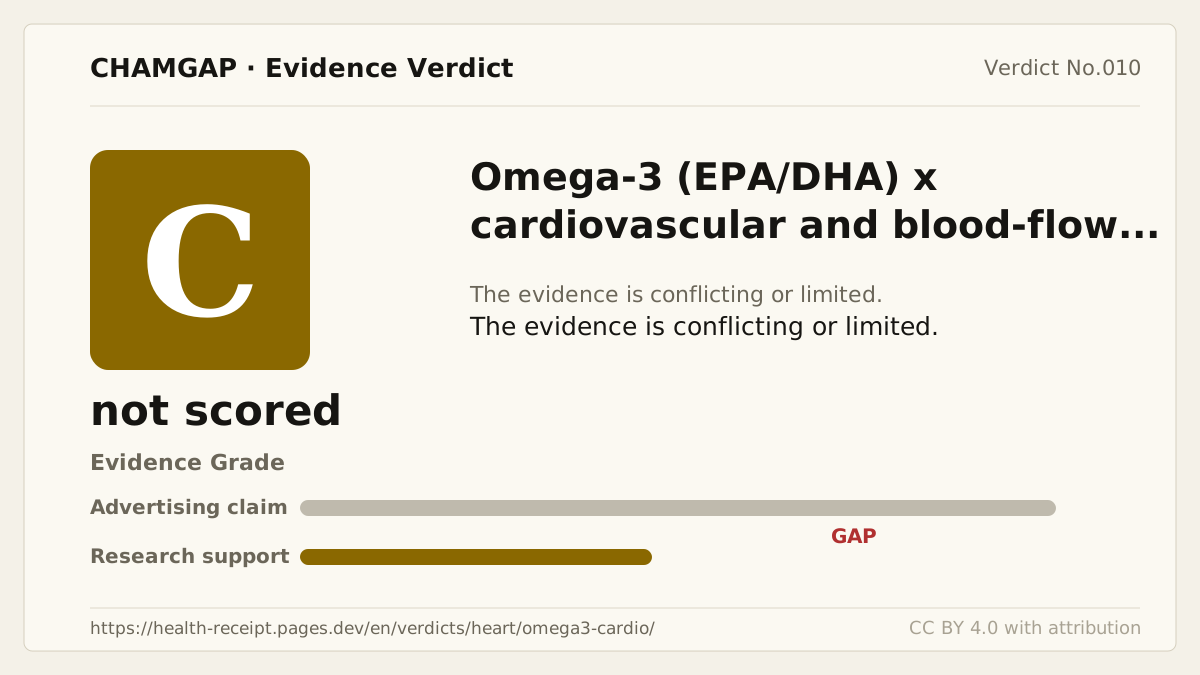
[Chamgap] Omega-3 x blood flow and cardiovascular health — Evidence Grade C·54. 5 cited sources checked. Source: https://chamgap.com/en/verdicts/heart/omega3-cardio/ · CC BY 4.0CC BY 4.0 — free to use with attribution; do not distort grades, numbers, or verdict meaning.
What this document does and does not do
Chamgap is an information source. It reports what research has and has not confirmed; it does not tell readers what to take or buy. That decision belongs to readers and, when needed, medical or legal professionals. This verdict reflects literature available up to the search date and may change as new research appears. Nothing here is medical advice.