
Niacin,
does it really help with Cholesterol and lipids?
research showsNiacin's compound claim must be separated. In large RCTs, pharmacologic-dose nicotinic acid repeatedly lowered LDL and triglycerides and raised HDL, a clear human effect that merits grade A for lipid-surrogate improvement. By contrast, cardiovascular-event prevention when niacin was added to statins was null in AIM-HIGH, HPS2-THRIVE, and other evidence, with many discontinuations due to adverse effects, so that subclaim is grade D. Because strong lipid effects coexist with unproven clinical outcomes and harm, the overall grade is C. Flushing, elevated liver enzymes, and increased blood glucose are recorded separately as a safety 'Caution.'
ads claimKorean-language products and content connect niacin with 'cholesterol,' 'blood flow,' 'energy metabolism,' 'skin flushing,' 'NAD precursor,' and 'metabolic health.' Some explanations present the niacin content of ordinary B-complex products and pharmacologic doses for lipid improvement as if they had the same meaning.
Useful facts when choosing a product
- The nicotinic acid dose in lipid-improvement studies is usually 1-3 g/day, which differs greatly from ordinary vitamin B3 nutrient supplementation.
- Nicotinamide is the same vitamin B3 but differs from nicotinic acid, the form expected to have pharmacologic lipid-improvement effects.
- High-dose niacin can be associated with flushing, itching, gastrointestinal symptoms, elevated liver enzymes, hepatotoxicity, worsening blood glucose, and worsening gout.
- In AIM-HIGH and HPS2-THRIVE, changes in lipid values did not lead to reductions in major cardiovascular events.
- General health functional food listed claims are nutrient functions such as energy production and are distinct from cardiovascular-event prevention or lipid-treatment effects.
What the research actually shows
At pharmacologic doses of 500-3000 mg/day, niacin raises HDL and lowers triglycerides and LDL. AIM-HIGH added extended-release niacin 1,500-2,000 mg/day to statins in 3,414 patients with ASCVD, but it failed to reduce primary cardiovascular events and was stopped early. HPS2-THRIVE, in more than 25,000 high-risk patients, found that extended-release niacin plus laropiprant did not reduce major vascular events and increased serious adverse reactions such as increased blood glucose, diabetes-related problems, infections, and bleeding. A 2017 Cochrane review summarized that niacin did not reduce death, myocardial infarction, or stroke.
Why this is classified as C (50)
C. Lipid-marker improvement is a clear grade A human surrogate effect repeated in large RCTs. In contrast, cardiovascular-event prevention when niacin was added to statins is grade D because AIM-HIGH, HPS2-THRIVE, and other large trials were null and had many adverse-effect discontinuations. The overall grade is C because strong surrogate efficacy coexists with unproven clinical outcomes and harm; flushing, elevated liver enzymes, and increased blood glucose are recorded separately as a safety 'Caution.'
Counterpoint. Lipid-marker improvement is grade A, while cardiovascular-event prevention is grade D. The overall grade C reflects this asymmetry without either ignoring the clear surrogate effect or allowing it to outweigh the null clinical-outcome evidence.
Rejudgment record. Reassessment (calibration realignment) — Lipid-surrogate improvement is grade A, while cardiovascular-event prevention when niacin is added to statins is grade D. The overall grade C reflects the coexistence of strong lipid effects, unproven clinical outcomes, and harm.
Sub-claim grades by effect
This ingredient is marketed for several effects. A single overall grade blends strong and weak claims together, so each effect is graded separately here. The overall grade reflects the strongest disconfirming or core claim.
| Effect (sub-claim) | Grade | Basis |
|---|---|---|
| Lipid-marker improvement (LDL, TG, HDL) | A | Clear lipid-surrogate effects repeatedly demonstrated in large RCTs |
| Cardiovascular-event prevention | D | Null in large RCTs including AIM-HIGH and HPS2-THRIVE, with many adverse-effect discontinuations |
Cross-check — Codex and Claude
Evidence Table
| Study | Design | Sample | Funding | Endpoint | Result | Weight |
|---|---|---|---|---|---|---|
| Boden WE et al. 2011 (AIM-HIGH) | Large randomized double-blind RCT | 3,414 | Supported by NHLBI, Abbott, and Merck | Major cardiovascular events | HDL/triglycerides improved, but primary cardiovascular events were not reduced, at 16.4% vs 16.2%. | Core |
| Landray MJ et al. 2014 (HPS2-THRIVE) | Large randomized RCT | 25,673 | Industry/research support including Merck | Major vascular events | Extended-release niacin plus laropiprant did not reduce major vascular events and increased serious adverse reactions. | Core |
| Schandelmaier S et al. 2017 | Cochrane systematic review | 39,195 | Independent/public | Death, myocardial infarction, and stroke | Niacin did not reduce all-cause mortality, cardiovascular mortality, myocardial infarction, or stroke. | Core |
| Bruckert E et al. 2010 | Meta-analysis | Unknown | Cardiovascular events and lipids | Earlier studies suggested a possibility of event reduction, but this was not confirmed in later large statin-combination RCTs. | Supporting |
Receipt — 5 References
All 5 cited sources were verified for existence at the original page (as of 2026-07-09).
Reviewed and approved: Chamgap Editorial Team · Approval date: 2026-07-09 · Corrections: 1
Correction log — 1
Corrections applied to this verdict, in chronological order. Changes are logged, not erased.
- 2026-07-11 · Calibration realignment (grade changed) — Niacin's improvement of lipid markers (LDL, triglycerides, HDL) is a clear, repeatedly demonstrated human effect that was wrongly lumped into D (no human effect). The lipid-marker improvement (A) and the null cardiovascular-event prevention (D; AIM-HIGH, HPS2-THRIVE) are now separated as sub-claims, with an overall C. Safety is 'caution' for flushing, liver enzymes, and glucose. 2026-07-11 calibration realignment. (grade D→C)
Cite this verdict
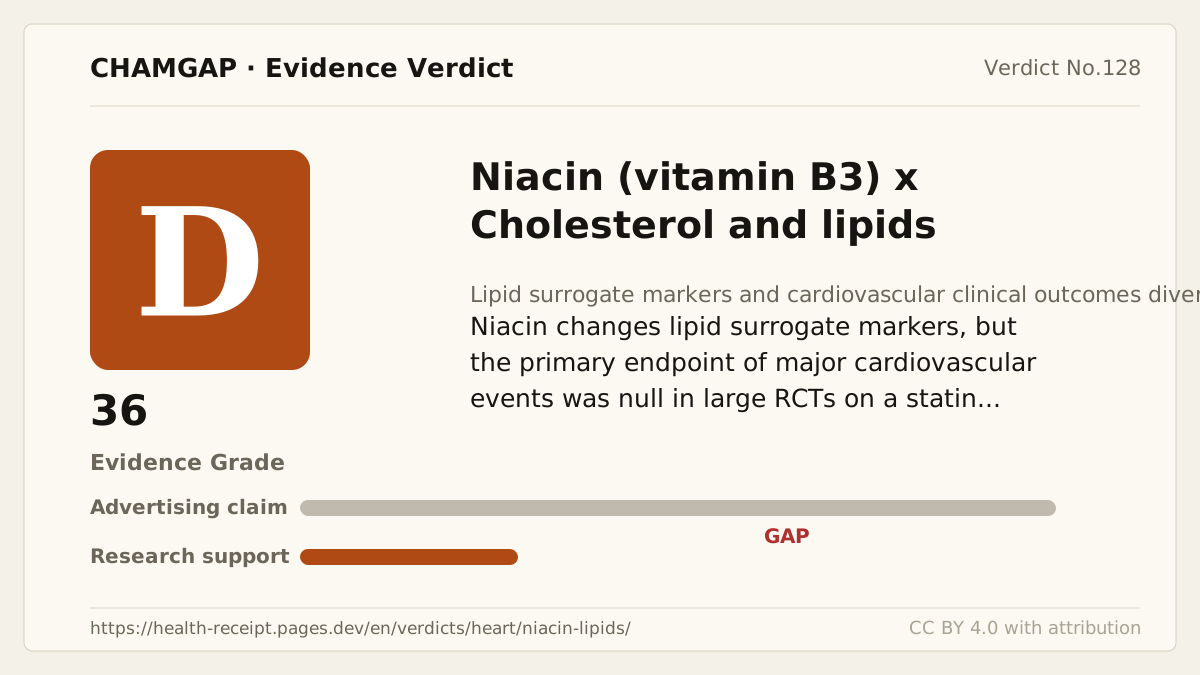
[Chamgap] Niacin (vitamin B3) × Cholesterol and lipids — Evidence Grade C·50. 5 cited sources checked. Source: https://chamgap.com/en/verdicts/heart/niacin-lipids/ · CC BY 4.0CC BY 4.0 — free to use with attribution; do not distort grades, numbers, or verdict meaning.
What this document does and does not do
Chamgap is an information source. It reports what research has and has not confirmed; it does not tell readers what to take or buy. That decision belongs to readers and, when needed, medical or legal professionals. This verdict reflects literature available up to the search date and may change as new research appears. Nothing here is medical advice.