
Coenzyme Q10,
does it really help with antioxidant and blood-pressure improvement?
research showsThe antioxidant and high-blood-pressure reduction claims for coenzyme Q10 are, based on public MFDS recognition data, both within the recognized functionality scope (regulatory recognition and evidence-grade strength are separate). The actual evidence strength is mixed. Blood pressure: the strictest review (2016 Cochrane, RCTs only) found no significant difference from placebo (systolic -3.68mmHg, CI included 0). The commonly cited 'up to 17mmHg systolic reduction' came from a 2007 meta-analysis; within the confirmed scope, that analysis is linked to coenzyme Q10 sellers (Pharma Nord, Blackmores) and about 60% of participants were from uncontrolled open-label studies (full original funding acknowledgment behind paywall not directly checked, follow-up needed). A 2022 meta-analysis with independent funding (National Natural Science Foundation of China) found systolic pressure about 5mmHg lower in cardiometabolic-disease patients, not healthy general adults, and diastolic pressure was consistently null across analyses. Antioxidant: oxidative-stress markers (MDA decrease, total antioxidant capacity increase) improved consistently in two independent meta-analyses. However, these are blood surrogate markers, GRADE evidence is mostly 'very low to low,' and whether marker improvement leads to actual reductions in disease, death, or cardiovascular events was not measured. In short, 'may help' wording is regulator-permitted. Blood-pressure effects are small or conflicting and mostly patient data; antioxidant evidence is consistent for surrogate markers but unconnected to clinical outcomes. Public recognized daily intake is 90-100mg, but all four collected ads did not state mg content, and expressions such as 'lowers blood pressure' may exceed the recognized wording ('may help reduce high blood pressure').
ads claimThe four collected ads (EGOLUX, Vita Delight/JW Pharmaceutical, Myrtail, Natural Plus) center on phrases such as 'blood-pressure lowering,' 'good for blood pressure,' 'helps reduce high blood pressure,' and 'antioxidant' (ad wording and mg non-labeling are based on the collected text and the original capture/sources are follow-up materials outside this citation list). The expressions 'antioxidant' and 'high blood-pressure reduction' themselves are within the MFDS-recognized functionality wording for coenzyme Q10, 'may help antioxidant function and reducing high blood pressure,' based on public recognition data. But there are two gaps. First is expression strength: seller phrases such as 'blood-pressure lowering,' 'how to lower blood pressure,' and 'good for blood pressure' are more definitive than the recognized wording 'may help reduce high blood pressure' and may suggest treatment or guaranteed effect. The ad impression 'lowers blood pressure' contrasts with the strictest evidence (2016 Cochrane), which found no effect versus placebo in general hypertensive patients, and with repeated null diastolic results. Second is dose transparency: public recognition data say daily intake is 90-100mg coenzyme Q10, but the four collected ads did not state mg content in product name/body, so whether they meet recognized dose cannot be checked.
Useful facts when choosing a product
- Based on public MFDS recognition data, functionality is 'may help antioxidant function and reducing high blood pressure' (generic ingredient). 'Antioxidant' and 'blood-pressure reduction' expressions are within this range, but definitive phrases such as 'lowers blood pressure' or 'good for blood pressure' may exceed recognized wording.
- Public recognized daily intake is 90-100mg as coenzyme Q10. The four collected ads did not state mg content in product name/body, so recognized dose compliance cannot be confirmed.
- Blood-pressure evidence is mixed. The strictest 2016 Cochrane review (strict RCTs only) reported no significant BP lowering versus placebo in general hypertensive patients (systolic -3.68mmHg, CI included 0, GRADE moderate).
- The origin of the commonly used 'up to 17mmHg systolic reduction' number, Rosenfeldt 2007, is linked within the confirmed scope to coenzyme Q10 sellers (Pharma Nord, Blackmores) and about 60% open-label studies without placebo; funding text needs full original recheck.
- Even independent evidence (Zhao 2022, GRADE moderate) found only about 5mmHg systolic effect and nonsignificant diastolic effect. Significant BP effects are mostly in patients with cardiometabolic disease, so evidence for healthy adults is limited.
- Antioxidant evidence consistently improves oxidative-stress surrogate markers (MDA, TAC) in two independent meta-analyses, but GRADE is mostly 'very low' and whether these markers reduce disease, cardiovascular events, or death is unmeasured.
- Evidence for statin-associated muscle pain improvement is a separate issue from this claim and is not included.
- Safety note from public data outside this citation list: MFDS 2022 reevaluation is known as allowing pregnant women and advising lactating women to avoid intake, and hypotension possibility has been reported when combined with blood-pressure drugs.
What the research actually shows
Human clinical evidence exists but directions diverge. The strictest blood-pressure evidence, the 2016 Cochrane systematic review (Ho MJ et al.; DOI 10.1002/14651858.CD007435.pub3), concluded that coenzyme Q10 100-200mg/day for 8-12 weeks in primary hypertension did not significantly lower BP versus placebo (systolic -3.68mmHg [95% CI -8.86~1.49], diastolic -2.03mmHg [95% CI -4.86~0.81], both CIs include 0). GRADE was moderate, and authors reassessed earlier positive Cochrane findings as based on low-quality/high-bias trials. In contrast, the widely cited 'systolic up to 17mmHg / diastolic up to 10mmHg reduction' comes from Rosenfeldt 2007 (Journal of Human Hypertension; PMID 17287847), where the RCT subgroup reported systolic -16.6mmHg; however, about 59-64% of 362 participants were in open-label studies without placebo/blinding, and within the confirmed scope funding was linked to coenzyme Q10 sellers (Pharma Nord, Blackmores), with full acknowledgment behind paywall not directly checked. Zhao 2022 dose-response meta-analysis (Advances in Nutrition; PMID 36130103), funded by the National Natural Science Foundation of China, found in cardiometabolic-disease patients systolic -4.77mmHg (95% CI -6.57~-2.97, GRADE moderate) but diastolic -1.67mmHg nonsignificant (GRADE low), suggesting an optimal 100-200mg/day U-shaped dose response. Tabrizi 2018 in metabolic-disease patients also found only systolic small significance (SMD -0.30) and diastolic null (SMD -0.08). Antioxidant evidence is more directionally consistent: Dai 2022 (Antioxidants; PMID 35883851) reported TAC increase (SMD 1.83) and MDA decrease (SMD -0.77), and Sangsefidi 2020 (Food Science & Nutrition; PMID 32328242) found the same direction (MDA SMD -1.12, TAC SMD 1.29). But GRADE for oxidative-stress markers was all 'very low' because of high heterogeneity, imprecision, and possible publication bias, and MDA/TAC are blood surrogate markers without measured hard outcomes.
Why this is classified as C (50)
Judged C, limited/conflicting evidence. Why it is not A/B: for blood pressure, the strictest evidence (2016 Cochrane, strict RCTs only) reported no significant effect versus placebo with moderate evidence, so evidence directly conflicts. The origin of the often-cited '17mmHg' number (Rosenfeldt 2007) is flagged, within the confirmed scope, for industry funding (Pharma Nord, Blackmores) and about 60% uncontrolled open-label studies (A1/A2; full acknowledgment not directly checked). Independent evidence (Zhao 2022) shows only about 5mmHg systolic effect, diastolic effects are consistently null, and significant effects are mostly in patients, limiting generalization to healthy people. Antioxidant evidence is directionally consistent but mostly GRADE very low and limited to surrogate markers (MDA/TAC), with hard clinical outcomes unmeasured (B1). Why it is not F: regulatory functionality is publicly confirmed and antioxidant-marker improvement plus small systolic reduction in patients are reproduced in independent evidence. Why it is not D: no-conflict independent RCT/meta-analysis evidence is not null for systolic/antioxidant markers, and high-quality group disappearance was not shown. Thus C fits.
Counterpoint. Arguments against this judgment: (1) public MFDS data recognize 'may help reduce high blood pressure,' so by regulator standards this is a recognized BP functional ingredient; C may look stingy. (2) The 2022 independent GRADE moderate meta-analysis (Zhao) found statistically significant systolic -4.77mmHg and even dose-response, so an effect in appropriately dosed patients may be accepted. (3) Antioxidant markers (MDA/TAC) align in two independent meta-analyses. Limits: regulatory recognition is separate from evidence grade, and 2016 Cochrane found effect disappearance in strict RCTs. Significant BP effects are mostly patient data and weak for healthy general adults, while antioxidant markers are surrogate and do not prove disease/death reduction. Even with these counterarguments, evidence remains C-level, not A/B.
| Endpoint | S | Surrogate marker - laboratory or imaging measures |
| Replication | R1 | Single confirmatory trial |
| Independence | I1 | Mixed funding sources |
| Effect size | E+ | Meets the clinically important threshold |
The scoring table and the verdict agree (C).
Cross-check — Codex and Claude
Evidence Table
| Study | Design | Sample | Funding | Endpoint | Result | Weight |
|---|---|---|---|---|---|---|
| Ho MJ, Li ECK, Wright JM 2016 | systematic review | 50 | possible manufacturer or industry involvement | liver / blood pressure | Strict RCTs only in primary hypertension (2 trials, n=50); coenzyme Q10 100-200mg/day for 8-12 weeks showed systolic -3.68mmHg (95% CI -8.86~1.49) and diastolic -2.03mmHg (95% CI -4.86~0.81) versus placebo, both CIs including 0 and nonsignificant, GRADE moderate; non-industry Cochrane. | key |
| Rosenfeldt FL, Haas SJ, Krum H et al. 2007 | meta-analysis of randomized controlled trials | 362 | possible manufacturer or industry involvement | Meta-analysis of 12 clinical trials and 362 participants; RCT subgroup reported systolic -16.6mmHg (12.6~20.6, P<0.001) and diastolic -8.2mmHg (6.2~10.2, P<0.001), the origin of the advertising-circulated 'up to 17mmHg systolic' number. | key | |
| Study 3 | meta-analysis | mixed or partly industry-related | Dose-response meta-analysis in cardiometabolic-disease patients; systolic -4.77mmHg (95% CI -6.57~-2.97, GRADE moderate) significant, diastolic -1.67mmHg (95% CI -4.30~0.96, GRADE low) nonsignificant, U-shaped optimum 100-200mg/day; funding from National Natural Science Foundation of China, no conflicts declared. | key | ||
| Study 4 | meta-analysis of randomized controlled trials | 684 | possible manufacturer or industry involvement | 17 RCTs and 684 metabolic-disease patients; systolic SMD -0.30 (95% CI -0.52~-0.08) significant, diastolic SMD -0.08 (95% CI -0.46~0.29) nonsignificant, reproducing the 'small systolic significance, diastolic null' pattern. | key | |
| Burke BE, Neuenschwander R, Olson RD 2001 | double-blind randomized controlled trials and meta-analysis | 83 | possible manufacturer or industry involvement | blood pressure | 83 patients with isolated systolic hypertension in randomized double-blind placebo-controlled RCT; 120mg/day for 12 weeks reduced systolic by -17.8±7.3mmHg, a representative individual trial driving the large 2007 Rosenfeldt effect. | supporting |
| Study 6 | meta-analysis of randomized controlled trials | 2,012 | possible manufacturer or industry involvement | antioxidant markers | 34 RCTs and 2,012 adults; total antioxidant capacity (TAC) SMD 1.83 (95% CI 1.07~2.59, p<0.001) increased and MDA SMD -0.77 (95% CI -1.06~-0.47, p<0.001) decreased, but all three markers had GRADE very low due to high heterogeneity/imprecision and suspected TAC publication bias; funding from non-industry Chinese government sources. | supporting |
| Sangsefidi ZS, Yaghoubi F, Hajiahmadi S, Hosseinzadeh M 2020 | meta-analysis of randomized controlled trials | possible manufacturer or industry involvement | blood pressure / antioxidant markers | 19 RCTs; MDA SMD -1.12 (95% CI -1.58~-0.65, p<0.0001) decreased and TAC SMD 1.29 (95% CI 0.35~2.23, p=0.007) increased, independently reproducing antioxidant-marker improvement; funding from Shahid Sadoughi University of Medical Sciences (non-industry). | supporting |
Receipt — 7 References
All 7 cited sources were verified for existence at the original page (as of 2026-07-06).
Reviewed and approved: Chamgap Editorial Team · Approval date: 2026-07-06 · Corrections: none
Cite this verdict
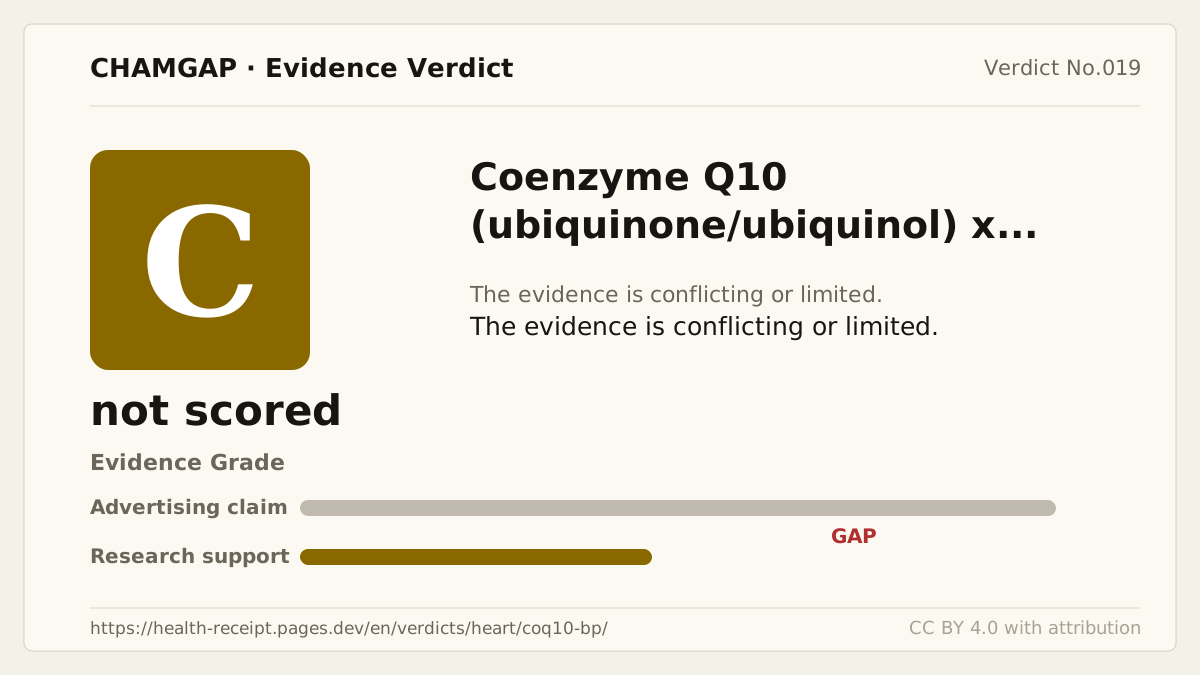
[Chamgap] Coenzyme Q10 x antioxidant and blood pressure — Evidence Grade C·50. 7 cited sources checked. Source: https://chamgap.com/en/verdicts/heart/coq10-bp/ · CC BY 4.0CC BY 4.0 — free to use with attribution; do not distort grades, numbers, or verdict meaning.
What this document does and does not do
Chamgap is an information source. It reports what research has and has not confirmed; it does not tell readers what to take or buy. That decision belongs to readers and, when needed, medical or legal professionals. This verdict reflects literature available up to the search date and may change as new research appears. Nothing here is medical advice.