
Bilberry extract,
does it really help with eye fatigue, eye health, vision/night vision, and dry-eye-related claims?
research showsBilberry extract has small positive RCTs for eye fatigue after digital-device use and surrogate accommodation-function markers. However, primary endpoints in positive studies mainly center on surrogate markers such as CFF, HFC, and pupillary response, and many studies are manufacturer-funded. Actual improvement in visual acuity or night vision is not supported by systematic reviews and RCTs.
ads claimIn the Korean market, bilberry/anthocyanins are often promoted as 'eye health,' 'improving eye fatigue,' 'dim eyes,' 'vision protection,' 'night-blindness improvement,' 'retinal vascular and nerve protection,' 'dry-eye relief,' and as complex eye supplements with lutein, zeaxanthin, and astaxanthin. Informational articles mention MFDS functional wording together with a 240 mg extract and anthocyanoside 72-108 mg standard, and shopping-mall product names use 'eye aging,' 'dim eyes,' 'eye fatigue,' 'stinging eyes,' and 'vision protection' together. Some articles/advertisements introduce a World War II pilot night-vision anecdote, but this claim does not match modern RCTs/systematic reviews.
Useful facts when choosing a product
- According to domestic informational articles, health-functional-food-style bilberry extract is often discussed at a daily bilberry extract 240 mg and anthocyanoside 72-108 mg standard.
- Market products are more often combinations with lutein, zeaxanthin, astaxanthin, vitamin A/E, omega-3, or pycnogenol than bilberry alone. Combination-product results are difficult to interpret as bilberry-alone effects.
- Product names mix extract mg, raw-material equivalent, and anthocyanin content. Even if the raw-material equivalent looks large, it is not the same as standardized anthocyanin content.
- MFDS recognition status is regulatory information only, and this judgment's evidence grade was determined separately based on independence, endpoints, and reproducibility of human RCTs.
What the research actually shows
Human studies differ by effect. For eye fatigue/VDT fatigue, Japanese RCTs using 480 mg/day for 8 weeks or 240 mg/day for 12 weeks improved some objective indicators and symptoms, but the indicators are surrogate endpoints and independent replication is weak. A 2021 RCT of 32 participants also found significant change in the primary pupillary-response endpoint, but the sample was small and industry-funded. In contrast, for night vision, a 2004 systematic review found that 4 recent rigorous RCTs were all negative, and a 2000 Navy/young male crossover RCT also found no effect on night vision or night contrast sensitivity. For dry eye, there is a 22-participant Mirtoselect RCT and a bilberry+fish-oil pilot, but samples are small and combination/no-placebo studies are mixed, limiting single-ingredient conclusions.
Why this is classified as C (46)
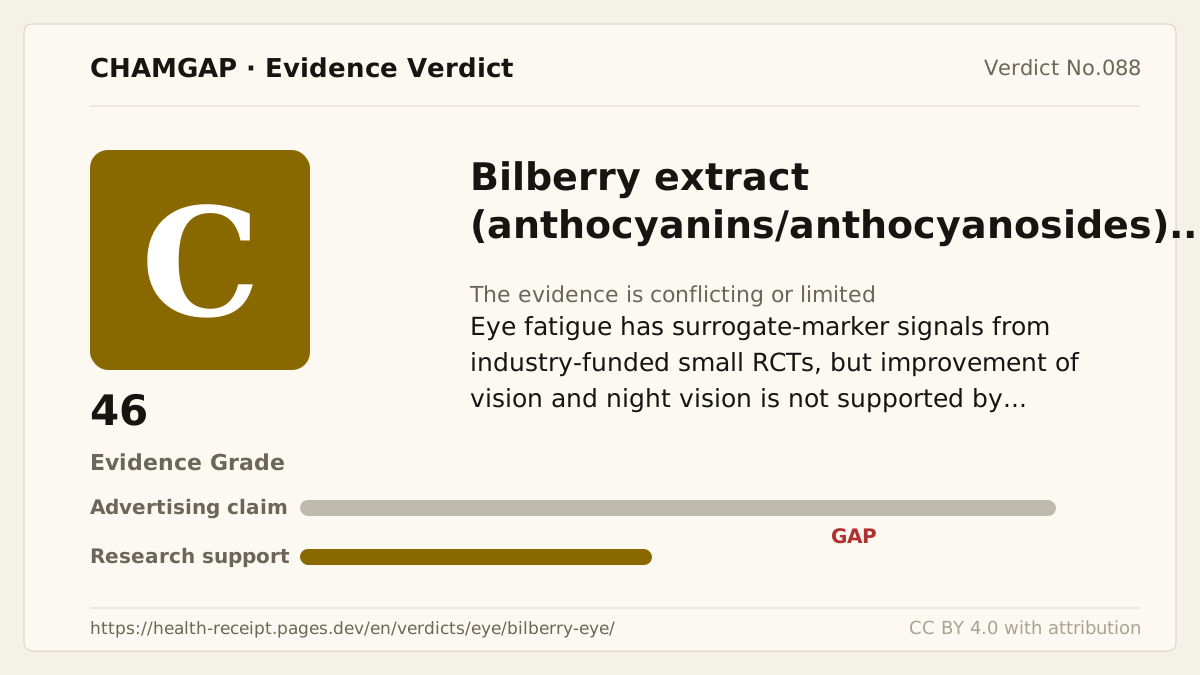
Boundary rule 1 was applied. The core primary endpoints of positive eye-fatigue RCTs are mainly surrogate markers of accommodation/fatigue such as CFF, HFC-1, and pupillary response, so the maximum is C. Boundary rule 2b also applies. A substantial portion of positive single-ingredient RCTs were funded by raw-material/product companies or involved company researchers, and there is no large independent RCT or consistent meta-analysis. Vision/night-vision claims are in fact negative in systematic reviews and RCTs. Therefore the overall 'eye and vision' advertising claim receives C, 46 points.
Counterpoint. If limited to the narrow effect of eye fatigue, there are several double-blind human RCTs, and some indicators and symptoms are consistently positive. However, claims extending to clinically perceptible vision improvement, night-vision improvement, and prevention/treatment of macular degeneration, glaucoma, or cataract lack separate evidence or have more direct negative evidence.
Rejudgment record. Draft and blinded review converged — Eye fatigue has surrogate-marker signals from industry-funded small RCTs, but improvement of vision and night vision is not supported by more direct RCTs/systematic reviews.
Cross-check — Codex and Claude
Evidence Table
| Study | Design | Sample | Funding | Endpoint | Result | Weight |
|---|---|---|---|---|---|---|
| Ozawa Y et al. 2015 | RCT | 80 | possible manufacturer/industry involvement | not specified | 88 enrolled and 80 completed RCT; bilberry 480 mg/day for 8 weeks improved post-VDT CFF decline and some subjective symptoms, but NPA was negative. | core |
| Kosehira M, Machida N, Kitaichi N 2020 | RCT | 2 | possible manufacturer/industry involvement | not specified | RCT in 109 participants; after standardized bilberry 240 mg/day for 12 weeks, HFC-1 after VDT load improved at 8 weeks p=0.014 and 12 weeks p=0.017. | core |
| Sekikawa T et al. 2021 | double-blind RCT | 32 | not reported | ALT | Randomized double-blind placebo-controlled study in 32 participants; after 6 weeks, change in the primary pupillary-response endpoint was significant in subgroup analysis. | core |
| Canter PH, Ernst E 2004 | systematic review/RCT | 12 | not reported | liver/vision | Review of 12 placebo-controlled studies among 30 studies; all 4 recent RCTs were negative, not supporting the hypothesis that bilberry improves night vision in normal people. | core |
| Muth ER, Laurent JM, Jasper P 2000 | double-blind RCT | 15 | not reported | liver/vision/gastrointestinal | Double-blind placebo-controlled crossover trial in 15 young men; after 160 mg three times daily for 21 days, there was no difference in night vision or night contrast sensitivity. | supportive |
| Riva A et al. 2017 | double-blind RCT | 21 | possible manufacturer/industry involvement | not specified | Among 22 people with dry-eye symptoms, 21 completed; the Mirtoselect group improved Schirmer test p=0.019 and BAP p=0.003. | supportive |
| Frontiers in Nutrition 2023 | not specified | 24 | not reported | not specified | Pilot in 24 participants using a combination of bilberry 600 mg plus fish-oil DHA 240 mg; OSDI/NITBUT/PRT improvements were reported, but it was a no-placebo combination product. | supportive |
| Drugs | not specified | not reported | glycemia/pregnancy | Summary of eye-related clinical evidence and safety; food-level intake is GRAS, but information on high-dose supplements, pregnancy/lactation, and interactions is limited. | supportive | |
| Study 9 | not specified | not reported | gastrointestinal | A Korean informational article introduced bilberry extract for eye health, anthocyanins, the 240 mg/72-108 mg standard, and the pilot anecdote. | supportive | |
| Study 10 | not specified | not reported | dry eye/glycemia/gastrointestinal | Broad efficacy descriptions were confirmed for eye vascular disorders, night blindness, eye fatigue, dry eye, blood glucose, and vascular health. | supportive |
Receipt — 10 References
Of 10 cited sources, 1 had limited original-page access (blocked or summary-only) and were verified via index/summary, marked partial; the rest were verified at the original page. As of 2026-07-07.
Reviewed and approved: Chamgap Editorial Team · Approval date: 2026-07-07 · Corrections: none
Cite this verdict
[Chamgap] Bilberry extract (anthocyanins/anthocyanosides) × eye fatigue, eye health, vision/night vision, and dry-eye-related claims — Evidence Grade C·46. 10 cited sources checked. Source: https://chamgap.com/en/verdicts/eye/bilberry-eye/ · CC BY 4.0CC BY 4.0 — free to use with attribution; do not distort grades, numbers, or verdict meaning.
What this document does and does not do
Chamgap is an information source. It reports what research has and has not confirmed; it does not tell readers what to take or buy. That decision belongs to readers and, when needed, medical or legal professionals. This verdict reflects literature available up to the search date and may change as new research appears. Nothing here is medical advice.