
Astaxanthin,
does it really help with eye fatigue, skin health, and antioxidant effects?
research showsAstaxanthin has positive human-study signals for eye fatigue and accommodation, skin hydration and elasticity, and oxidative-stress markers. However, the eye evidence mixes small RCTs and combination-product studies and is centered on manufacturer-funded studies, while antioxidant evidence is mainly blood and ocular biomarkers rather than clinical outcomes. Claims seen in advertising, such as vision protection, prevention of eye disease, inhibition of skin aging, and systemic antioxidant effects, are often broader than the current clinical evidence.
ads claimKorean advertising and informational articles introduce astaxanthin with phrases such as 'improvement of eye fatigue,' 'improvement of eye accommodation,' 'increased retinal capillary blood flow,' 'vision protection and recovery from eye fatigue,' 'reduction of UV and blue-light damage,' 'antioxidant power 6000 times stronger than vitamin C,' 'improvement of skin hydration and elasticity and inhibition of aging,' and 'reduced MDA.' Products are commonly complex eye supplements with lutein, zeaxanthin, omega-3, and bilberry, and article-style ads often present MFDS functional-recognition wording for Haematococcus extract together with figures from individual studies.
Useful facts when choosing a product
- In Korean product names and advertising, the ingredient is usually displayed as 'Haematococcus extract' rather than 'astaxanthin.'
- Eye products are often combinations containing lutein, zeaxanthin, omega-3, bilberry, and vitamins A/C/E rather than astaxanthin alone, making it difficult to interpret product effects as astaxanthin-alone effects.
- Frequently advertised retinal blood flow, pupillary response, accommodation, MED, and MDA are surrogate or intermediate markers rather than final clinical outcomes such as disease occurrence, vision preservation, or prevention of aging.
- MFDS recognition status is a regulatory fact related to permitted functional labeling, and the evidence grade was judged separately.
What the research actually shows
Eyes: a single-ingredient astaxanthin RCT in 60 healthy VDT users in 2023 found that after 9 mg/day for 6 weeks, the decline in corrected visual acuity of the dominant eye after VDT work was less than placebo only in the subgroup aged 40 or older; the overall group, younger subgroup, functional visual acuity, and pupillary constriction rate were not consistently significant. A 2021 RCT of a bilberry anthocyanin+astaxanthin+lutein combination product was positive for pupillary response and some subjective symptoms, but the effect of astaxanthin alone cannot be separated. The 2025 AstaReal pediatric digital eye-fatigue RCT had a positive CVS-Q primary endpoint, but it is a product-name study and is at the stage before independent replication. Dry-eye research is at about the level of one small short-term RCT. Skin: a 2021 systematic review/meta-analysis pooled 8 RCTs and reported possible improvement in hydration and elasticity, but the trials were small, many were industry-funded, and wrinkle measures were less consistent. The 2018 Fujifilm RCT found significant change in MED and attenuation of hydration loss at irradiated sites after 4 mg/day for 9 weeks, but analysis n=22, raw post-MED itself was not significant, and all authors were affiliated with the sponsor. Antioxidant: RCT meta-analyses report mild improvements in oxidative-stress and inflammation biomarkers, but this is not evidence for preventing clinical events. No dedicated large independent RCT or Cochrane-grade conclusive evidence was found.
Why this is classified as C (55)
There are human RCTs and a skin meta-analysis, so this is not '?' or F. However, by core effect, eye studies are centered on small, short-term, manufacturer-funded RCTs and surrogate markers, and positive combination-product results cannot be separated as astaxanthin-alone effects. Skin evidence is relatively better but is still a set of small RCTs with prominent industry interests. Antioxidant evidence is biomarker-level rather than clinical health effects. Applying boundary rules 1 and 2b, the overall combined claim is judged at a maximum of C.
Counterpoint. Narrowly, there are real RCT signals for the possibility of 'relief of digital eye-fatigue markers in some people,' 'improvement of skin hydration and elasticity markers,' and 'improvement of oxidative-stress biomarkers.' The skin area has a meta-analysis combining several RCTs, so the literature is not completely lacking, and major safety signals have not stood out in the short-term 4-12 mg/day range.
Rejudgment record. Draft and blinded review converged — Human RCTs and a skin meta-analysis exist, but most are small, short-term, industry-funded, and surrogate-marker centered, so C is the limit for advertising claims about vision protection, anti-aging, and systemic antioxidant effects.
Cross-check — Codex and Claude
Evidence Table
| Study | Design | Sample | Funding | Endpoint | Result | Weight |
|---|---|---|---|---|---|---|
| Sekikawa T, Kizawa Y, Li Y, Miura N 2023 | double-blind RCT | 3 | possible manufacturer/industry involvement | vision | Single-ingredient astaxanthin 9 mg/day for 6 weeks in 60 healthy VDT users; only the dominant-eye corrected-visual-acuity protection effect after VDT was significant versus placebo in the subgroup aged 40 or older, while functional visual acuity and pupillary constriction rate were not significant. | core |
| Kizawa Y, Sekikawa T, Kageyama M, Tomobe H, Kobashi R, Yamada T 2021 | double-blind RCT | 20 | possible manufacturer/industry involvement | not specified | Combination of bilberry anthocyanin 72 mg + astaxanthin 6 mg + lutein 10 mg/day for 6 weeks in an RCT, PPS 20 participants per group; primary pupillary response and some subjective focus symptoms were positive, but the effect of astaxanthin alone cannot be separated. | core |
| Hecht KA, Marwah M, Wood V et al. 2025 | double-blind RCT | 64 | possible manufacturer/industry involvement | liver/AST | In 64 children aged 10-14, AstaReal 4 mg/day for 84 days produced a larger primary CVS-Q change, astaxanthin -4.00 vs placebo -1.72, and lower VFLS, but some objective markers such as Schirmer I did not differ between groups. | core |
| Nagaki Y, Mihara M, Takahashi J et al. 2005 | not specified | not reported | not specified | A Japanese paper reporting increased retinal capillary blood flow after astaxanthin intake in normal volunteers; it is repeatedly cited in domestic advertising as evidence for 'increased retinal blood flow.' | core | |
| Benefits and Safety of Astaxanthin in the Treatment of Mild-To-Moderate Dry Eye Disease in Middle-Aged and Elderly Patie | not specified | 60 | not reported | dry eye/gastrointestinal | Short-term RCT in 60 middle-aged and older patients with mild-to-moderate dry eye; after 12 mg/day for 30 days, improvements in symptoms and signs including OSDI were reported. | supportive |
| Zhou X, Cao Q, Orfila C et al. 2021 | meta-analysis | possible manufacturer/industry involvement | hydration/elasticity/wrinkles/skin | Reviewed 11 human publications related to skin aging and meta-analyzed 8 RCTs; hydration and elasticity showed improvement signals, while wrinkle depth was less consistent. | supportive | |
| Ito N, Seki S, Ueda F 2018 | double-blind RCT | 22 | possible manufacturer/industry involvement | hydration | Healthy Japanese participants: 23 enrolled and 22 analyzed; after 4 mg/day for 9 weeks, primary MED change and attenuation of hydration loss at UV-irradiated sites were significant, but post-MED raw value and TEWL were not significant. | supportive |
| Astaxanthin supplementation mildly reduced oxidative stress and inflammation biomarkers: a systematic review and meta-an | meta-analysis of RCTs | not reported | stress/antioxidant | An astaxanthin RCT meta-analysis reported mild improvements in oxidative-stress and inflammation biomarkers, but did not prove prevention of clinical events. | supportive |
Receipt — 8 References
Of 8 cited sources, 2 had limited original-page access (blocked or summary-only) and were verified via index/summary, marked partial; the rest were verified at the original page. As of 2026-07-07.
Reviewed and approved: Chamgap Editorial Team · Approval date: 2026-07-07 · Corrections: none
Cite this verdict
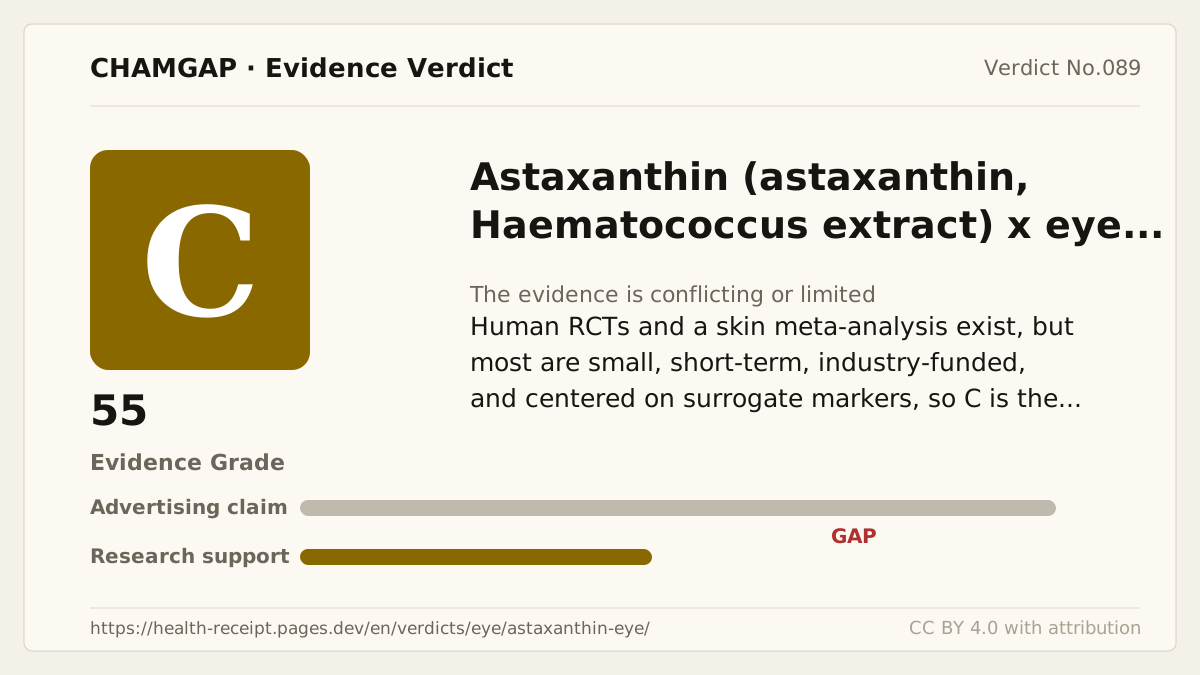
[Chamgap] Astaxanthin (astaxanthin, Haematococcus extract) × eye fatigue, skin health, and antioxidant effects — Evidence Grade C·55. 8 cited sources checked. Source: https://chamgap.com/en/verdicts/eye/astaxanthin-eye/ · CC BY 4.0CC BY 4.0 — free to use with attribution; do not distort grades, numbers, or verdict meaning.
What this document does and does not do
Chamgap is an information source. It reports what research has and has not confirmed; it does not tell readers what to take or buy. That decision belongs to readers and, when needed, medical or legal professionals. This verdict reflects literature available up to the search date and may change as new research appears. Nothing here is medical advice.