
Lutein and zeaxanthin,
does it really help with macular health and eye health?
research showsHere are the facts worth knowing before deciding whether to keep taking lutein and zeaxanthin. This ingredient is a health functional food ingredient for which the MFDS actually recognizes the functionality 'may help eye health by maintaining macular pigment optical density (MPOD), which can decrease with aging' (unlike collagen or glutathione cases, it is within a regulator-recognized scope). The type of evidence is fairly solid in that a large human randomized controlled trial (AREDS2, 4203 participants) and multiple meta-analyses exist. However, in that large trial, the prespecified primary main analysis did not show a statistically significant effect of lutein and zeaxanthin alone in suppressing progression to advanced macular degeneration (HR 0.90, P=.12), significance came from secondary, long-term, and subgroup analyses, and the effect size was modest (relative risk reduction about 9-10%). Also, this clinical result concerns the setting of 'slowing progression in patients' already at risk for macular degeneration, and studies in healthy general adults generally showed only increases in the surrogate marker MPOD, while the authors wrote that whether this leads to patient-noticeable functional improvement such as vision is 'unclear.' Also keep in mind when deciding that low-dose products (under 5mg/day) did not detect MPOD change.
ads claimAdvertisements and detail pages commonly foreground 'macular health,' 'helps eye health,' and 'MFDS-recognized functionality.' There are three gaps with the evidence. First, the MFDS-recognized wording is 'maintenance of macular pigment optical density,' which is functionality for a surrogate marker and does not mean prevention of blindness or improvement of vision. Second, the primary main analysis of the largest clinical trial was not statistically significant, but advertisements tend to selectively cite subgroups, secondary analyses, or 10-year follow-up where significance appeared. Third, the broad phrase 'eye health' gives the impression of extending high-risk AMD patient data to healthy general adults, but evidence in general adults is only the surrogate marker MPOD.
Useful facts when choosing a product
- The target population with the thickest clinical evidence is high-risk patients who already have AMD, while evidence in healthy general adults is limited to the surrogate marker macular pigment optical density (MPOD).
- The MFDS-recognized functionality wording is 'maintenance of macular pigment optical density.' Check in the detail page that this is not recognition of vision improvement or blindness prevention but an expression about a surrogate marker.
- Including AREDS2 follow-up studies, there is a meaningful share of research involving industry funding from ingredient and product manufacturers such as DSM. Checking funding sources helps interpret the results.
- The labeled contents of lutein and zeaxanthin in mg, the mixing ratio, and whether they match clinical doses, typically lutein 10mg and zeaxanthin 2mg, can be compared on the detail page.
What the research actually shows
The primary endpoint was 'progression to advanced AMD,' and in the prespecified main analysis of AREDS2, lutein and zeaxanthin alone did not significantly reduce it (HR 0.90, P=.12). Statistical significance was confirmed only in (1) secondary analyses, (2) a post hoc analysis separating out the lowest dietary-intake subgroup (HR 0.74), and (3) 10-year observational epidemiologic follow-up after trial end. These analyses do not fully receive the protection of randomization. Best-corrected visual acuity (BCVA), the final outcome actually felt by patients, was not significant. Evidence in healthy eyes remains at the surrogate marker (intermediate marker) MPOD, not clinical outcomes such as blindness or vision. In other words, the structure is 'primary endpoint not significant plus dependence on surrogate markers and subgroups.'
Why this is classified as C (50)
Why it is C: well-designed large human RCT evidence (AREDS2, 4203 participants) and multiple meta-analyses exist, so the evidence 'type' is fairly strong. However, the prespecified primary main analysis of the key trial was negative (HR 0.90, P=.12), significance appeared only in secondary, long-term, and subgroup analyses, and the effect size was also modest (HR 0.90~0.91, upper CI 0.99). The clinical-outcome signal is in 'slowing progression in patients,' and evidence in healthy eyes remains at the surrogate marker macular pigment optical density (MPOD), not clinical outcomes such as vision or blindness. General-population/function-context studies have a high share of industry funding (Hammond=DSM, Wilson=ILSI/IAFNS, pediatric=OmniActive, AREDS2 formulations supplied by manufacturers). When the primary clinical endpoint is negative and general-population evidence is limited to surrogate markers, the grade is capped at C (boundary rule ①). Why not B: B requires a consistent signal reproduced in clinical endpoints, but negative primary analysis, modest effect, and surrogate-marker dependence do not satisfy this. Why not D: because human signals with consistent direction and reproduction in specific subgroups/surrogate markers exist, this is distinct from 'animal/cell only' or 'no evidence.' Regulatory note: MFDS recognized functionality, but the recognized scope is 'maintenance of macular pigment optical density' (surrogate marker), so it does not automatically guarantee clinical efficacy for 'overall eye health,' and regulatory recognition itself is judged separately from the scientific evidence grade (boundary rule ④).
Counterpoint. A higher-grade view, B, argues that the signal is sufficiently robust based on MFDS functionality recognition, consistent direction in the 10-year follow-up, and a clear HR 0.74 among people with low dietary intake. Our answer: those signals all came from outside the prespecified primary main analysis, subgroup analyses lose the balance protection of randomization and carry a high false-positive risk, and it has not been established that improvement in the surrogate marker MPOD leads to final outcomes such as vision or blindness, so we do not raise it further. A lower-grade view, D, says the evidence is absent because the primary endpoint failed. Our answer: direction is consistent, safety is good, and signals are reproducible in specific subgroups and surrogate markers, so it is distinct from 'no evidence'; recording this signal as an unconfirmed possibility is accurate, so it is kept at C.
| Endpoint | S | Surrogate marker - laboratory or imaging measures |
| Replication | R1 | Single confirmatory trial |
| Independence | I1 | Mixed funding sources |
| Effect size | E+ | Meets the clinically important threshold |
The scoring table and the verdict agree (C).
Cross-check — Codex and Claude
Evidence Table
| Study | Design | Sample | Funding | Endpoint | Result | Weight |
|---|---|---|---|---|---|---|
| Study 1 | randomized controlled trial | 4203 | possible manufacturer or industry involvement | Target=patients aged 50-85 at high risk for advanced AMD, 4203 participants / dose=lutein 10mg + zeaxanthin 2mg, median about 5 years / result=the primary main analysis did not show that L/Z alone significantly lowered progression to advanced AMD (HR 0.90, P=.12) / funding=NIH and NEI government funding (formulations and components externally supplied). | key | |
| Study 2 | possible manufacturer or industry involvement | Target=AMD-risk patients aged 50-85 / dose=lutein 10mg + zeaxanthin 2mg/day / result=secondary analysis L/Z vs placebo advanced AMD HR 0.90 (95%CI 0.82-0.99, P=.04), vs beta-carotene HR 0.82 (P=.02); lowest dietary-intake quintile HR 0.74 (0.59-0.94) in post hoc subgroup analysis / funding=NIH government funding. | key | |||
| Chew EY, Clemons TE, Agrón E, Domalpally A, Keenan TDL, Vitale S, Weber C, Smith DC, Christen W (AREDS2 Research Group) 2022 | possible manufacturer or industry involvement | liver | Target=moderate AMD patients with mean age 72 years (57.7% women) / total 10-year follow-up / result=progression to advanced AMD with L/Z vs no L/Z HR 0.91 (95%CI 0.84-0.99, P=.02), modest but significant / funding=NIH government funding (follow-up supplements provided by manufacturer Bausch and Lomb). | key | ||
| Feng L, Nie K, Jiang H, Fan W 2019 | randomized controlled trial | 5 | possible manufacturer or industry involvement | vision / antioxidant markers | Target=AMD patients (9 RCTs, 920 eyes) / dose=lutein 10-20mg/day (5 studies combined other antioxidants) / result=MPOD MD 0.07 (0.03-0.10), visual acuity after more than 1 year MD 0.28 (0.06-0.50), contrast sensitivity MD 0.26 (0.22-0.30) / funding=National Natural Science Foundation of China (government funding). | key |
| Ma L, Liu R, Du JH, Liu T, Wu SS, Liu XH 2016 | 07, | possible manufacturer or industry involvement | vision | Target=AMD patient subgroup (938) plus healthy subgroup (826) analyzed separately / dose=0-20mg/day for 8 weeks to 2 years / result=MPOD significantly increased (patients WMD 0.07, healthy 0.09 ODU), dose-response existed and those with lower baseline improved more / funding=Chinese NSFC and other government/local funds. | supporting | |
| Wilson LM, Tharmarajah S, Jia Y, Semba RD, Schaumberg DA, Robinson KA 2021 | meta-analysis | 3189, | possible manufacturer or industry involvement | Target=adults with healthy eyes (excluding AMD patients, 46 studies, N=3189, mean age 43) / dose groups=<5mg, 5 to <20mg, >=20mg/day for 3-12 months / result=clear dose-response (<5mg ineffective MD 0.02 [-0.01~0.05], 5 to <20mg +0.04, >=20mg +0.11) / funding=industry pooled fund (ILSI North America/IAFNS). | supporting | |
| Hammond BR, Fletcher LM, Roos F, Wittwer J, Schalch W 2014 | double-blind trial | possible manufacturer or industry involvement | gastrointestinal / stress / recovery | Target=young healthy adults without disease, mean about 23 years, prevention/function context / dose=lutein 10mg + zeaxanthin 2mg/day for 1 year / result=MPOD significantly increased and color contrast plus photostress recovery improved significantly; glare disability did not reach significance / funding=manufacturer conflicts of interest present. | supporting | |
| Parekh R, Hammond BR Jr, Chandradhara D 2024 | double-blind randomized controlled trial | possible manufacturer or industry involvement | ALT / gastrointestinal / cognition | Target=healthy children aged 5-12 without disease, digital-device eye-fatigue/performance context / dose=lutein 10mg + zeaxanthin 2mg gummy once daily for 180 days / result=primary MPOD rose, secondary cognitive performance and ocular-fatigue VAS improved / funding=manufacturer OmniActive Health Technologies, developer of test product Lutemax Kids. | supporting |
Receipt — 8 References
Of 8 cited sources, 1 had limited original-page access (blocked or summary-only) and were verified via index/summary, marked partial; the rest were verified at the original page. As of 2026-07-06.
Reviewed and approved: Chamgap Editorial Team · Approval date: 2026-07-06 · Corrections: 1
Correction log — 1
Corrections applied to this verdict, in chronological order. Changes are logged, not erased.
- 2026-07-11 · Rationale alignment — The rationale argued a higher grade (B), stating that downgrading a large RCT to C would violate the evidence hierarchy, but the final grade was C. Because the primary clinical endpoint was negative and the general-population evidence rests on a surrogate (MPOD), the C cap is correct, so the rationale was rewritten around C. Grade, score, and citations are unchanged. Found in the 2026-07-11 internal audit (Codex/Claude cross-check). (grade C unchanged)
Cite this verdict
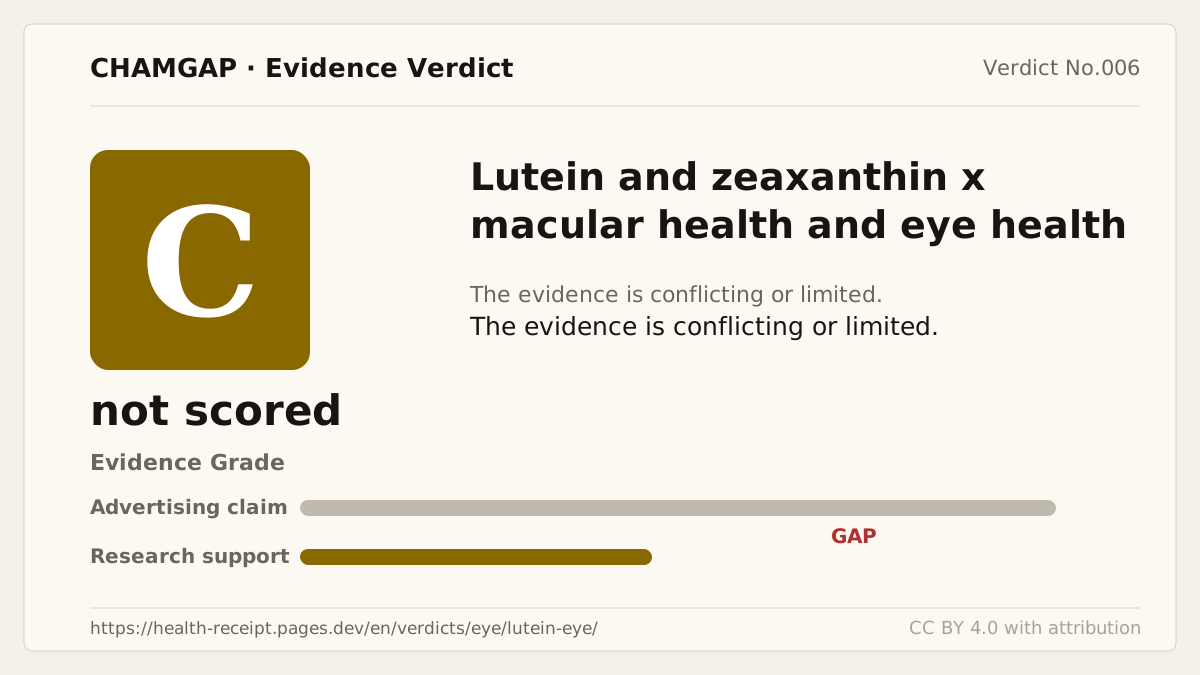
[Chamgap] Lutein and zeaxanthin x eye health (macula) — Evidence Grade C·50. 8 cited sources checked. Source: https://chamgap.com/en/verdicts/eye/lutein-eye/ · CC BY 4.0CC BY 4.0 — free to use with attribution; do not distort grades, numbers, or verdict meaning.
What this document does and does not do
Chamgap is an information source. It reports what research has and has not confirmed; it does not tell readers what to take or buy. That decision belongs to readers and, when needed, medical or legal professionals. This verdict reflects literature available up to the search date and may change as new research appears. Nothing here is medical advice.