
Vitamin B12,
does it really help with Fatigue and anemia?
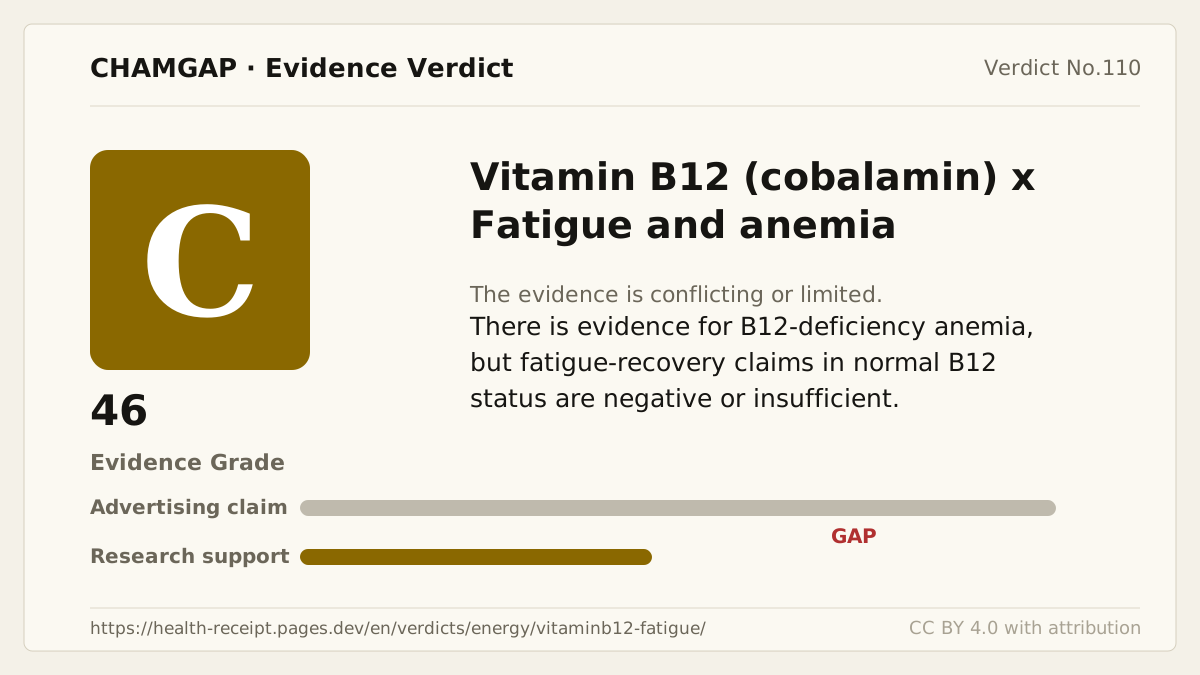
research showsThere is evidence for supplementation/treatment of megaloblastic anemia in people with confirmed vitamin B12 deficiency. However, evidence that B12 reduces fatigue when B12 status is normal is weak, and an RCT in fatigued IBS/IBD patients was negative. The key issue is therefore not fatigue itself, but whether B12 deficiency or deficiency anemia is present.
ads claimIn the Korean market, B12 or vitamin B-complex products are exposed with phrases such as 'fatigue recovery,' 'energy metabolism,' 'vitality,' 'blood formation,' 'red blood cell formation,' 'anemia prevention,' and 'needed for vegans/vegetarians.' Informational articles and hospital materials generally explain that if B12 is deficient, anemia, fatigue, lethargy, and neurologic symptoms can occur. Advertising content blurs this deficiency condition, and many expressions read as if fatigue will improve even with normal B12 status.
Useful facts when choosing a product
- Common product forms are standalone B12 (usually cyanocobalamin or methylcobalamin, 500-1000 mcg or higher) or B-complex combinations. Combination-product studies must be separated from B12-alone effects.
- The adult Daily Value (DV) is 2.4 mcg, and absorption decreases at high supplement doses. NIH ODS gives an example absorption rate of about 1.3% when 1000 mcg is administered.
- Atrophic gastritis, pernicious anemia, gastrointestinal surgery, ileal disease/resection, long-term metformin or PPI use, and strict vegan diets are deficiency risk factors.
- The toxicity potential of B12 itself is low and no tolerable upper intake level (UL) has been set. However, symptoms such as fatigue, anemia, and numbness may also have other causes such as iron deficiency, folate deficiency, chronic disease, or bleeding, so they must be separated from simple fatigue-recovery product claims.
What the research actually shows
Studies in deficient patients mainly compare high-dose oral B12 with intramuscular B12 injections. The 2018 Cochrane review included 3 RCTs and 153 people and found that serum B12 normalization was generally similar with oral and injection routes, but evidence quality was low and clinical symptoms such as fatigue were not reported. In Bolaman 2003's RCT of megaloblastic anemia, Hb recovered from about 8.4 g/dL to around 13.8 g/dL and MCV also normalized in both groups. However, this was a route-of-administration comparison, not a no-treatment control, and reporting of primary clinical symptoms was weak. The independent multicenter OB12 RCT in 2020 (n=283) found that oral therapy was noninferior to injection for serum B12 normalization at 8 weeks, but 52-week results were less clear, and quality of life and deficiency-related signs did not differ between administration routes. Evidence is much weaker for fatigue without clear deficiency. In 95 IBS/IBD fatigue patients with normal B12, 1000 mcg/day for 8 weeks did not reduce subjective fatigue more than placebo. A 2021 systematic review/meta-analysis found no effect on cognition or depression in normal or subclinical B12 status, and idiopathic fatigue had only one analyzable study.
Why this is classified as C (46)
The deficiency-anemia axis can receive a B because human RCTs and consistent hematologic recovery data exist. However, most evidence compares oral versus injection routes, the primary/main Cochrane evidence is tilted toward surrogate markers such as serum B12 normalization, and clinical symptoms such as fatigue are rarely reported. Claims of fatigue recovery in normal B12 status are negative in independent RCTs or lack literature. Therefore this is not A; deficiency-anemia evidence is recognized, but the effect of correcting deficiency cannot be repurposed as a general fatigue claim in normal B12 status (the same structure as iron 050), so it was judged overall C.
Counterpoint. The same grade cannot be applied to expectations of 'fatigue recovery' in people without B12 deficiency. Conversely, in deficiency-related megaloblastic anemia, B12 is the causal nutrient, so the evidence and clinical plausibility are much stronger than for a general fatigue supplement.
Rejudgment record. Reassessment (downgraded B->C) — There is evidence for correcting B12-deficiency anemia, but fatigue improvement in normal B12 status is negative/insufficient -> deficiency correction cannot be repurposed as a general-population effect (same as iron 050). Consistent with blinded C
Cross-check — Codex and Claude
Evidence Table
| Study | Design | Sample | Funding | Endpoint | Result | Weight |
|---|---|---|---|---|---|---|
| Wang H, Li L, Qin LL, Song Y, Vidal-Alaball J, Liu TH 2018 | RCT | 153 | Possible manufacturer/industry involvement | Review of 3 B12-deficiency RCTs (153 people): high-dose oral and injectable routes can both normalize serum B12, but evidence quality was low and clinical symptoms such as fatigue were not reported. | Core | |
| Bolaman Z, Kadikoylu G, Yukselen V, Yavasoglu I, Barutca S, Senturk T 2003 | RCT | Possible manufacturer/industry involvement | anemia | In patients with B12-deficiency megaloblastic anemia, both oral and injection groups showed large improvements toward normalization of Hb and MCV within 90 days. | Core | |
| Kuzminski AM, Del Giacco EJ, Allen RH, Stabler SP, Lindenbaum J 1998 | Possible manufacturer/industry involvement | recovery | In newly diagnosed B12 deficiency, oral 2000 mcg/day raised serum B12 more than injection therapy, while hematologic markers recovered similarly. | Core | ||
| Sanz-Cuesta T, Escortell-Mayor E, Cura-Gonzalez I et al. 2020 | RCT | 283 | Mixed; some industry-related involvement | serum B12/anemia | Independent multicenter RCT in 283 people aged 65 or older with B12 deficiency: oral therapy was noninferior to injection for serum normalization at 8 weeks, but maintenance of the effect at 52 weeks was less clear. | Core |
| Scholten AM, Vermeulen E, Dhonukshe-Rutten RAM et al. 2018 | Double-blind RCT | 95 | Possible manufacturer/industry involvement | In 95 IBS/IBD fatigue patients with normal blood B12 concentrations, B12 1000 mcg/day for 8 weeks did not improve subjective fatigue more than placebo. | Supporting | |
| Markun S, Gravestock I, Jager L, Rosemann T, Pichierri G, Burgstaller JM 2021 | Meta-analysis of RCTs | 6276 | Mixed; some industry-related involvement | depression/cognition | Review of 16 RCTs (6276 people) in normal/subclinical B12 status: no cognitive or depression effect, and idiopathic fatigue had only 1 study, so meta-analysis was impossible. | Supporting |
| NIH Office of Dietary Supplements | exercise performance/anemia | B12 deficiency can cause fatigue and megaloblastic anemia; there is no evidence for improved exercise performance/energy in normal B12 status, and no UL has been set. | Supporting |
Receipt — 7 References
Of 7 cited sources, 4 had limited original-page access (blocked or summary-only) and were verified via index/summary, marked partial; the rest were verified at the original page. As of 2026-07-07.
Reviewed and approved: Chamgap Editorial Team · Approval date: 2026-07-07 · Corrections: 1
Correction log — 1
Corrections applied to this verdict, in chronological order. Changes are logged, not erased.
- 2026-07-11 · Rationale alignment — The closing of the rationale still read 'judged at the lower B/C range', conflicting with the final grade C (including the English and synth copies). Because deficiency correction cannot be repurposed as a general fatigue claim in normal B12 status, C is correct, so the wording was aligned to C. Grade, score, and citations are unchanged. Found in the 2026-07-11 internal audit (Codex/Claude cross-check). (grade C unchanged)
Cite this verdict
[Chamgap] Vitamin B12 (cobalamin) x fatigue and anemia — Evidence Grade C·46. 7 cited sources checked. Source: https://chamgap.com/en/verdicts/energy/vitaminb12-fatigue/ · CC BY 4.0CC BY 4.0 — free to use with attribution; do not distort grades, numbers, or verdict meaning.
What this document does and does not do
Chamgap is an information source. It reports what research has and has not confirmed; it does not tell readers what to take or buy. That decision belongs to readers and, when needed, medical or legal professionals. This verdict reflects literature available up to the search date and may change as new research appears. Nothing here is medical advice.