
Taurine,
does it really help with Fatigue and vitality?
research showsIt is difficult to conclude that taurine clearly reduces everyday fatigue. Exercise-performance studies include small RCT and meta-analytic signals that time to exhaustion may increase slightly in hot environments or during fixed-intensity exercise, but samples are small and the outcomes are centered on exercise-performance measures. A relatively large cirrhosis RCT that used fatigue symptoms as the primary endpoint was negative in the overall population.
ads claimIn the Korean market, taurine is commonly linked with phrases such as "main ingredient of Bacchus," "fatigue relief," "energy booster," "vitality," and "a tired day." Informational articles also describe taurine as promoting energy production and increasing vitality, or broadly group it with endurance improvement, fatigue recovery, antioxidant effects, liver and heart health, and anti-aging. Sales pages and advertorials often involve beverages or combinations with spirulina, arginine, vitamins, caffeine, and other ingredients rather than taurine alone, so attribution of advertising effects is unclear.
Useful facts when choosing a product
- Korean informational articles connect taurine around 1000 mg with fatigue and vitality imagery in the context of Bacchus and energy drinks.
- Online product search results display perceived-fatigue phrases such as "a tired day" and "fatigue." Some product pages were dynamic, limiting access to the main text.
- Taurine is an aminosulfonic acid present in foods such as seafood and meat. The effect of taurine alone in supplements or beverages must be separated from combination effects with caffeine, sugar, and vitamins.
- Short-term RCTs and reviews generally found few serious adverse-event signals in the 1-6 g/day range. However, energy-drink products may also contain caffeine and sugars, so their safety should not be treated as identical to taurine alone.
What the research actually shows
Single-ingredient taurine studies fall into three broad groups. First, exercise performance: a 2018 Sports Medicine meta-analysis of 10 studies and 116 participants reported small effects for overall endurance performance, Hedges' g 0.40, and TTE g 0.43. However, a 2023 Strength & Conditioning Journal meta-analysis found that fatigue/endurance-related outcomes such as TTE across 3 studies and 43 participants (MD 0.43 min, 95% CI -0.31 to 1.16), RPE, and VO2max were not significant. A 2021 JISSN review also summarized the evidence as limited and diverse. Second, direct fatigue symptoms: a 2026 randomized open-label RCT in decompensated cirrhosis fatigue (n=220) found that L-taurine 1000 mg/day for 12 weeks did not differ significantly from standard care on the primary endpoint of Fatigue Assessment Scale change. Third, eye fatigue/VDT studies: a 25-person RCT showed some improvement in surrogate markers such as PVEP P100 amplitude, but this is difficult to regard as independent replication of subjective fatigue improvement. Caffeine/energy-drink combination studies are difficult to separate as taurine-alone evidence because effects are mixed with caffeine, sugar, and vitamins.
Why this is classified as C (48)
This is rated C. Human RCTs and meta-analyses exist, but the core effects are centered on exercise performance, time to exhaustion, RPE, blood lactate, and surrogate/performance markers such as PVEP/CFF rather than improvement in fatigue symptoms. A relatively large RCT using direct fatigue as the primary endpoint was negative in the overall analysis, while positive exercise studies are small and condition-specific. Under boundary rule 1, evidence centered on surrogate and performance indicators is capped at C; the exercise-vitality signal means it is not F.
Counterpoint. For athletes or people doing fixed-intensity exercise in hot environments, RCTs suggest that taurine alone may modestly help TTE or maintenance of repeated sprint performance. Therefore, if narrowed to "exercise endurance," it is not completely unsupported. However, this evidence is not direct enough to extend immediately to everyday fatigue or vitality recovery in the general population.
Rejudgment record. Convergent — Draft = blinded C. Direct RCT evidence for everyday fatigue is lacking and is mixed with energy-drink combination effects.
Cross-check — Codex and Claude
Evidence Table
| Study | Design | Sample | Funding | Endpoint | Result | Weight |
|---|---|---|---|---|---|---|
| Waldron M, Patterson SD, Tallent J, Jeffries O 2018 | Meta-analysis | 116 | Mixed/partly industry related | A meta-analysis of 10 studies and 116 participants reported small positive effects for overall endurance performance, Hedges' g 0.40, and TTE g 0.43. | Core | |
| Buzdagli Y, Eyipinar CD, Tekin A, Siktar E, Skonieczna-Zydecka K 2023 | Meta-analysis/RCT | Mixed/partly industry related | Although 16 RCTs were pooled, fatigue/endurance-related indicators such as TTE, VO2max, and RPE were not significant, while jump performance was positive. | Core | ||
| Kurtz JA, VanDusseldorp TA, Doyle JA, Otis JS 2021 | The review examined single-ingredient taurine exercise studies through September 2020 and concluded that the results were limited and mixed, making firm conclusions difficult. | Supporting | ||||
| Sasidharan S, Philips CA, Tharakan A et al. 2026 | RCT | 220 | In a 220-person randomized open-label RCT, L-taurine 1000 mg/day for 12 weeks did not differ significantly from standard care on the primary endpoint of Fatigue Assessment Scale change. | Core | ||
| Zhang M, Bi LF, Ai YD, Yang LP, Wang HB, Liu ZY, Sekine M, Kagamimori S 2004 | 25 | In a 25-person RCT of male college students, 3 g/day for 12 days attenuated the decrease in PVEP P100 amplitude related to VDT-induced visual fatigue. | Supporting | |||
| Page LK, Jeffries O, Waldron M 2019 | 11 | Liver/gastrointestinal | In an 11-man crossover RCT, 50 mg/kg taurine increased exercise TTE at 35 C to 25.16 minutes versus 22.43 minutes (p=0.040). | Supporting | ||
| Cheng X, Lin Y, Li Z 2026 | 16 | Mixed/partly industry related | Liver | In a 16-person single-blind crossover trial, TTE and repeated-sprint maintenance under hot and humid conditions improved depending on dose and sex, but between-condition differences in RPE were not clear. | Supporting | |
| KB Think 2024 | Gastrointestinal | A Korean informational article connected taurine with Bacchus as a main ingredient, fatigue relief, energy boosting, and increased vitality. | Supporting | |||
| Study 9 | Gastrointestinal/recovery/endurance/antioxidant | Advertorial-style content presented taurine in the context of endurance improvement, fatigue recovery, alcohol metabolism, antioxidant effects, and recommended health-supplement intake. | Supporting | |||
| Study 10 | Gastrointestinal | Search results and dynamic pages exposed taurine products in connection with perceived-fatigue phrases such as "a tired day" and "fatigue." | Supporting |
Receipt — 10 References
Of 10 cited sources, 2 had limited original-page access (blocked or summary-only) and were verified via index/summary, marked partial; the rest were verified at the original page. As of 2026-07-07.
Reviewed and approved: Chamgap Editorial Team · Approval date: 2026-07-07 · Corrections: none
Cite this verdict
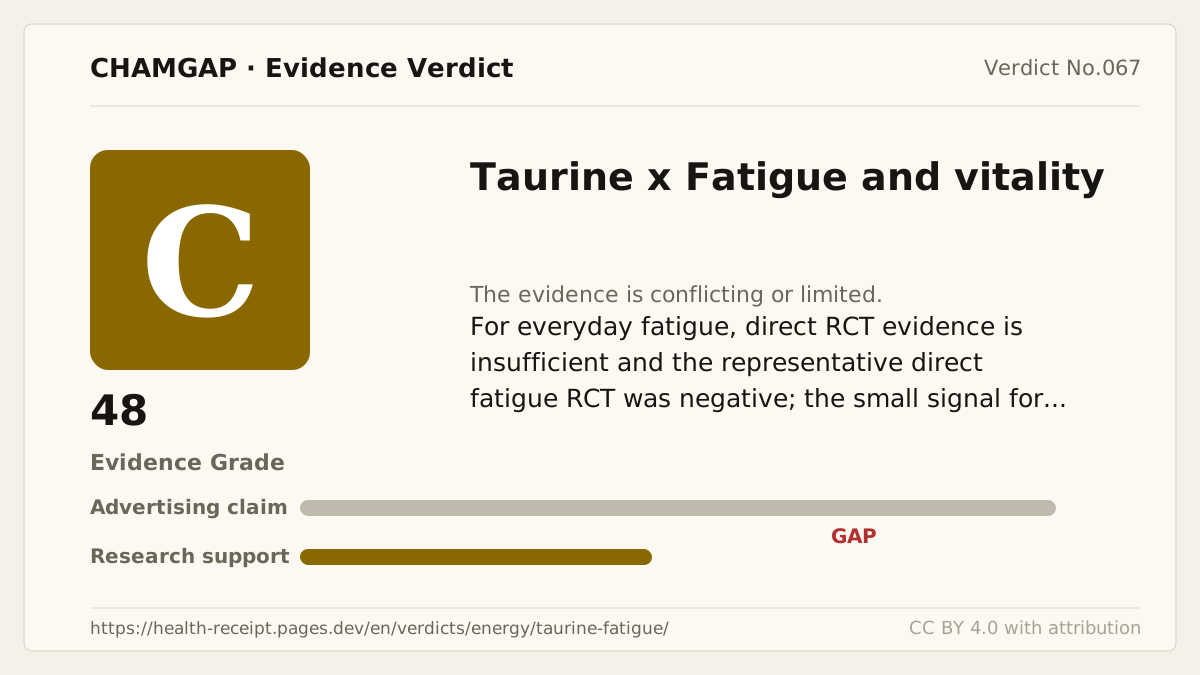
[Chamgap] Taurine × fatigue and vitality — Evidence Grade C·48. 10 cited sources checked. Source: https://chamgap.com/en/verdicts/energy/taurine-fatigue/ · CC BY 4.0CC BY 4.0 — free to use with attribution; do not distort grades, numbers, or verdict meaning.
What this document does and does not do
Chamgap is an information source. It reports what research has and has not confirmed; it does not tell readers what to take or buy. That decision belongs to readers and, when needed, medical or legal professionals. This verdict reflects literature available up to the search date and may change as new research appears. Nothing here is medical advice.