
Octacosanol,
does it really help with fatigue and endurance?
research showsFor endurance during exercise, small human studies show signals of improved exercise duration or VO2max. However, fatigue-recovery/vitality claims largely extend surrogate indicators such as blood lactate, ammonia, and inorganic phosphate, and increased exercise time, into perceived fatigue. Evidence is weak for improving everyday fatigue in the general population.
ads claimDomestic advertisements and informational articles describe octacosanol as an ingredient for “endurance, stamina, vitality” and use mechanistic phrases such as migratory bird flight, increased glycogen storage, promoted fat metabolism, oxygen transport/use, recovery from post-exercise fatigue, and fatigue relief. Market products are often combined not as standalone products but with saw palmetto, zinc, B vitamins, red ginseng, rhodiola, etc., and bundled as “male vitality,” “prostate+endurance,” or “stress fatigue+endurance.” Numbers cited in advertising mix 6.6 mg, 7 mg, 10.2 mg, and 40 mg/day human studies with MFDS-recognized wording.
Useful facts when choosing a product
- The domestic health-functional-food ingredient name is usually “oil containing octacosanol,” and the functional wording is “may help improve endurance.” MFDS recognition was treated separately from evidence grade.
- In a past notification revision, daily intake of octacosanol was expanded from 10 mg to 7~40 mg. A 2025 report on standards/specification revision explains that from January 1, 2026, it will change to 10~40 mg, and caution wording will be added to avoid use by children, pregnant women, and lactating women and to consult if adverse events occur.
- Market products often contain combinations that make it difficult to judge octacosanol-only effect. Fatigue/vitality advertising for products also containing rhodiola, B vitamins, saw palmetto, zinc, etc. must separate ingredient-specific evidence.
- Animal tests report increased exercise time and changes in oxidative-capacity indicators at high dose or feed addition, but these cannot be directly converted into doses/effects for general fatigue improvement in humans.
What the research actually shows
The found human evidence is mostly small Korean exercise-physiology studies. In healthy men, college students, track athletes, and taekwondo athletes, 7-day to 8-week trials measured exercise time to exhaustion, VO2max, O2 pulse, AT, and blood fatigue substances. Some had placebo groups, but abstracts often do not clarify randomization, blinding, or allocation concealment; some are pre/post comparisons or extremely small n=7~8 studies. Shin Seung-rim 2007 master’s thesis reported in 25 participants that after 6 weeks, exercise time was -0.9 min in placebo and +4.4 min in the intake group. Nam Sang-nam 2003 and Yang Yoon-kwon/Lee Sang-hoon 2004 were n=8 pre/post studies showing exercise-time/VO2max signals. So In-cheol 2006 and Ye Jeong-bok 2008 mainly measured blood fatigue substances, and perceived fatigue was not the primary endpoint. No dedicated human meta-analysis was found; animal studies are positive but are only supporting evidence for human efficacy judgment. Funding sources are generally unreported in abstracts, and a 1999 product study was not used as core evidence because media reports place it in product development/sales context.
Why this is classified as C (55)
Endurance itself has small positive human signals on direct performance indicators such as exercise time to exhaustion, so this is not ? or F. However, there is no dedicated meta-analysis or large independent RCT, randomization/blinding/funding-source information is incomplete, and many studies are short pre/post or small studies at n=7~25. In particular, “fatigue recovery” centers on surrogate indicators such as blood lactate, ammonia, and inorganic phosphate rather than perceived fatigue, so it was treated as maximum C under the borderline rule.
Counterpoint. Positive signals repeat in short-term exercise tests in athletes or healthy men. However, whether these signals generalize to everyday fatigue, chronic fatigue, work fatigue, or male vitality requires separate human trials.
Rejudgment record. Converged — Draft=blind C. Small endurance signals; fatigue is surrogate indicators.
Cross-check — Codex and Claude
Evidence Table
| Study | Design | Sample | Funding | Endpoint | Result | Weight |
|---|---|---|---|---|---|---|
| Study 1 | randomized controlled trial | 25 | manufacturer/industry involvement possible | liver | In 25 healthy male college students, after 6 weeks of intake, 75% VO2max treadmill exercise time to exhaustion was reported as -0.9 min in placebo and +4.4 min in the intake group. | core |
| Study 2 | randomized controlled trial | 8 | manufacturer/industry involvement possible | liver and gastrointestinal | In 8 long-distance runners, after 4 weeks of intake, maximal exercise time and VO2max increased significantly; after 2 weeks of discontinuation, significant differences disappeared. | core |
| Study 3 | randomized controlled trial | 8 | manufacturer/industry involvement possible | In 8 healthy men, before/after 40 mg/day for 7 days, increases were reported in VO2max, all-out time, O2 pulse, and AT. | core | |
| Study 4 | randomized controlled trial | 10 | manufacturer/industry involvement possible | liver | In 20 healthy men (octacosanol n=10, placebo n=10), after 10 days VO2max, O2 pulse, AT, etc. showed significant between-group differences, while blood lactate was not significant. | core |
| Study 5 | randomized controlled trial | 14 | manufacturer/industry involvement possible | In 14 high-school taekwondo athletes, comparison of 40 mg/day for 8 weeks versus placebo reported significant decreases in blood NH3 and inorganic phosphate. | supporting | |
| Study 6 | not specified | 21 | body weight, liver, and gastrointestinal | In 21 male high-school taekwondo athletes during a 6-day camp/weight-loss situation, lactate and ammonia indicators in the 20 mg twice/day intake group were reported better than control/weight-loss groups. | supporting | |
| Kim H, Park S, Han DS, Park T 2003 | preclinical study | liver | In trained rats, after octacosanol 0.75% feed for 4 weeks, running time to exhaustion was 46% longer than exercise-trained controls. | supporting | ||
| Study 8 | not specified | gastrointestinal and endurance | Domestic informational article presents endurance/stamina, glycogen storage, fatigue relief, oxygen transport, etc. in an advertising context. | supporting | ||
| Study 9 | not specified | Basis document revising the daily intake of oil containing octacosanol from 10 mg to 7~40 mg. | supporting | |||
| Study 10 | not specified | Reported a revision scheduled for 2026 setting daily intake of oil containing octacosanol at 10~40 mg and adding cautions to avoid use by children, pregnant women, and lactating women. | supporting |
Receipt — 10 References
Of 10 cited sources, 4 had limited original-page access (blocked or summary-only) and were verified via index/summary, marked partial; the rest were verified at the original page. As of 2026-07-07.
Reviewed and approved: Chamgap Editorial Team · Approval date: 2026-07-07 · Corrections: none
Cite this verdict
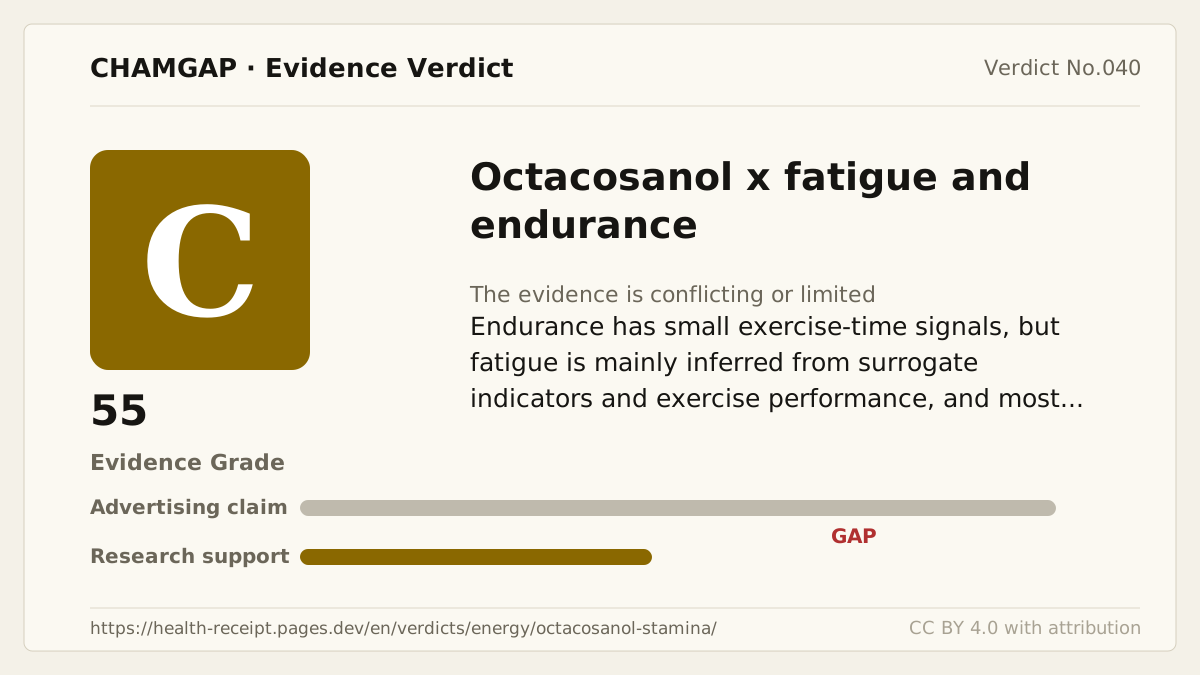
[Chamgap] Octacosanol x fatigue and endurance — Evidence Grade C·55. 10 cited sources checked. Source: https://chamgap.com/en/verdicts/energy/octacosanol-stamina/ · CC BY 4.0CC BY 4.0 — free to use with attribution; do not distort grades, numbers, or verdict meaning.
What this document does and does not do
Chamgap is an information source. It reports what research has and has not confirmed; it does not tell readers what to take or buy. That decision belongs to readers and, when needed, medical or legal professionals. This verdict reflects literature available up to the search date and may change as new research appears. Nothing here is medical advice.