
Schisandra,
does it really help with Fatigue, liver, and antioxidant effects?
research showsSome human randomized trials exist for schisandra, but fatigue recovery is centered on surrogate markers such as strength and lactate rather than direct fatigue scales, and liver/antioxidant evidence is also mainly from small trials or mixture studies. Current evidence shows possibility signals, but it is insufficient to say that ordinary schisandra tea or syrup reliably produces fatigue, liver, or antioxidant health effects.
ads claimKorean market advertisements and informational content broadly connect omija syrup, omija tea, jelly, and Schisandra extract products to fatigue recovery, liver health/detox/hangover, antioxidant/anti-aging, immunity, blood glucose, and bronchial health. Product news has promoted Schisandra extract health functional foods together with muscle-strength improvement evidence, and general informational posts present fatigue, liver, and antioxidant claims bundled within one paragraph. Food Safety Korea's individually recognized Schisandra extract functionality is confirmed as muscle-strength improvement and joint health, and is distinct from fatigue, liver, and antioxidant functionality.
Useful facts when choosing a product
- Omija tea, omija syrup, concentrates, jellies, and standardized extracts used in clinical trials can differ in extraction method, schizandrin/lignan content, and intake amount.
- Food Safety Korea's individually recognized Schisandra extract (No. 2018-9, Bioport Korea) lists functional content as 'may help improve muscle strength' and 'may help joint health,' and the published daily intake is Schisandra extract (concentrate) 1582 mg/day.
- The test material in the Park 2020 RCT was Bioport Korea-provided Schisandra extract 1000 mg/day, and the extract was reported as schizandrin 4.92 mg/g.
- The test material in the Cho 2021 RCT was Schisandra extract 1 g/day, and all participants were instructed to walk 30-60 minutes per day at least 3 days per week.
- The Chiu 2013 liver/antioxidant trial was not Schisandra alone but a commercial Schisandra fruit extract+sesamin combination product (BRAND'S W SCH).
What the research actually shows
Human studies differ by effect. For fatigue, Park 2020 RCT (n=45, postmenopausal women, Schisandra extract 1000 mg/day, 12 weeks) found significant group x time interactions for quadriceps strength and resting lactate, but this was not a subjective-fatigue improvement trial; it was a muscle-strength/lactate surrogate-marker trial. Cho 2021 RCT (n=54, adults aged 50 or older with low muscle mass, Schisandra extract 1 g/day + walking, 12 weeks) showed increased knee-extension strength, but muscle mass, anti-inflammatory/antioxidant markers, and quality of life did not differ. For liver/antioxidant effects, Chiu 2013 RCT (n=40, borderline elevated ALT/AST, 5 months) reported that a Schisandra fruit extract+sesamin combination (SCH) improved ALT/AST and oxidative-stress markers, but it was not Schisandra alone and centered on surrogate markers such as ALT/AST and antioxidant capacity. The 2025 systematic review/meta-analysis on liver injury was preclinical evidence pooling 54 animal experiments. No large independent RCT or Cochrane-style human meta-analysis was identified.
Why this is classified as C (47)
When the compound claim is separated into fatigue, liver, and antioxidant outcomes, all remain C. The fatigue claim is based mainly on muscle strength and lactate surrogate markers rather than repeated RCTs using direct fatigue symptoms or everyday fatigue recovery as primary endpoints, so boundary rule 1 caps it at C. The liver claim has a small human RCT, but it used a schisandra+sesamin mixture and surrogate endpoints such as ALT/AST, ultrasound, and bilirubin, with insufficient independent replication. Antioxidant claims use oxidative-stress markers rather than health outcomes, and Cho 2021 found no difference in antioxidant markers. Positive signals prevent D/F, but no multiple independent RCTs or consistent human meta-analysis were identified to justify A/B.
Counterpoint. Two RCTs found muscle-strength signals with standardized schisandra extract, and small human trials reported improvements in liver enzymes and oxidative-stress markers. Thus, it is not accurate to say there is no evidence at all, but current advertising generalizes beyond the studied range when it claims fatigue recovery, liver health, and antioxidant health effects.
Rejudgment record. Draft=blinded convergent — For fatigue, liver, and antioxidant claims, human RCT signals exist, but they center on surrogate markers such as strength, lactate, ALT/AST, and oxidative markers and on mixture studies rather than direct clinical effects
Cross-check — Codex and Claude
Evidence Table
| Study | Design | Sample | Funding | Endpoint | Result | Weight |
|---|---|---|---|---|---|---|
| Study 1 | liver/joints/muscle strength/antioxidant | The published functionality of Korea's individually recognized Schisandra extract is muscle-strength improvement and joint health, separate from fatigue, liver, and antioxidant claims. | Core | |||
| Study 2 | liver/gut/gastrointestinal/recovery/antioxidant | A Korean informational post confirmed a market-claim case connecting omija syrup to fatigue recovery, liver health, and antioxidant effects. | Core | |||
| Study 3 | RCT | muscle strength | A case in which a Schisandra extract product was sold by citing experimental results of improved quadriceps strength and grip strength after 12 weeks of intake. | Core | ||
| Park J, Han S, Park H 2020 | Double-blind RCT | 45 | muscle strength | In a 45-person RCT of postmenopausal women, after Schisandra extract 1000 mg/day for 12 weeks, quadriceps strength and resting lactate interaction were significant. | Core | |
| Cho YH, Lee SY, Lee CH, Park JH, So YS 2021 | Double-blind RCT | 54 | muscle strength/muscle/antioxidant | In a 54-person RCT of adults aged 50 or older with low muscle mass, after Schisandra extract 1 g/day + walking for 12 weeks, bilateral knee-extension strength increased, but muscle mass and antioxidant markers did not differ. | Supporting | |
| Chiu HF, Chen TY, Tzeng YT, Wang CK 2013 | 40 | ALT/AST/antioxidant | In a 40-person RCT of people with borderline elevated ALT/AST 40-60 U/L, 5 months of a Schisandra fruit extract+sesamin combination improved ALT/AST and antioxidant markers. | Supporting | ||
| Li et al. 2025 | Meta-analysis of preclinical studies | liver | The 2025 systematic review/meta-analysis on liver injury was a preclinical analysis including 54 animal experiments. | Supporting | ||
| Memorial Sloan Kettering Cancer Center 2022 | Human studies are limited, and possible drug interactions involving CYP/P-gp and tacrolimus are presented. | Supporting |
Receipt — 8 References
Of 8 cited sources, 1 had limited original-page access (blocked or summary-only) and were verified via index/summary, marked partial; the rest were verified at the original page. As of 2026-07-07.
Reviewed and approved: Chamgap Editorial Team · Approval date: 2026-07-07 · Corrections: none
Cite this verdict
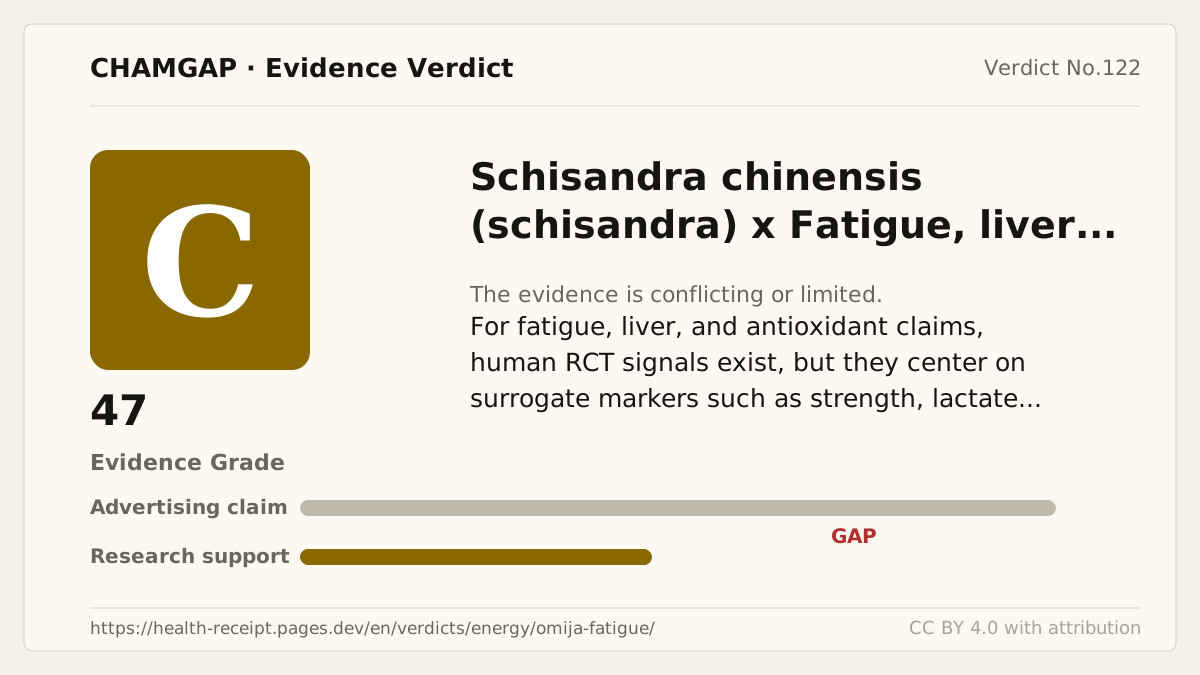
[Chamgap] Schisandra x fatigue, liver, and antioxidant effects — Evidence Grade C·47. 8 cited sources checked. Source: https://chamgap.com/en/verdicts/energy/omija-fatigue/ · CC BY 4.0CC BY 4.0 — free to use with attribution; do not distort grades, numbers, or verdict meaning.
What this document does and does not do
Chamgap is an information source. It reports what research has and has not confirmed; it does not tell readers what to take or buy. That decision belongs to readers and, when needed, medical or legal professionals. This verdict reflects literature available up to the search date and may change as new research appears. Nothing here is medical advice.