
Rhodiola,
does it really help with Fatigue and stress?
research showsThere are small human trials reporting that Rhodiola extract reduced stress-related fatigue or feelings of fatigue. However, an independent RCT using validated fatigue measures produced negative results favoring placebo. Therefore, it is not yet possible to conclude there is no effect, but it is also difficult to regard the evidence as clear, independently replicated support for fatigue or stress improvement. The conclusion is C (46 points), a borderline C close to D.
ads claimIn the Korean market, the central health-functional-food wording is "may help improve fatigue caused by stress." Product advertisements often combine Rhodiola with B vitamins, vitamin C, L-theanine, magnesium, milk thistle, green-tea extract, and other ingredients and broaden the message to "fatigue OFF," "vitality," "stress care," "office workers/students," and "tension relief." Informational articles and brand content add explanations involving cortisol reduction, ATP production, Hsp70, neurotransmitters, concentration, and study efficiency, but general claims about learning ability/concentration and mechanistic explanations are broader interpretations than the actual fatigue RCTs.
Useful facts when choosing a product
- Domestic functional wording is mainly "may help improve fatigue caused by stress," and advertisements/articles mention daily intakes of 200-600 mg together with the marker compound rosavin.
- A substantial share of clinical evidence concerns specific standardized extracts such as SHR-5 or WS 1375, so it cannot be generalized directly to all Rhodiola raw materials, doses, or combination products.
- Korean products are more often combinations with B vitamins, theanine, magnesium, green-tea extract, milk thistle, and other ingredients than single-ingredient products, so the effect of Rhodiola alone must be separated from the overall product effect.
- Fatigue-improvement claims are reported across subjective fatigue scales and some cognition/attention tests, but mechanistic explanations such as cortisol, the HPA axis, ATP, and Hsp70 are supporting information, not substitutes for clinical efficacy evidence.
What the research actually shows
A systematic review found that among 11 clinical trials, 3 of 5 mental-fatigue studies were positive, but meta-analysis was impossible because outcome scales differed, and all studies were rated as having high or unclear risk of bias. The key positive RCT was Olsson 2009, a 28-day SHR-5 study in 60 people with stress-related fatigue, where the primary fatigue scale (Pines burnout scale) was significant versus placebo (p=0.047). Darbinyan 2000, Shevtsov 2003, and Spasov 2000 also reported positive fatigue/work-performance indicators in physicians, cadets, and students under stress, but samples were small and some used single dosing, nonvalidated fatigue indices, and product-related authors/funding. Conversely, the Canadian nursing-student RCT by Punja 2014 used randomization, blinding, and validated primary outcomes, yet both RAND-36 Vitality and VAS-F favored placebo. Longer-term fatigue/burnout studies are mostly open-label single-arm studies and are difficult to use as core adjudication evidence. Large independent RCTs such as GEM or Cochrane reviews were not identified.
Why this is classified as C (46)
Grade C (46 points). The independent RCT using validated primary outcomes (Punja 2014) was negative, with placebo favored on both RAND-36 Vitality and VAS-F, so a blinded assessment alone could support D. However, small RCTs such as Olsson 2009 show positive signals for stress-related fatigue, and the signal is not empty enough to fix the grade at F/D. Because positive evidence is concentrated in small, short-term studies of specific standardized extracts with product links and lacks independent replication, boundary rule 2-b caps it at C, and the score is set at the lower borderline, 46.
Counterpoint. A D view is also fully plausible. In the strictest independent RCT, validated fatigue measures were negative in favor of placebo, while studies cited as positive are generally small or short-term and lean toward specific products/researcher links such as SHR-5. From this perspective, it could be lowered from C to D because "positive signals have not been independently verified and the core independent trial failed."
Rejudgment record. Re-adjudication (borderline C, dissenting D recorded) — The independent RCT using validated indicators favored placebo and was negative (blinded D), but small positive signals make F/D not definitive -> maximum C under 2-b. The D dissent is recorded in the counterview.
Cross-check — Codex and Claude
Evidence Table
| Study | Design | Sample | Funding | Endpoint | Result | Weight |
|---|---|---|---|---|---|---|
| Ishaque S, Shamseer L, Bukutu C, Vohra S 2012 | Meta-analysis/RCT | Possibly manufacturer/industry related | Eleven clinical trials were reviewed, but meta-analysis was impossible due to heterogeneity; 3 of 5 mental-fatigue studies were positive, and overall studies had high/unclear risk of bias. | Core | ||
| Olsson EMG, von Scheele B, Panossian AG 2009 | Double-blind systematic review/RCT | 60, | Possibly manufacturer/industry related | n=60, SHR-5 576 mg/day for 28 days; the primary fatigue scale (Pines burnout scale) was significant versus placebo (p=0.047), and attention measures and cortisol response also partly improved. | Core | |
| Darbinyan V, Kteyan A, Panossian A, Gabrielian E, Wikman G, Wagner H 2000 | RCT | 56 | Possibly manufacturer/industry related | Liver | In a crossover RCT of n=56 young physicians on night duty, SHR-5 170 mg/day for 2 weeks significantly improved an investigator-developed Fatigue Index, with no adverse events reported. | Core |
| Shevtsov VA et al. 2003 | RCT | 161 | Possibly manufacturer/industry related | In a single-dose RCT of n=161 cadets, both 2-capsule and 3-capsule SHR-5 groups had higher AFI than placebo (1.0385, 1.0195 vs 0.9046; p<0.001). | Core | |
| Spasov AA, Wikman GK, Mandrikov VB, Mironova IA, Neumoin VV 2000 | Double-blind | 40 | Possibly manufacturer/industry related | Liver | In n=40 students during exams, SHR-5 100 mg/day for 20 days improved mental fatigue and well-being, while some objective tests (text correction/tapping) were not significant. | Supporting |
| Punja S, Shamseer L, Olson K, Vohra S 2014 | RCT | 48 | Possibly manufacturer/industry related | In n=48 randomized (40 analyzed) over 42 days, both validated primary outcomes, RAND-36 Vitality and VAS-F, favored placebo (p=0.011 and p=0.015), with no adverse-event difference. | Supporting | |
| Lekomtseva Y, Zhukova I, Wacker A 2017 | 100 | Possibly manufacturer/industry related | Stress | In an open-label single-arm study of n=100, WS 1375 400 mg/day for 8 weeks improved fatigue/stress scales such as MFI-20 from baseline, but there was no control group. | Supporting | |
| National Center for Complementary and Integrative Health | NCCIH states that human studies are low-to-moderate quality and do not provide sufficient reliable evidence; it notes possible safety up to 12 weeks but reports headache, insomnia, dizziness, oral symptoms, and losartan interaction. | Supporting | ||||
| Study 9 | 60 | Gastrointestinal/concentration | A Korean informational article explains MFDS functionality, a 60-person 28-day trial, cortisol reduction, and limits of study/concentration claims. | Supporting | ||
| Study 10 | Gastrointestinal/stress | Korean health-functional-food product information confirms wording that Rhodiola extract "may help improve fatigue caused by stress." | Supporting |
Receipt — 10 References
All 10 cited sources were verified for existence at the original page (as of 2026-07-07).
Reviewed and approved: Chamgap Editorial Team · Approval date: 2026-07-07 · Corrections: none
Cite this verdict
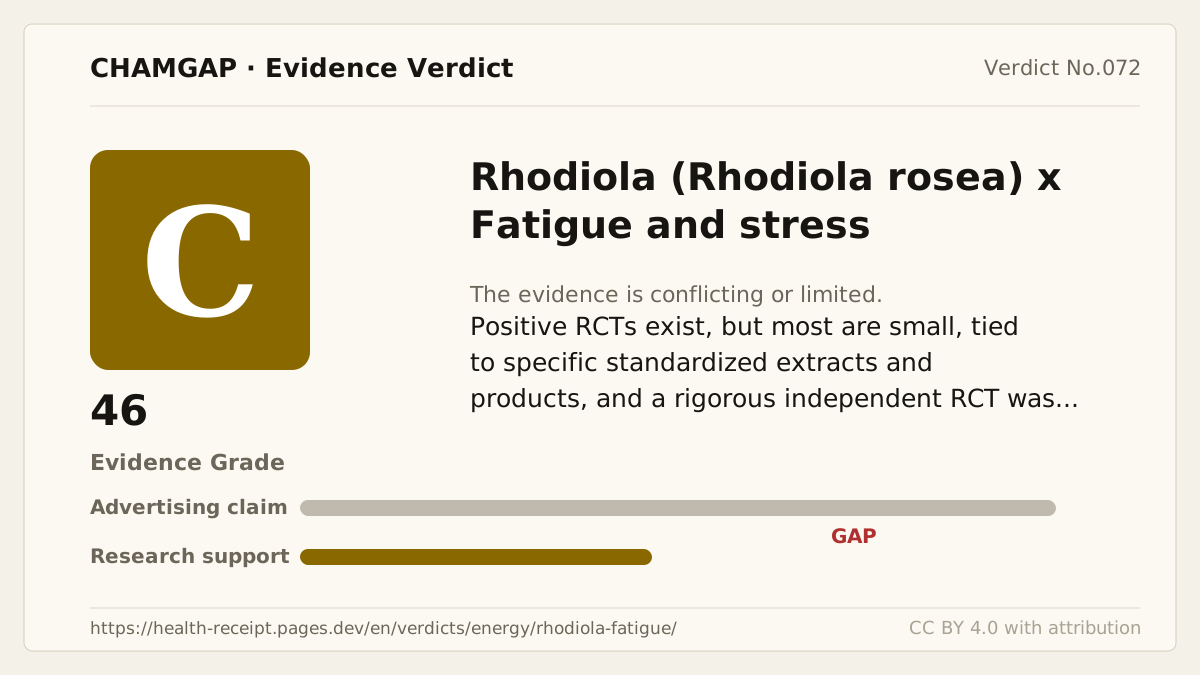
[Chamgap] Rhodiola (Rhodiola rosea) × fatigue and stress — Evidence Grade C·46. 10 cited sources checked. Source: https://chamgap.com/en/verdicts/energy/rhodiola-fatigue/ · CC BY 4.0CC BY 4.0 — free to use with attribution; do not distort grades, numbers, or verdict meaning.
What this document does and does not do
Chamgap is an information source. It reports what research has and has not confirmed; it does not tell readers what to take or buy. That decision belongs to readers and, when needed, medical or legal professionals. This verdict reflects literature available up to the search date and may change as new research appears. Nothing here is medical advice.