
Iron,
does it really help with Fatigue?
research showsIron can be related to fatigue in a deficiency state, but direct evidence that it reduces fatigue in non-deficient ordinary people is insufficient. Positive RCTs and meta-analyses mainly come from women without anemia but with low ferritin or from iron-deficient non-anaemic adults, so it is difficult to extend them as-is to general fatigue-improvement claims.
ads claimIn the Korean market, advertising and informational content commonly connect iron with “fatigue,” “vitality,” “energy production,” “oxygen transport,” and “blood formation.” Food Safety Korea’s nutrient function table presents iron’s functional content as “needed for oxygen transport in the body and blood formation” and “needed for energy production,” and lists a daily intake of 3.6-15 mg and a warning against excessive intake in children aged 6 or younger. Informational articles tended to discuss “the connection between fatigue and iron,” “signs of iron deficiency,” and “checking ferritin,” while introducing results from deficiency or low-ferritin studies in the context of general fatigue consumers. Some advertorial articles presented iron supplements as one effort for fatigue relief and emphasized raw-material/natural status as a selection point.
Useful facts when choosing a product
- In domestic health functional food nutrient functionality, iron can be labeled as “needed for oxygen transport in the body and blood formation” and “needed for energy production,” but this is regulatory labeling separate from the RCT grade for improving fatigue.
- Food Safety Korea’s table gives an iron daily intake range of 3.6-15 mg, while the oral elemental iron dose in major fatigue RCTs was 80 mg/day and IV studies used 800-1000 mg as a single or divided dose, so these are not directly the same as product intake amounts.
- Iron products are often combined with vitamin C, folic acid, B vitamins, copper, and others, so vitality/fatigue phrases perceived in combination-product advertising do not prove an effect of iron alone.
- Normal Hb alone cannot completely exclude depleted iron stores, but the target of this verdict is ordinary people who are not deficient by ferritin/TSAT and similar measures.
What the research actually shows
The key human evidence found concerns “non-anaemic iron deficiency.” Verdon 2003 BMJ gave elemental iron 80 mg/day for 4 weeks to 144 non-anaemic women presenting with fatigue, and the 10-point fatigue VAS decreased more than with placebo, but the response was seen only at ferritin <=50 ug/L. Vaucher 2012 CMAJ gave elemental iron 80 mg/day for 12 weeks to 198 menstruating women with fatigue, ferritin <50 ug/L, and Hb >12 g/dL, and the decrease in Current and Past Psychological Scale fatigue score was greater than placebo. PREFER 2014 found that in 290 fatigued women with ferritin <50 ug/L and TSAT <20% or ferritin <15 ug/L, IV ferric carboxymaltose increased the subjective fatigue response rate, but Vifor Pharma sponsored the study and participated in the design. Krayenbuehl 2011 Blood found that in 90 women with ferritin <=50 ng/mL, the overall primary fatigue change with IV iron sucrose was borderline/non-significant at p=0.07 and was significant only in the ferritin <=15 ng/mL subgroup. Houston 2018 BMJ Open meta-analysis included 18 IDNA adult RCTs and 1,170 participants; subjective fatigue decreased (SMD -0.38), but objective physical capacity such as VO2max did not improve. Keller 2020 Scientific Reports blood-donor RCT in non-anaemic repeat blood donors with ferritin <=50 ug/L increased ferritin/Hb but showed no difference in fatigue scores (p=0.819). Thus, the crux of the research is extrapolation between “evidence for correcting deficiency” and “fatigue improvement in non-deficient ordinary people.”
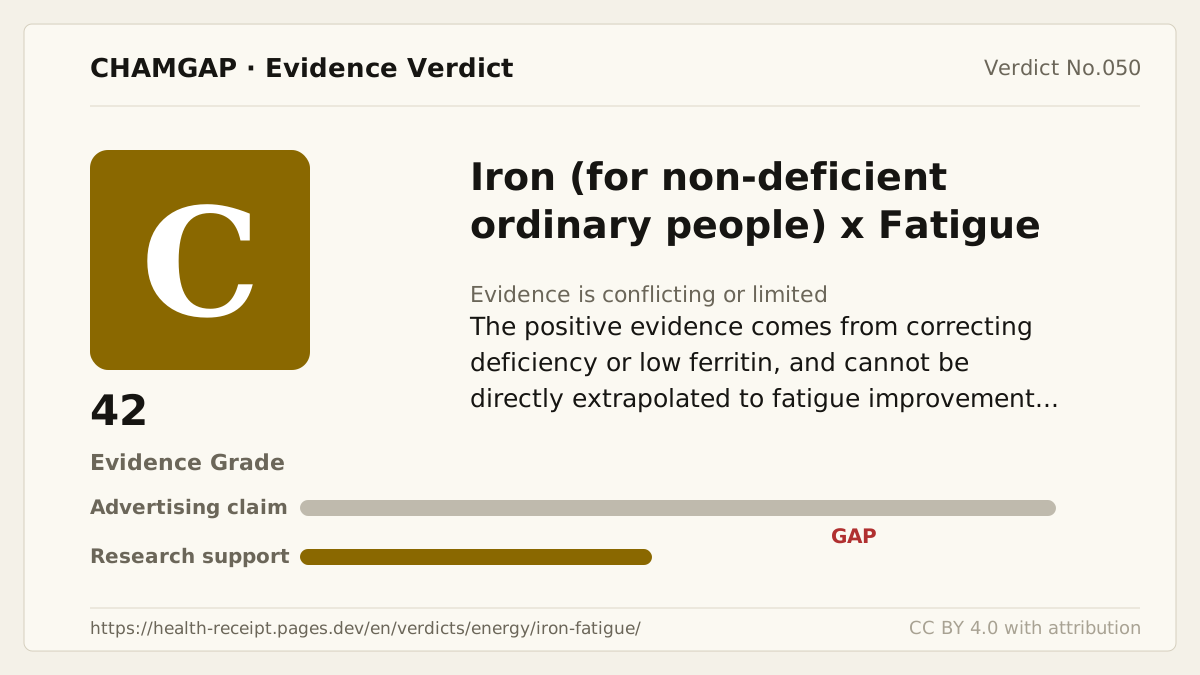
Why this is classified as C (42)
C (42). Human RCTs and meta-analyses exist, but the subjects are mostly non-anaemic iron deficiency or fatigued women/adults with low ferritin. For the direct clinical question of fatigue improvement in non-deficient ordinary people, human proof is insufficient. In addition, some key positive trials were sponsored by manufacturers of iron preparations or related companies, results are centered on subjective fatigue, and objective physical capacity did not improve in meta-analysis. MFDS nutrient functional labeling was not used as a basis to raise the evidence grade, according to the principle of regulatory neutrality.
Counterpoint. In people with fatigue and low ferritin, especially menstruating women, RCTs on non-anaemic iron deficiency reported reductions in subjective fatigue. Therefore, the more accurate verdict is not “iron has nothing to do with fatigue,” but “the same effect has not been proven in non-deficient ordinary people.”
Rejudgment record. convergent — Draft = blind C. Positive evidence is evidence for correcting deficiency/low ferritin, with a boundary around general-population claims.
Cross-check — Codex and Claude
Evidence Table
| Study | Design | Sample | Funding | Endpoint | Result | Weight |
|---|---|---|---|---|---|---|
| Study 1 | Regulatory labeling | not reported | not specified | Iron’s labeled functionality is oxygen transport, blood formation, and energy production, and the daily intake is presented as 3.6-15 mg. | core | |
| Study 2 | not specified | not reported | fatigue | Introduced a study of women who took iron supplements for 12 weeks and explained the connection between fatigue and iron as a general consumer article. | core | |
| Study 3 | not specified | not reported | fatigue/iron metabolism | Explained iron deficiency, oxygen transport, ATP production, and the need to check ferritin in an informational article. | core | |
| Study 4 | not specified | not reported | fatigue | Advertorial-style content connecting iron supplements with fatigue-relief efforts and emphasizing selection of raw materials and manufacturing methods. | core | |
| Verdon F et al. 2003 | double-blind RCT | 144 | possible manufacturer/industry involvement | anemia | In 144 non-anaemic women, oral elemental iron 80 mg/day for 4 weeks reduced fatigue VAS more, but the effect was limited to ferritin <=50 ug/L. | supporting |
| Vaucher P, Druais PL, Waldvogel S, Favrat B 2012 | RCT | 198 | possible manufacturer/industry involvement | anemia | In 198 non-anaemic menstruating women with fatigue and ferritin <50 ug/L, elemental iron 80 mg/day for 12 weeks increased the reduction in fatigue scores. | supporting |
| Krayenbuehl PA et al. 2011 | not specified | 90 | possible manufacturer/industry involvement | not specified | In 90 fatigued women with ferritin <=50 ng/mL, the overall fatigue change with IV iron sucrose was p=0.07, and it was significant in the ferritin <=15 ng/mL subgroup. | supporting |
| Favrat B et al. 2014 | RCT | 290 | possible manufacturer/industry involvement | ALT | In 290 iron-deficient fatigued women, IV ferric carboxymaltose 1000 mg increased the Day 56 fatigue response rate to 65.3% vs 52.7%. | supporting |
| Houston BL et al. 2018 | systematic review of RCTs | not reported | not specified | Across 18 IDNA adult RCTs, subjective fatigue decreased (SMD -0.38), but objective physical capacity such as VO2max did not significantly improve. | supporting | |
| Keller P et al. 2020 | not specified | not reported | anemia | In repeat blood donors with ferritin <=50 ug/L, IV iron increased ferritin/Hb, but there was no difference in fatigue scores (p=0.819). | supporting | |
| NIH Office of Dietary Supplements | not specified | not reported | gut | Iron-only supplements are commonly high-dose, and gastrointestinal adverse effects such as nausea and constipation can occur at 45 mg/day or more. | supporting | |
| Tolkien Z et al. 2015 | meta-analysis of RCTs | not reported | not specified | In a meta-analysis of 43 adult RCTs, ferrous sulfate increased the risk of GI adverse effects compared with placebo (OR 2.32, 95% CI 1.74-3.08). | supporting |
Receipt — 12 References
Of 12 cited sources, 1 had limited original-page access (blocked or summary-only) and were verified via index/summary, marked partial; the rest were verified at the original page. As of 2026-07-07.
Reviewed and approved: Chamgap Editorial Team · Approval date: 2026-07-07 · Corrections: none
Cite this verdict
[Chamgap] Iron x fatigue — Evidence Grade C·42. 12 cited sources checked. Source: https://chamgap.com/en/verdicts/energy/iron-fatigue/ · CC BY 4.0CC BY 4.0 — free to use with attribution; do not distort grades, numbers, or verdict meaning.
What this document does and does not do
Chamgap is an information source. It reports what research has and has not confirmed; it does not tell readers what to take or buy. That decision belongs to readers and, when needed, medical or legal professionals. This verdict reflects literature available up to the search date and may change as new research appears. Nothing here is medical advice.