
Arginine,
does it really help with fatigue and vitality?
research showsDirect proof is weak for the general claim of improving everyday fatigue and vitality. Studies of L-arginine alone mainly examined surrogate indicators and performance tests such as exercise performance, nitric oxide, ammonia, and oxygen cost, and recent systematic reviews and multiple RCTs have not confirmed consistent improvement. An L-arginine+vitamin C combination RCT was positive in long-COVID patients, but because it involved a disease population, a combination product, and a secondary fatigue result, it is difficult to extend to the effect of arginine alone in the general population.
ads claimIn the Korean market, expressions include “fatigue recovery,” “vitality for a lethargic daily life,” “energy production,” “improved blood circulation,” “removal of fatigue substances,” “increased exercise ability,” “recovery through liver detoxification,” and “people needing concentration, travel stamina, or hangover relief.” Informational articles and shopping-mall content often explain that NO production and vasodilation, oxygen/nutrient supply, and ammonia/waste-product removal lead to fatigue recovery and vitality improvement.
Useful facts when choosing a product
- Domestic articles introduce Laraolla liquid and Uptension liquid as high-dose over-the-counter medicines containing L-aspartic acid-L-arginine hydrate 5290 mg, labeled as L-aspartic acid-L-arginine 5000 mg. This is not the same as a pure L-arginine single supplement.
- In domestic OTC-type product articles, efficacy/effects are described as adjunctive therapy for symptoms of mental/physical functional asthenia and recovery periods from amino-acid deficiency. The evidence grade was judged separately from regulatory recognition.
- Commercial health-information content mentions adult intake of 3~5 g/day and combinations with vitamin C, B6, magnesium, etc., but such combinations must be separated from judgment of L-arginine-alone effects.
- Pre-workout intake and fatigue-recovery positioning are common, but research endpoints are usually performance or physiological indicators such as 6-minute walk, time-to-exhaustion, power output, and plasma nitrite/ammonia.
What the research actually shows
Human evidence for L-arginine alone is concentrated on exercise performance, exercise tolerance, and NO/ammonia indicators rather than perceived fatigue itself. A 2025 systematic review examined 20 isolated-arginine RCTs in healthy exercisers, total 340 participants, and found no improvement in performance time, functional capacity, muscular endurance, or muscle strength, while aerobic capacity was positive only in some studies. A 2022 crossover RCT in young men found that neither acute 5 g intake nor twice-daily intake for 14 days improved exercise-induced ammonia or 15-minute cycling power versus placebo. A 2013 crossover RCT also found that acute 6 g intake did not improve plasma nitrite, oxygen cost, or severe exercise tolerance. A 2020 meta-analysis reported positive effects on aerobic and anaerobic performance, but heterogeneity was large and the endpoint was exercise performance; later broader systematic reviews and public-agency summaries rate consistency as low. The L-arginine+vitamin C combination improved 6-minute walk distance and fatigue persistence in a single-center RCT in long-COVID fatigue patients, but it is not direct evidence for the single ingredient or general fatigue claim.
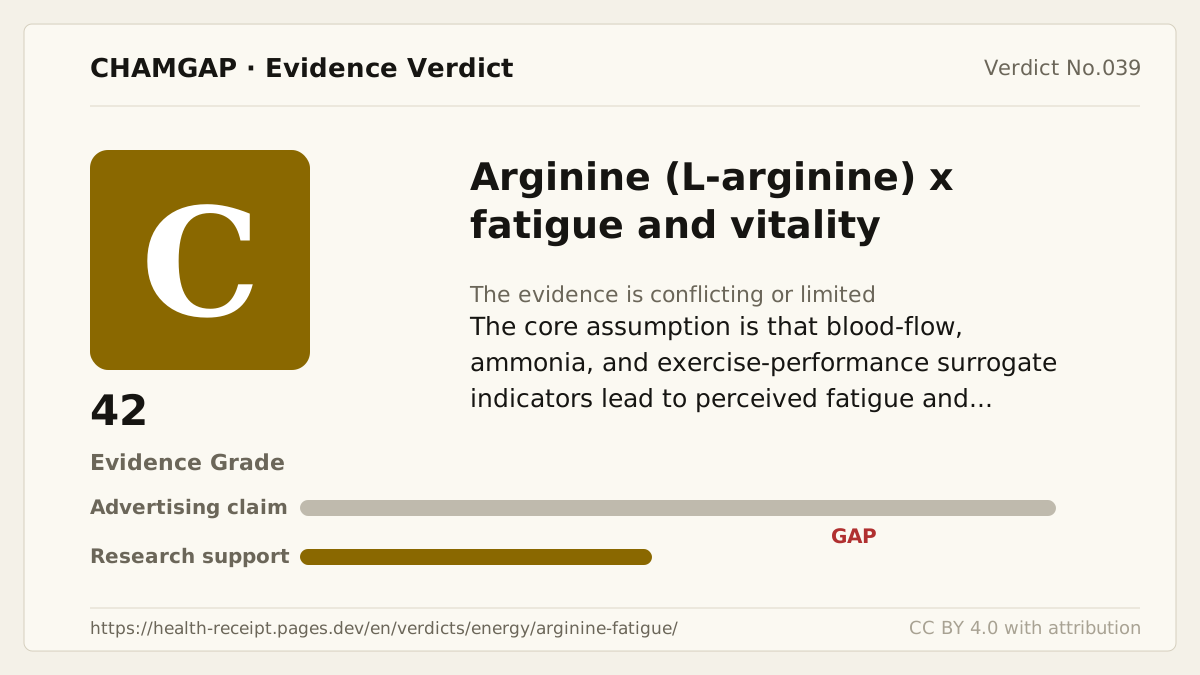
Why this is classified as C (42)
Judged C. Human RCTs and reviews exist, but the focus is not direct perceived outcomes for general fatigue/vitality; it is surrogate indicators such as exercise performance, blood flow, and ammonia. Independent reproducibility for single-ingredient studies is weak. Repeated null RCTs and inconsistency in the latest systematic review make B or higher difficult. However, because the long-COVID combination-product RCT and some exercise-performance meta-analyses are not completely negative, this is low C rather than F.
Counterpoint. Arginine has physiological plausibility related to NO biosynthesis, the urea cycle, and vascular function, and some positive data exist, such as the 2020 exercise-performance meta-analysis and the long-COVID L-arginine+vitamin C RCT. However, these data mostly concern exercise performance or disease populations/combination products, and are distant from the Korean market’s general “fatigue/vitality” claim.
Rejudgment record. Converged — Draft=blind C. Blood-flow/performance surrogate indicators not connected to perceived fatigue.
Cross-check — Codex and Claude
Evidence Table
| Study | Design | Sample | Funding | Endpoint | Result | Weight |
|---|---|---|---|---|---|---|
| Motta BAO, de Arruda LK, Zanella PB 2025 | systematic review of RCTs | 340 | manufacturer/industry involvement possible | muscle strength/endurance/performance time | Review of 20 isolated-arginine RCTs in healthy exercisers, total 340 participants; performance time, functional capacity, muscular endurance, and muscle strength did not improve, and only aerobic capacity was positive in some studies. | core |
| NIH Office of Dietary Supplements | government summary | exercise performance | ODS summarizes arginine exercise-performance evidence as limited/conflicting and states that 2~20 g/day has little or no effect on anaerobic/aerobic performance. | core | ||
| Viribay A, Burgos J, Fernandez-Landa J, Seco-Calvo J, Mielgo-Ayuso J 2020 | meta-analysis of RCTs | exercise performance | Reviewed 18 single-arginine RCTs and in 15-trial meta-analysis reported positive results for aerobic SMD 0.84 and anaerobic SMD 0.24, but aerobic heterogeneity was large. | core | ||
| Hiratsu A, Tataka Y, Namura S, Nagayama C, Hamada Y, Miyashita M 2022 | not specified | 16 | manufacturer/industry involvement possible | Crossover RCT in 16 healthy young men: after acute 5 g and 14-day intake, exercise-induced ammonia and 15-minute cycling power did not improve versus placebo. | core | |
| Vanhatalo A, Bailey SJ, DiMenna FJ, Blackwell JR, Wallis GA, Jones AM 2013 | not specified | 8 | exercise performance | In 15-person running and 8-person cycling experiments, acute arginine 6 g did not improve plasma nitrite, oxygen cost, or severe exercise tolerance. | supporting | |
| Tosato M, Calvani R, Picca A et al. 2022 | not specified | 46 | Single-blind RCT in 46 adults with long-COVID fatigue: L-arginine 1.66 g + liposomal vitamin C 500 mg twice daily for 28 days improved 6-minute walk distance and fatigue persistence. | supporting | ||
| Study 7 | not specified | liver, gastrointestinal, and recovery | Domestic article presented Uptension liquid as a high-dose L-aspartic acid-L-arginine hydrate product and emphasized expected fatigue reduction, increased exercise ability, and recovery through liver detoxification. | supporting | ||
| Study 8 | not specified | gastrointestinal and recovery | Laraolla advertising article presented high-dose arginine, help with fatigue recovery, adjunctive support for lethargy symptoms, blood circulation/fatigue-substance removal, and daily vitality imagery. | supporting | ||
| Study 9 | not specified | gastrointestinal, muscle, and recovery | Informational content links NO vasodilation, oxygen/nutrient supply, fatigue recovery/vitality enhancement, and reduced muscle fatigue before/after exercise. | supporting |
Receipt — 9 References
Of 9 cited sources, 1 had limited original-page access (blocked or summary-only) and were verified via index/summary, marked partial; the rest were verified at the original page. As of 2026-07-07.
Reviewed and approved: Chamgap Editorial Team · Approval date: 2026-07-07 · Corrections: none
Cite this verdict
[Chamgap] Arginine x fatigue and vitality — Evidence Grade C·42. 9 cited sources checked. Source: https://chamgap.com/en/verdicts/energy/arginine-fatigue/ · CC BY 4.0CC BY 4.0 — free to use with attribution; do not distort grades, numbers, or verdict meaning.
What this document does and does not do
Chamgap is an information source. It reports what research has and has not confirmed; it does not tell readers what to take or buy. That decision belongs to readers and, when needed, medical or legal professionals. This verdict reflects literature available up to the search date and may change as new research appears. Nothing here is medical advice.