
Riboflavin,
does it really help with Migraine prevention?
research showsIn adult migraine prevention, an RCT using riboflavin 400 mg/day reported a direct reduction in migraine attack frequency, and the AAN/AHS guideline classified it as 'probably effective.' However, because the number of studies and sample sizes are small and pediatric RCTs have negative results, this is a B judgment limited to adult high-dose prevention. Riboflavin safety is generally assessed as good.
ads claimKorean-language product copy presents riboflavin together with 'migraine supplement,' 'headache prevention,' 'mitochondrial energy,' 'B-complex,' and 'magnesium and coenzyme Q10 combinations.' Products at the general vitamin B2 recommended-daily-intake level and 400 mg high-dose products are both visible.
Useful facts when choosing a product
- The representative dose in migraine prevention studies is 400 mg/day, which differs greatly from the 1-10 mg range in ordinary B-complex products.
- Effect is usually evaluated by migraine days and attack frequency after at least 3 months of use.
- Riboflavin can make urine yellow, and some studies reported mild adverse reactions such as diarrhea and abdominal pain.
- Because it is a water-soluble vitamin, overall safety is assessed as good.
- Combination products with magnesium, coenzyme Q10, and feverfew mix the effects of each ingredient, so they are separate from riboflavin-only evidence.
What the research actually shows
The Schoenen 1998 double-blind RCT reported reduced attack frequency and headache days, and an increased rate of 50% or greater response, after riboflavin 400 mg/day for 3 months in 55 adult migraine patients. The 2012 AAN/AHS guideline assessed riboflavin as 'probably effective' for prevention of episodic migraine in adults. A 2017 systematic review summarized that migraine frequency might decrease when 400 mg/day is used for at least 3 months in adult studies. In contrast, some pediatric and adolescent RCTs did not confirm superiority over placebo, making it difficult to apply the adult evidence directly.
Why this is classified as B (66)
B. An adult 400 mg/day RCT directly lowered migraine attack frequency, and AAN/AHS also assessed it as probably effective. Reflecting the limited number of studies and sample sizes and negative pediatric RCTs, it is kept as B limited to adult high-dose prevention, with a score of 66.
Counterpoint. If narrowed to adult 400 mg/day prevention, it corresponds to B. If broadened to low-dose general B-complex products, children, or claims of acute headache relief, the strength of evidence declines.
Rejudgment record. Final reassessment — Adult 400 mg/day RCT and AAN/AHS probably effective evidence were reflected. Considering limited study number and sample size and negative pediatric RCTs, this is B limited to adult high-dose prevention.
Cross-check — Codex and Claude
Evidence Table
| Study | Design | Sample | Funding | Endpoint | Result | Weight |
|---|---|---|---|---|---|---|
| Schoenen J et al. 1998 | Randomized double-blind RCT | 55 | Unknown/presumed independent academic | Migraine attack frequency and headache days | With 400 mg/day for 3 months, reduced attack frequency and headache days and an increased 50% response rate were reported. | Core |
| Holland S et al. 2012 | AAN/AHS evidence-based guideline | Professional society | Prevention of episodic migraine in adults | Riboflavin 400 mg was classified as 'probably effective.' | Core | |
| Thompson DF, Saluja HS 2017 | Systematic review | Unknown | Migraine frequency | It reported a possibility of reduced frequency in adults when 400 mg/day was taken for at least 3 months, while pediatric evidence was unclear. | Core | |
| MacLennan SC et al. 2008 | Pediatric randomized RCT | 48 | Unknown | Pediatric migraine frequency | In the pediatric study, high-dose riboflavin did not show superiority over placebo. | Contrary |
Receipt — 4 References
All 4 cited sources were verified for existence at the original page (as of 2026-07-09).
Reviewed and approved: Chamgap Editorial Team · Approval date: 2026-07-09 · Corrections: none
Cite this verdict
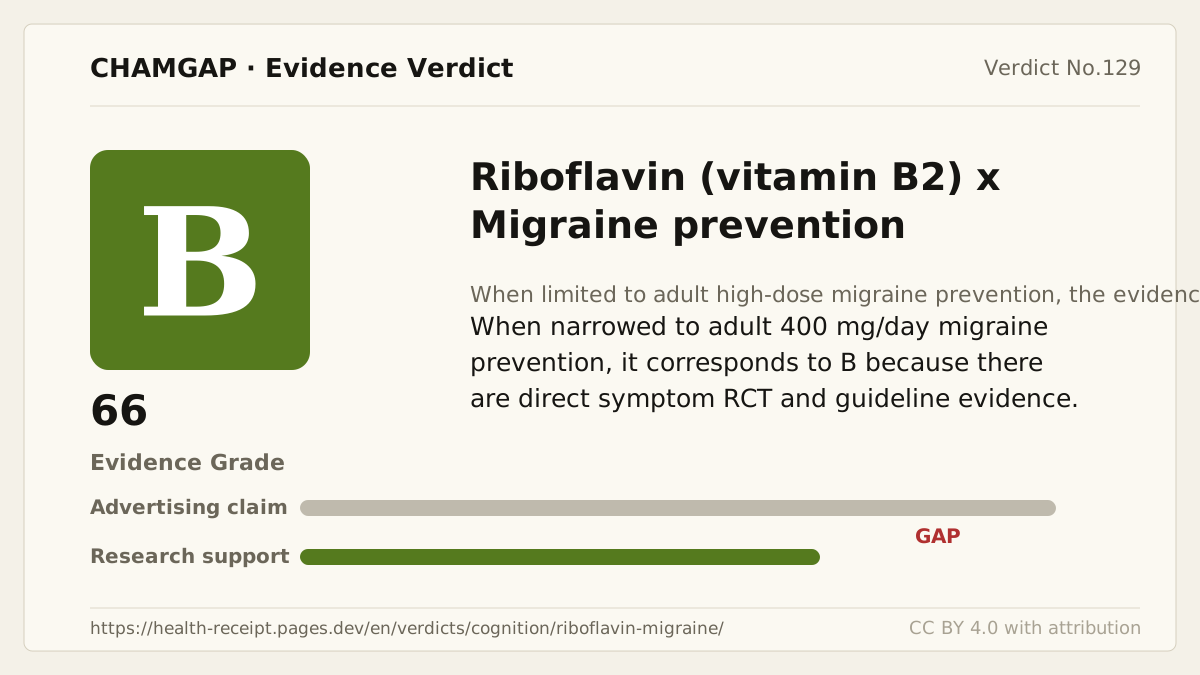
[Chamgap] Riboflavin (vitamin B2) × Migraine prevention — Evidence Grade B·66. 4 cited sources checked. Source: https://chamgap.com/en/verdicts/cognition/riboflavin-migraine/ · CC BY 4.0CC BY 4.0 — free to use with attribution; do not distort grades, numbers, or verdict meaning.
What this document does and does not do
Chamgap is an information source. It reports what research has and has not confirmed; it does not tell readers what to take or buy. That decision belongs to readers and, when needed, medical or legal professionals. This verdict reflects literature available up to the search date and may change as new research appears. Nothing here is medical advice.