
Ginkgo biloba leaf extract,
does it really help with Memory, cognition, and blood circulation?
research showsGinkgo biloba leaf extract is distributed in the domestic health functional food and over-the-counter drug markets with expressions about memory improvement and blood-flow improvement. However, large independent RCTs targeting healthy adults, subjective memory decline, MCI, and dementia prevention are generally negative. In diagnosed dementia patients, there are signals for improvement in cognitive and daily-function symptoms over about 6 months, but heterogeneity is large and this differs from evidence that it prevents long-term disease progression. For blood flow, clinical and surrogate markers such as walking distance in intermittent claudication and blood fluidity are mixed, and the latest Cochrane conclusion is that clinically meaningful benefit in peripheral vascular disease is not clear.
ads claimIn the Korean market, health functional food detail pages and informational articles repeatedly use expressions such as “may help improve memory and blood flow,” “brain health,” “middle-aged/senior,” and “people who need improved blood flow.” Product examples add vitamins and minerals to ginkgo biloba leaf extract and present flavonol glycosides 36 mg as the “maximum daily intake amount by MFDS standards.” Advertorial content explains that the two functions of memory and blood-flow improvement have been recognized for health functional foods, while also mentioning the pharmaceutical market, EGb761 raw material, distinction between powder and extract, and caution with anticoagulant co-use.
Useful facts when choosing a product
- Domestic functional expressions were judged for evidence grade separately from MFDS recognition status.
- Ginkgo biloba leaf extract is included in Food Safety Korea’s list of notified ingredients related to memory.
- Domestic products highlight labels such as flavonol glycosides 28-36 mg/day or 36 mg/tablet.
- The standardized extract often used in clinical trials is EGb 761, and GEM and GuidAge used 120 mg twice daily (total 240 mg/day).
- Health functional food products are often combined with vitamins/minerals, phosphatidylserine, omega-3, and others rather than being extract alone, so they should be separated from evidence for ginkgo leaf extract alone.
- Blood-flow claims mix mechanisms/surrogate markers such as platelet inhibition and vasodilation with walking-distance studies in peripheral vascular disease.
- Ginkgo leaf extract differs from ginkgo fruit/seeds, and toxicity issues of the fruit/seeds should not be confused with extract evidence.
What the research actually shows
The evidence differs by efficacy. (1) Memory improvement in healthy adults and older adults: In the Solomon 2002 JAMA 6-week RCT, both standard neuropsychological tests and subjective evaluations showed no difference. (2) Dementia prevention/delay of cognitive decline: GEM 2008/2009 JAMA followed 3,069 participants for a median of 6.1 years and found overall dementia HR 1.12 (95% CI 0.94-1.33), with no difference in changes in cognitive domains. GuidAge 2012 also followed 2,854 older adults with memory complaints for 5 years and was not significant for probable AD, HR 0.84 (95% CI 0.60-1.18; p=0.306). (3) MCI/subjective memory decline: 2026 Cochrane summarized 12 MCI studies with 1,913 participants as showing little to no difference in 6-month global status, cognition, or ADL. (4) Diagnosed dementia: The same Cochrane suggested possible small improvements at 6 months in cognition (Syndrom-Kurztest MD -1.86, 95% CI -3.48 to -0.24) and ADL (MD -0.19, 95% CI -0.35 to -0.03) across 13 studies and 3,288 participants, but specified heterogeneity (I2 91-96%) and study-method issues. (5) Blood circulation/peripheral vessels: The 2013 Cochrane on intermittent claudication concluded that in 14 RCTs and 739 participants, the increase in walking distance was statistically borderline and there was no evidence of clinically meaningful benefit in peripheral vascular disease.
Why this is classified as C (45)
If the combination claim is separated by efficacy, memory/cognition claims for healthy adults, MCI, and dementia prevention are repeatedly negative and close to F. Conversely, short-term symptoms in diagnosed dementia have some positive signals in RCTs and the latest Cochrane, so treating the whole item as F would underestimate them. For blood flow, a meta-analysis of walking distance in intermittent claudication showed an old small positive signal, but clinically meaningful benefit was uncertain in the 2013 Cochrane; moreover, “blood flow” in advertising is often interpreted through surrogate markers, so the maximum is C. Therefore the consumer-facing integrated verdict for “memory, cognition, and blood circulation” is C 45, while separately stating that memory prevention/healthy-person enhancement is F, short-term symptoms in diagnosed dementia are limited C-B, and blood flow is C.
Counterpoint. In diagnosed dementia patient groups, some standardized ginkgo leaf extract studies showed small improvements in 6-month cognition and ADL scores, and the latest Cochrane also summarizes that it “may lead to some improvements.” This evidence does not directly extend to memory enhancement or dementia prevention in healthy people, or to general “blood circulation improvement.”
Rejudgment record. convergent — Draft = blind C. Large independent RCTs (GEM, etc.) for healthy people, MCI, and dementia prevention were negative; cognition evidence is largely surrogate-marker-centered.
Cross-check — Codex and Claude
Evidence Table
| Study | Design | Sample | Funding | Endpoint | Result | Weight |
|---|---|---|---|---|---|---|
| Wieland LS, Ludeman E, Chi Y et al. 2026 | not specified | 10,613 | not reported | memory | Latest Cochrane of 82 studies and 10,613 participants: subjective memory decline/MCI show uncertain or little to no effect, while diagnosed dementia may show some symptom improvement at 6 months but with large heterogeneity. | core |
| Solomon PR, Adams F, Silver A, Zimmer J, DeVeaux R 2002 | RCT | 230 | possible manufacturer/industry involvement | cognition/memory | In a 6-week RCT of 230 healthy adults aged 60 or older using 40 mg three times daily, all objective and subjective memory/cognition outcomes showed no significant difference. | core |
| DeKosky ST, Williamson JD, Fitzpatrick AL et al. 2008 | RCT | 3069 | possible manufacturer/industry involvement | not specified | GEM, 3,069 participants, 120 mg twice daily, median 6.1-year follow-up: overall dementia HR 1.12 (0.94-1.33), AD HR 1.16 (0.97-1.39), negative. | core |
| Snitz BE, O'Meara ES, Carlson MC et al. 2009 | RCT | possible manufacturer/industry involvement | liver/cognition/memory | GEM cognitive-decline analysis: no difference between ginkgo and placebo in annual rates of change for memory, attention, global cognition, and related domains. | core | |
| Vellas B, Coley N, Ousset PJ et al. 2012 | not specified | 2854 | not reported | memory | GuidAge in 2,854 adults aged 70 or older with memory complaints over 5 years: probable AD HR 0.84 (0.60-1.18; p=0.306), prevention effect not significant. | supporting |
| Nicolai SPA, Kruidenier LM, Bendermacher BLW et al. 2013 | RCT | 739 | not reported | liver/gut | Fourteen RCTs in intermittent claudication, 739 participants: increase in absolute claudication distance was borderline (P=0.06), with no evidence of clinically meaningful peripheral vascular disease benefit. | supporting |
| Pittler MH, Ernst E 2000 | meta-analysis of RCTs | 415 | not reported | not specified | Early meta-analysis of 8 RCTs and 415 participants: pain-free walking distance WMD 34 m (95% CI 26-43), but the effect size was small and clinical meaning uncertain. | supporting |
| NCCIH | not specified | not reported | not specified | Moderate amounts of leaf extract are generally well tolerated in most adults, but caution is needed for bleeding risk and drug interactions when combined with anticoagulants such as warfarin. | supporting | |
| Study 9 | not specified | not reported | memory | Ginkgo biloba leaf extract is included in the notified functional ingredient list related to memory improvement. | supporting | |
| GNM Life | not specified | not reported | blood flow/gut/memory | Example of a domestic product detail page: used expressions recommending the product to consumers needing memory/blood-flow improvement, with memory and blood-flow improvement and flavonol glycosides 36 mg. | supporting | |
| Study 11 | not specified | not reported | blood flow/memory | Example of an informational article: explained that it had been recognized as a health functional food for the two functions of memory and blood-flow improvement, and described caution with anticoagulants/aspirin and before surgery. | supporting |
Receipt — 11 References
Of 11 cited sources, 1 had limited original-page access (blocked or summary-only) and were verified via index/summary, marked partial; the rest were verified at the original page. As of 2026-07-07.
Reviewed and approved: Chamgap Editorial Team · Approval date: 2026-07-07 · Corrections: none
Cite this verdict
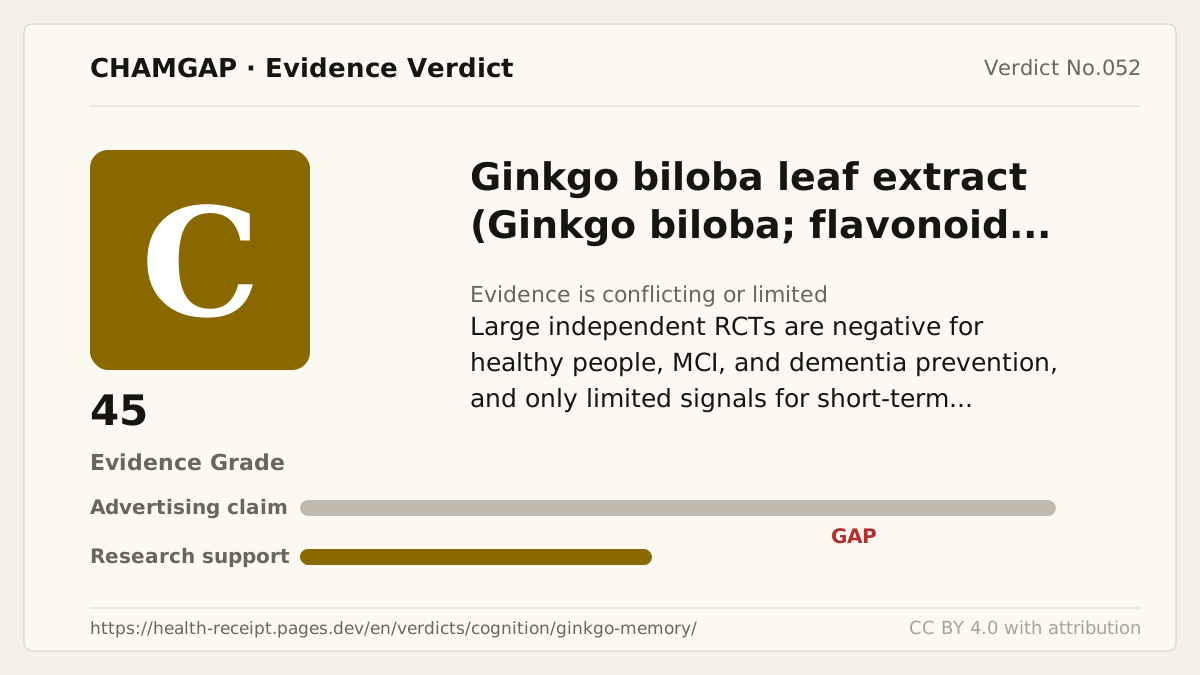
[Chamgap] Ginkgo biloba leaf extract x memory, cognition, and blood circulation — Evidence Grade C·45. 11 cited sources checked. Source: https://chamgap.com/en/verdicts/cognition/ginkgo-memory/ · CC BY 4.0CC BY 4.0 — free to use with attribution; do not distort grades, numbers, or verdict meaning.
What this document does and does not do
Chamgap is an information source. It reports what research has and has not confirmed; it does not tell readers what to take or buy. That decision belongs to readers and, when needed, medical or legal professionals. This verdict reflects literature available up to the search date and may change as new research appears. Nothing here is medical advice.