
Lion's mane mushroom,
does it really help with cognition, memory, and nerves?
research showsLion's mane mushroom has some signals of improved cognitive-test performance in small RCTs in people with mild cognitive impairment or older adults. However, the evidence is small and the results are mixed for making broad claims extending to improved memory and concentration in general adults, prevention or treatment of dementia, and nerve regeneration.
ads claimIn the Korean market, phrases such as 'brain health,' 'memory and concentration,' 'improvement of cognitive function,' 'dementia prevention,' 'NGF/nerve growth factor,' and 'nerve cell growth' recur. Policy briefing/Rural Development Administration reports introduced animal and cell experiments showing a 33% reduction in water-maze time, more than 50% shortening of distance, and a 1.2-fold increase in hippocampal NGF, and some affiliate blog-style posts connect this to recommendations for brain-health supplements. Some product pages display combinations of lion's mane mushroom extract and ginkgo leaf extract as 'helping improve memory and blood circulation.' A 2026 article, in the context of mushroom coffee, described demand for managing memory, concentration, and cognitive function while also pointing out the lack of evidence and the need to check each product's content and quality.
Useful facts when choosing a product
- Market products come in many forms, including fresh mushrooms, powders, capsules, liquid sticks, and mushroom coffee, and combination products mixed with ginkgo, probiotics, vitamins, or other mushrooms are more common than lion's mane alone.
- Human-study doses and standardization differ from one another: about 2.88 g/day dried fruiting-body powder (Mori 2009), 3.2 g/day fruiting-body supplement (Saitsu 2019), 1.8 g/day (Docherty 2023), a 10 g/day muffin (Grozier 2022), an acute 3 g 10:1 extract (Surendran 2025), and erinacine A-enriched mycelium 1.05 g/day (Li 2020).
- Hericenone series are emphasized more in fruiting bodies and erinacine series more in mycelium, so the single advertising name 'lion's mane mushroom' should not be assumed to be identical to clinical-trial products.
- A 'memory improvement' label on Korean products may be based not on evidence for lion's mane alone but on combination with other functional ingredients such as ginkgo leaf extract. MFDS recognition status and the evidence grade were considered separately.
What the research actually shows
Human studies exist, but most are pilot or small studies with samples of about 18 to 41 participants. Mori 2009 was an RCT of 30 Japanese participants with mild cognitive impairment; during 16 weeks of intake, an HDS-R-based cognitive scale improved more than placebo, but declined after discontinuation, and the authors' affiliations included a mushroom company research institute. Saitsu 2019 was an RCT of 31 people aged 50 years or older; after 12 weeks only MMSE was significant, while Benton visual retention and S-PA were not significant. Li 2020 reported some MMSE/IADL and biomarker signals in a pilot study of patients with mild Alzheimer disease, but the relationship with a manufacturer laboratory was substantial. Studies in healthy young adults are more mixed. Docherty 2023 found only acute Stroop speed positive in 41 participants, with 28-day stress at trend level and the remaining outcomes limited or null. Grozier 2022 found no effect on cognitive or metabolic flexibility after 4 weeks of intake in 24 participants. Surendran 2025, an acute crossover RCT in 18 participants, found no significant effect on the overall cognition and mood composite, and some tasks moved in opposing directions. A 2024 systematic evaluation also concluded that human intervention results for mushroom supplementation were mixed and that adequate samples and sensitive cognitive tests were needed.
Why this is classified as C (55)
There are several human RCTs, so this is not a '?' or F. However, the core positive evidence is small, some studies have substantial manufacturer-laboratory or product interests, and repeated clear efficacy has not been confirmed in healthy general adults. Primarily, advertising claims about 'memory, concentration, nerve regeneration/dementia prevention' broadly interpret surrogate markers such as NGF, animal and cell data, and small cognitive-test signals. Because there is no large independent RCT or consistent meta-analysis, it is difficult to raise the grade to B or higher; because human research is not absent, it was judged at the upper end of C.
Counterpoint. There are real positive RCT signals in mild cognitive impairment or older-adult subgroups. In particular, results such as Mori 2009, where cognitive scales improved over time during intake, are hard to dismiss completely. If independent, large, long-term RCTs reproduce the findings with standardized fruiting-body or mycelial formulations, the grade could rise.
Rejudgment record. Convergent — Human RCT signals exist, but studies are small, formulations are inconsistent, and conflicts of interest are present
Cross-check — Codex and Claude
Evidence Table
| Study | Design | Sample | Funding | Endpoint | Result | Weight |
|---|---|---|---|---|---|---|
| Mori K, Inatomi S, Ouchi K, Azumi Y, Tuchida T 2009 | double-blind RCT | 30 | possible manufacturer/industry involvement | cognition | MCI RCT in 30 participants; about 2.88 g/day fruiting-body powder for 16 weeks improved an HDS-R-based cognitive scale, with decline after discontinuation. | core |
| Saitsu Y, Nishide A, Kikushima K, Shimizu K, Ohnuki K 2019 | RCT | 31 | possible manufacturer/industry involvement | not specified | RCT in 31 adults aged 50 years or older with normal MMSE; after 12 weeks only MMSE was significant, while Benton visual retention and S-PA were not significant. | core |
| Li I-C, Chang H-H, Lin C-H, Chen W-P, Lu T-H, Lee L-Y et al. 2020 | double-blind study/systematic review | possible manufacturer/industry involvement | not specified | Pilot study in mild Alzheimer disease using erinacine A-enriched mycelium 1.05 g/day; after 49 weeks, some MMSE/IADL and biomarker signals were reported. | core | |
| Grozier CD, Alves VA, Killen LG, Simpson JD, O'Neal EK, Waldman HS 2022 | RCT | 24 | not reported | liver/cognition | Single-blind placebo-controlled study in 24 healthy college students; after 10 g/day for 4 weeks, there was no significant effect on cognitive or metabolic flexibility. | core |
| Docherty S, Doughty FL, Smith EF 2023 | double-blind RCT | 41 | possible manufacturer/industry involvement | stress | Pilot RCT in 41 healthy adults aged 18-45; acute Stroop speed p=0.005 and 28-day stress p=0.051, accompanied by null or limited negative results. | supportive |
| Surendran G, Saye J, Binti Mohd Jalil S, Spreadborough J, Duong K, Shatwan IM et al. 2025 | double-blind RCT | 18 | possible manufacturer/industry involvement | mood/cognition | Acute crossover RCT in 18 healthy adults aged 18-35; 3 g of 10:1 fruiting-body extract was not significant for overall cognition and mood composite outcomes. | supportive |
| Cha S, Bell L, Shukitt-Hale B, Williams CM 2024 | meta-analysis | not reported | liver | Systematic evaluation of 34 human studies: results from 10 intervention studies were mixed; Lion's mane had some signals in middle-aged and older adults, but adequate samples and testing were needed. | supportive | |
| Cornford N, Charnley M 2025 | meta-analysis of RCTs | not reported | not specified | Narrative Alzheimer-related review including 3 human RCTs and 13 animal studies; the need for additional human trials was specified. | supportive | |
| LiverTox: Lion's Mane | not specified | not reported | liver/gastrointestinal | In liver-toxicity network cases, lion's mane was not mentioned as a major cause, and trial summaries indicate serious adverse events are generally rare with short-term intake. | supportive |
Receipt — 9 References
Of 9 cited sources, 1 had limited original-page access (blocked or summary-only) and were verified via index/summary, marked partial; the rest were verified at the original page. As of 2026-07-07.
Reviewed and approved: Chamgap Editorial Team · Approval date: 2026-07-07 · Corrections: none
Cite this verdict
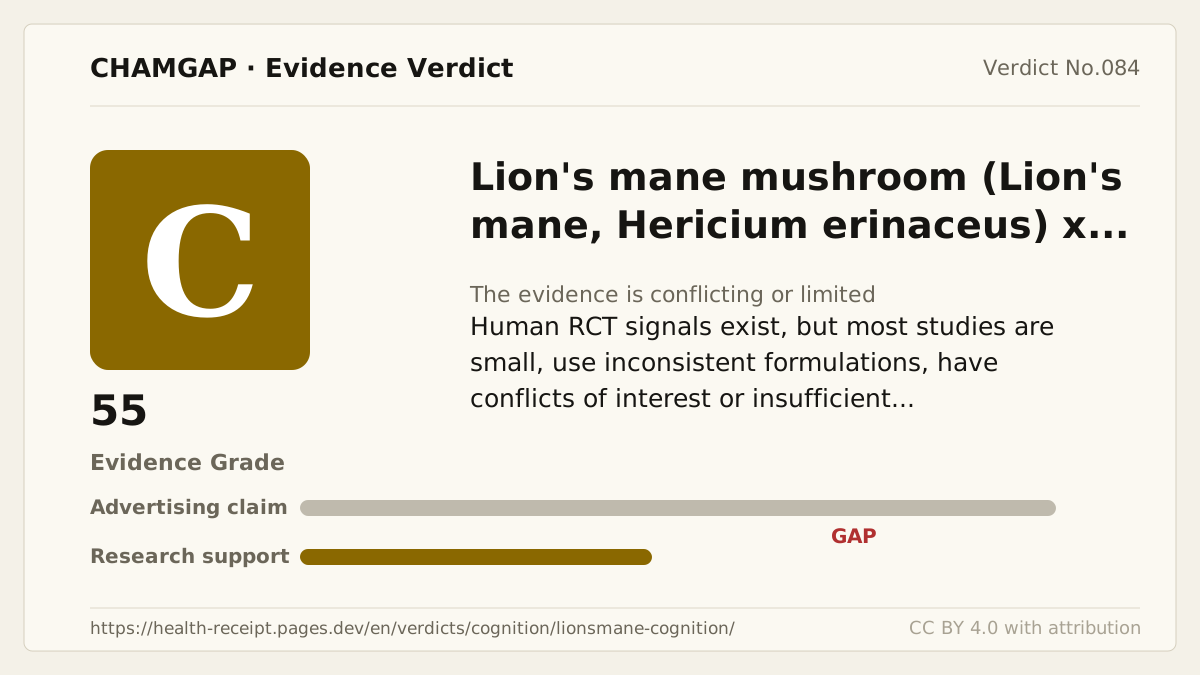
[Chamgap] Lion's mane mushroom × cognition, memory, and nerves — Evidence Grade C·55. 9 cited sources checked. Source: https://chamgap.com/en/verdicts/cognition/lionsmane-cognition/ · CC BY 4.0CC BY 4.0 — free to use with attribution; do not distort grades, numbers, or verdict meaning.
What this document does and does not do
Chamgap is an information source. It reports what research has and has not confirmed; it does not tell readers what to take or buy. That decision belongs to readers and, when needed, medical or legal professionals. This verdict reflects literature available up to the search date and may change as new research appears. Nothing here is medical advice.