
Phosphatidylserine,
does it really help with Cognition, memory, and concentration?
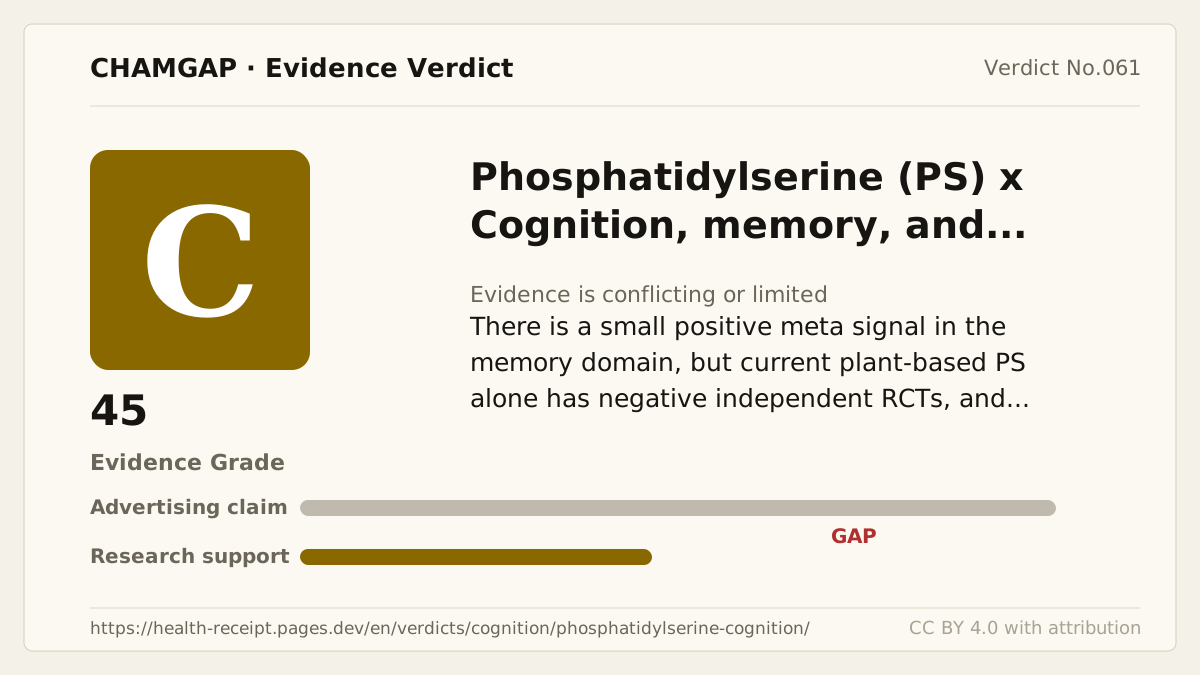
research showsPhosphatidylserine has a small possibility for some aging-related memory decline, but it is borderline as a clearly effective cognition/memory-improving ingredient. Old positive studies include bovine-cortex-derived PS, making them difficult to transfer directly to currently sold plant-based PS-only products such as soy or sunflower PS. Key independent RCTs of current plant-based PS alone are weak or negative, and positive evidence is skewed toward subgroup analyses, manufacturer-related studies, open-label studies, and combination products.
ads claimIn the Korean market, the scope of expressions is broad, including “may help improve cognition reduced by aging,” “memory/cognitive improvement,” “brain supplement,” “concentration,” “brain vitality for students, exam-takers, and office workers,” “dementia prevention,” or “management of mild cognitive impairment.” Product names and advertorials repeatedly include phrases such as PS 300 mg, non-GMO soy-derived, combinations with ginkgo, omega-3, zinc, and vitamins, and memory-improvement experience after at least 3 months of intake. Some content uses expressions that may be misunderstood as disease effects such as dementia prevention/treatment, but clinical evidence is mainly limited to some items of memory testing in older adults.
Useful facts when choosing a product
- Domestic health functional food functional wording is close to the regulatory phrase “may help improve cognition reduced by aging,” and this was interpreted separately from the evidence grade.
- Commercial products usually emphasize PS 300 mg/day and label the source as soy- or sunflower-derived.
- Many products are combined with ginkgo biloba extract, omega-3, zinc, B vitamins, folic acid, and others, making it difficult to attribute advertised effects to PS alone.
- For soy-derived products, soy allergy labeling is important, and ginkgo-containing products separately require caution with anticoagulants and antiplatelet agents.
- In studies, PS 100-300 mg/day was generally tolerated, and serious related adverse events were rare. Some studies mentioned possible gastrointestinal discomfort, itching, nausea, dizziness, and insomnia.
What the research actually shows
A 2022 systematic literature review/meta-analysis pooled 9 human studies (5 RCTs, total 961 participants) evaluating PS 100-300 mg/day for 6 weeks to 6 months and reported a small effect in the memory domain (SMD 0.22, 95% CI 0.06-0.38, I2=22%, p<0.01). However, this result mixes bovine cortex PS, which is difficult to use as a current food ingredient, PS-DHA/EPA combination products, and studies in dementia/Alzheimer patients. Evidence for soy-derived PS alone, which is closer to current market products, is mixed. The Japanese RCT by Kato-Kataoka 2010 (78 participants, 100 or 300 mg/day, 6 months) showed weak consistent differences versus placebo in the main tests for the overall group, with differences mainly in delayed recall in a subgroup with low baseline memory scores. Conversely, the Jorissen 2001 RCT (120 participants, 300 or 600 mg/day, 12 weeks) did not find differences in the primary outcomes of delayed recall/recognition. Richter 2013 found improvements in several memory and executive-function scores after 300 mg/day for 12 weeks, but it was a single-arm open-label study and all authors belonged to the ingredient company. PS-DHA combination RCTs and a 2025 ALA plus low-dose PS plus ginkgo plus vitamin combination RCT show positive signals, but it is difficult to isolate the effect of PS alone.
Why this is classified as C (45)
The final grade is confirmed as C, 45 points. A D verdict is possible because key independent RCTs of plant-based PS alone are weak or negative, but there is a small positive meta signal in memory and some RCT/subgroup results are not at a level that can be completely excluded. However, that signal relies on a mixture of old bovine-derived studies, plant-based PS alone, PS-DHA/EPA, and other combination products, so indirectness is large for current market claims about plant-based PS-only products. Therefore, rather than fixing it as F/D, it is kept as a lower-C borderline verdict.
Counterpoint. The D view is also reasonable. In independent RCTs of plant-based PS alone that are closest to current products, major memory/cognition markers did not clearly differ from placebo, and positive results are skewed toward low-baseline-memory subgroups, manufacturer-related studies, single-arm open-label studies, or combinations with PS-DHA/EPA, ginkgo, vitamins, and others. Old studies using bovine-cortex-derived PS are difficult to apply directly to current plant-based PS-only products, so conservatively D is possible because current plant-based PS alone lacks independent replication.
Rejudgment record. convergent — Draft = blind C. Some human memory RCT/meta signals, but current plant-based PS-alone independent evidence is weak/indirect.
Cross-check — Codex and Claude
Evidence Table
| Study | Design | Sample | Funding | Endpoint | Result | Weight |
|---|---|---|---|---|---|---|
| Kang EY et al. 2022 | meta-analysis/RCT | not reported | liver/memory | Meta-analysis of 9 studies (5 RCTs) found a small positive effect in the memory domain, SMD 0.22, while activities of daily living were not significant. | core | |
| Kato-Kataoka A et al. 2010 | not specified | 78 | possible manufacturer/industry involvement | memory | Japanese 78-person RCT; overall main-test differences were limited, and positive signals appeared mainly in delayed recall among the low-baseline-memory subgroup. | core |
| Jorissen BL et al. 2001 | not specified | 120 | possible manufacturer/industry involvement | cognition | 120-person soy-PS RCT, 300/600 mg/day for 12 weeks; primary delayed recall/recognition and other cognitive outcomes did not differ from placebo. | core |
| Richter Y et al. 2013 | not specified | 30 | not reported | memory | Single-arm open-label study in 30 people; after 300 mg/day for 12 weeks, memory recognition, memory recall, executive function, and some Rey-AVLT measures improved versus baseline. | core |
| Vakhapova V et al. 2010 | double-blind | possible manufacturer/industry involvement | not specified | PS-DHA/EPA combination RCT improved immediate verbal recall, and some results were prominent in post-hoc subgroups. | supporting | |
| Duan H et al. 2025 | double-blind RCT | 190 | not reported | liver/gut/memory | Chinese MCI RCT in 190 people; an ALA plus low-dose PS plus ginkgo plus vitamin combination improved some tests such as short-term memory. | supporting |
| Hirayama S et al. 2014 | not specified | possible manufacturer/industry involvement | gut/cognition/memory | KJFST review mentioned improvement in short-term auditory memory and attention in an ADHD child RCT, but the population differs from older-adult cognition/memory claims. | supporting | |
| FoodSafetyKorea | not specified | not reported | cognition | Food Safety Korea lists phosphatidylserine among notified functional ingredients related to cognitive ability. | supporting | |
| Study 9 | not specified | not reported | gut/cognition/memory | Domestic informational advertising connected mild cognitive impairment, 300 mg, intake for at least 3 months, and experiences of memory improvement. | supporting | |
| DementiaNews 2025 | not specified | not reported | gut | Report of National Assembly audit concern that phosphatidylserine advertorials could cause misunderstanding as dementia prevention/treatment. | supporting |
Receipt — 10 References
Of 10 cited sources, 3 had limited original-page access (blocked or summary-only) and were verified via index/summary, marked partial; the rest were verified at the original page. As of 2026-07-07.
Reviewed and approved: Chamgap Editorial Team · Approval date: 2026-07-07 · Corrections: none
Cite this verdict
[Chamgap] Phosphatidylserine x cognition, memory, and concentration — Evidence Grade C·45. 10 cited sources checked. Source: https://chamgap.com/en/verdicts/cognition/phosphatidylserine-cognition/ · CC BY 4.0CC BY 4.0 — free to use with attribution; do not distort grades, numbers, or verdict meaning.
What this document does and does not do
Chamgap is an information source. It reports what research has and has not confirmed; it does not tell readers what to take or buy. That decision belongs to readers and, when needed, medical or legal professionals. This verdict reflects literature available up to the search date and may change as new research appears. Nothing here is medical advice.