
Soy isoflavones,
does it really help with Menopausal symptoms in women, especially vasomotor symptoms such as hot flashes/night sweats?
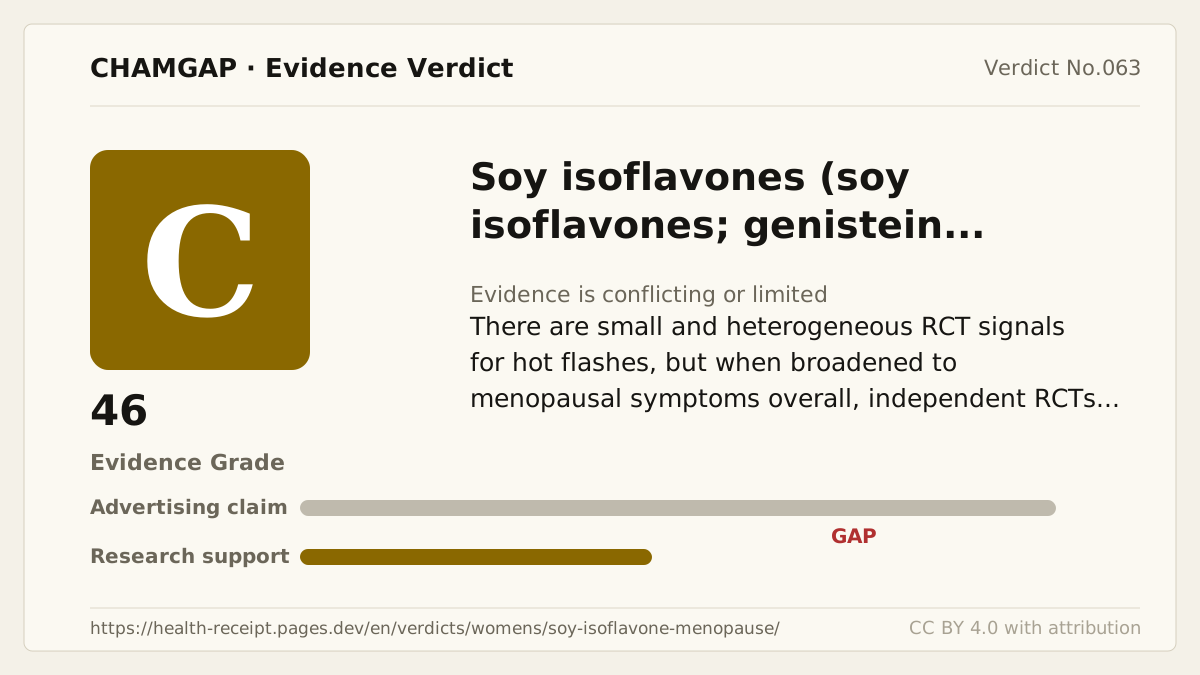
research showsSoy isoflavones have small improvement signals from some RCTs and older meta-analyses for vasomotor symptoms such as hot flashes/night sweats. However, Cochrane reviews, a large NIH-supported independent RCT, and 2022 and 2024 meta-analyses did not consistently reproduce improvement in overall menopausal symptoms or vasomotor symptoms. Formulations, doses, and participants differ by study, heterogeneity is large, and there are concerns about industry-related conflicts of interest, so the final verdict is C (46 points).
ads claimIn the Korean market and Korean informational content, soy isoflavones are described as “plant-based estrogen” and are often mentioned together with menopausal women’s health, relief of hot flashes/heat sensation, osteoporosis or bone health, depressed mood, skin elasticity, and cardiovascular health. Overseas direct-purchase product pages claimed relief of frequency and severity of menopausal hot flashes together with promotion of bone and heart health. A Korean Pharmaceutical Association article introduced estrogen receptor binding, hot flashes/fever, reduced osteoporosis risk, and even possible breast cancer prevention. Yuyu Pharma informational writing described soy isoflavones as ingredients that gently supplement the imbalance caused by estrogen decline. Guidance from the German Consumer Centre reposted by the Seoul Food Life Comprehensive Support Center stated that claims for relieving menopausal symptoms and preventing osteoporosis are not sufficiently proven and that safety has not been fully clarified.
Useful facts when choosing a product
- The “soy isoflavones” in products and articles are mentioned as a mixture of soy foods, soy germ extract, refined extracts, and synthetic genistein. In studies, aglycone equivalent, glycoside weight, and genistein content differ, so the same mg notation is not equivalent.
- In hot-flash studies, effects were more often seen with extracted/refined products high in genistein. It is difficult to interpret tofu/soy-milk intake studies and high-concentration capsule studies with the same strength.
- Domestic advertising language sometimes extends beyond hot flashes to bone, heart, skin, depression, and breast cancer prevention, but this C verdict reflects that even the possibility for hot flashes/some vasomotor symptoms is limited and inconsistent.
- The German Consumer Centre guidance from the Seoul Food Life Comprehensive Support Center introduces a recommendation for menopausal women’s supplements of a maximum 100 mg/day and maximum 10 months, and mentions uncertainty about long-term/high-dose safety.
- A history of estrogen-sensitive diseases such as breast cancer, anti-estrogen/aromatase-inhibitor treatment, thyroid disease or thyroid-hormone use, pregnancy/lactation, and long-term high-dose use are areas requiring separate consultation.
What the research actually shows
There are several human RCTs on soy/soy-derived isoflavones alone. The 2012 meta-analysis by Taku et al. quantitatively synthesized 17 of 19 trials of extracted/synthetic soy isoflavones and reported placebo-comparative reductions in hot-flash frequency by 20.6% and severity by 26.2%. However, heterogeneity was high, and there were industry-association-related conflicts of interest among the authors. The 2013 Cochrane review summarized that for phytoestrogens overall, there was no conclusive evidence that they reduce the frequency or severity of hot flushes/night sweats, and that genistein concentrates need additional research. The NIH-supported SPARE RCT (248 participants, 200 mg/day, 2 years) used bone density as the primary endpoint and menopausal symptoms as a secondary endpoint, but did not prevent menopausal symptoms or bone loss. A 2022 Korean meta-analysis included 11 RCTs, but hot flashes were not significant, and significant results for Kupperman index and estradiol showed extreme heterogeneity and disappearance after sensitivity analysis. A 2024 meta-analysis of RCTs from the last 10 years reported that in 5 studies and 425 participants, menopausal symptoms and quality of life had no significant effect and only depression scores decreased, while pointing out conflict-of-interest risk in included studies. A 2026 meta-analysis of sexual function/genitourinary symptoms showed improvement in vaginal dryness and genitourinary symptoms, but vasomotor symptoms only showed a trend toward significance and heterogeneity was large. Results for combination products (pomegranate, Sophora japonica, black cohosh, probiotics, vitamin D, etc.) were not directly transferred to the verdict for soy isoflavones alone.
Why this is classified as C (46)
The draft is downgraded from B to C. Some positive RCTs and a 2012 meta-analysis create a signal for improvement in hot flashes, but the evidence supporting the key efficacy is old and heterogeneous. The large independent SPARE RCT did not support prevention of menopausal symptoms, the 2022 meta-analysis found hot flashes not significant, and the 2024 meta-analysis of RCTs from the last 10 years also did not confirm improvement in menopausal symptoms or quality of life. Positive results mix high-genistein products, specific participant groups, and industry-related authors/product support, making them difficult to extend to general soy isoflavone claims. The grade is not lowered to D because of some hot-flash signals, but inconsistency in independent large RCTs and recent meta-analyses, high heterogeneity, and concerns about conflicts of interest correspond to boundary 1, so C (46 points) is confirmed.
Counterpoint. There is also not enough basis to declare it completely null. In participants with clear vasomotor symptoms or with refined products high in genistein, some trials reported improvement versus placebo, and some genitourinary symptoms have separate signals. However, these signals do not support menopausal symptoms overall, ordinary soy isoflavone products, or bone/cardiovascular/cancer prevention claims. For consumers, it is more appropriate to explain it not as a “menopause-solving ingredient,” but as a limited and uncertain possibility for hot flashes.
Rejudgment record. reassessment (downgraded B -> C) — Some RCT signals for hot flashes exist, but independent large trials and recent meta-analyses are inconsistent and heterogeneity is large -> boundary 1 C. Consistent with blind C.
Cross-check — Codex and Claude
Evidence Table
| Study | Design | Sample | Funding | Endpoint | Result | Weight |
|---|---|---|---|---|---|---|
| Taku K, Melby MK, Kronenberg F, Kurzer MS, Messina M 2012 | meta-analysis/RCT | possible manufacturer/industry involvement | hot flashes | A 17-RCT meta-analysis reported that soy isoflavones reduced hot-flash frequency and severity versus placebo by 20.6% and 26.2%, respectively, but heterogeneity was large. | core | |
| Lethaby A, Marjoribanks J, Kronenberg F, Roberts H, Eden J, Brown J 2013 | not specified | not reported | liver/hot flashes | Cochrane review judged that there was no conclusive evidence that phytoestrogen supplements reduce the frequency or severity of hot flashes/night sweats. | core | |
| Levis S, Strickman-Stein N, Ganjei-Azar P, Xu P, Doerge DR, Krischer J 2011 | double-blind RCT | 248 | not reported | menopause | NIH-supported 248-person RCT: 200 mg/day soy isoflavones for 2 years did not prevent bone loss or menopausal symptoms. | core |
| D'Anna R, Cannata ML, Atteritano M et al. 2007 | double-blind RCT | 247 | possible manufacturer/industry involvement | not specified | 54 mg/day genistein RCT reported positive results using reduction in hot-flush frequency/severity as the main efficacy criteria. | core |
| Nahas EA, Nahas-Neto J, Orsatti FL, Carvalho EP, Oliveira ML, Dias R 2007 | double-blind RCT | possible manufacturer/industry involvement | not specified | Soy isoflavone extract RCT reported that hot-flush severity decreased more than placebo. | supporting | |
| Kang I, Rim CH, Yang HS, Choe JS, Kim JY, Lee M 2022 | meta-analysis/RCT | not reported | not specified | In an 11-RCT meta-analysis, hot flashes were not significant, and significant Kupperman index/estradiol results had very high heterogeneity. | supporting | |
| Gencturk N, Bilgic FS, Kaban HU 2024 | meta-analysis/RCT | 425 | not reported | liver/depression/menopause | Meta-analysis of 5 RCTs from the last 10 years, 425 participants: menopausal symptoms and quality of life were not significant, and only depression scores improved. | supporting |
| Yildiz Karaahmet A, Sadeghi E 2026 | meta-analysis/RCT | 1325 | not reported | liver | 2026 meta-analysis of 13 RCTs found improvement in vaginal dryness/genitourinary symptoms, but vasomotor symptoms were not statistically significant. | supporting |
Receipt — 8 References
Of 8 cited sources, 2 had limited original-page access (blocked or summary-only) and were verified via index/summary, marked partial; the rest were verified at the original page. As of 2026-07-07.
Reviewed and approved: Chamgap Editorial Team · Approval date: 2026-07-07 · Corrections: none
Cite this verdict
[Chamgap] Soy isoflavones x menopausal symptoms in women, especially vasomotor symptoms such as hot flashes/night sweats — Evidence Grade C·46. 8 cited sources checked. Source: https://chamgap.com/en/verdicts/womens/soy-isoflavone-menopause/ · CC BY 4.0CC BY 4.0 — free to use with attribution; do not distort grades, numbers, or verdict meaning.
What this document does and does not do
Chamgap is an information source. It reports what research has and has not confirmed; it does not tell readers what to take or buy. That decision belongs to readers and, when needed, medical or legal professionals. This verdict reflects literature available up to the search date and may change as new research appears. Nothing here is medical advice.