
Complex extract including Cynanchum wilfordii,
does it really help with Relief of menopausal symptoms in women?
research showsIn the Korean market, Cynanchum wilfordii and pomegranate are often grouped with expressions such as “plant-based/estrogen-like,” “health of menopausal women,” and “menopausal symptoms such as hot flashes, sweating, sleep, and mood.” Randomized, double-blind, placebo-controlled human trials actually exist, and the primary endpoints are symptom markers such as Kupperman Index, hot-flash frequency/intensity, and MENQOL, not surrogate markers such as blood hormones. However, the evidence for Cynanchum wilfordii is not evidence for Cynanchum wilfordii alone, but for the Cynanchum wilfordii, Phlomis umbrosa, and Angelica gigas complex extract (EstroG-100), and pomegranate results are mixed by formulation, including concentrate, extract, and seed oil. Samples are generally around 70-112 participants, follow-up is mainly 4-12 weeks, and no large independent long-term RCT was found.
ads claimDomestic advertisements and informational articles introduce complex extract including Cynanchum wilfordii and pomegranate extract/concentrate together as functional ingredients for menopausal women’s health, and use expressions such as estrogen reduction, plant-based estrogen, natural estrogen-like substances, hot flashes, sweating, insomnia, depressed mood, vaginal dryness, and Kupperman Index improvement. Health Chosun explains that the complex extract including Cynanchum wilfordii is not single-ingredient Cynanchum wilfordii but a complex of Cynanchum wilfordii, Angelica gigas, and Phlomis umbrosa, and that there are studies lowering Kupperman Index, while also noting limitations regarding cholesterol changes, long-term safety, and bone-health evidence. Everyday Health Magazine describes pomegranate extract/concentrate as natural estrogen-like substances and the complex extract including Cynanchum wilfordii as a raw material with estrogen-like action, and mentions checking health functional food certification and human application trials. Food Safety Korea lists complex extract including Cynanchum wilfordii, pomegranate concentrate, and pomegranate extract as individually recognized ingredients that “may help the health of menopausal women,” but this regulatory fact was separated from the evidence grade.
Useful facts when choosing a product
- The key raw material in human RCTs related to Cynanchum wilfordii is not Cynanchum wilfordii alone, but the 3-ingredient complex extract EstroG-100, consisting of Cynanchum wilfordii, Phlomis umbrosa, and Angelica gigas.
- The dose repeatedly appearing in EstroG-100 RCTs is 514 mg/day for 12 weeks.
- The “complex extract including Cynanchum wilfordii” mentioned in domestic articles should be distinguished from single-ingredient Cynanchum wilfordii products.
- Pomegranate evidence mixes pomegranate concentrate, pomegranate extract, and pomegranate seed oil, so pomegranate juice, ordinary juice, and health functional food raw materials cannot be regarded as the same.
- The main primary/core endpoints in menopausal symptom studies were Kupperman Index, modified KMI, hot-flash frequency/intensity, and MENQOL, while blood E2/FSH were used as supporting or safety markers.
- Most trials were short-term, 4-12 weeks, and no large independent long-term RCT was identified.
- In the 2015 Cynanchum wilfordii market, there was an issue of adulteration with Cynanchum auriculatum, which is not efficacy evidence but a safety issue involving raw-material identity and quality control.
- Pomegranate is generally summarized as well tolerated, but possible drug interactions between juice/extract/supplements and drugs such as warfarin require separate caution.
- People with histories of hormone-related cancer, abnormal uterine bleeding, or use of anticoagulants/antiplatelet agents were excluded from most RCTs, making it difficult to generalize real-world use safety.
What the research actually shows
Separated by efficacy and raw material, the evidence is as follows. (1) Complex extract including Cynanchum wilfordii (EstroG-100): The 2012 Phytotherapy Research RCT included 64 participants for 12 weeks, set KMI and vaginal dryness as primary endpoints, and reported that KMI decreased from 29.5 to 11.3, whereas placebo decreased from 29.2 to 23.7. A 2022 Korean multicenter RCT included FAS 99 participants for 12 weeks, and the change in total modified KMI was EstroG -20.31±12.07 and placebo -14.10±13.51, showing significance between groups (p=0.0089/0.0163). A 2024 Iranian RCT analyzed 70 participants for 12 weeks, compared weekly reports of hot-flash frequency/intensity, and after week 6 mild, moderate, and severe hot flashes were reported more often in the placebo group. The authors specified that this trial had no external funding. (2) Pomegranate: A 2010 Korean pomegranate-concentrate RCT included 112 participants for 12 weeks, significantly improved Kupperman Index versus placebo (p<0.0001), and showed no difference in E2. A 2022 Iranian RCT randomized 78 participants, and after 4 weeks of intake, modified Kupperman Index and MENQOL improved more than placebo (p<0.001); it specified university medical-thesis funding and no conflicts of interest. In contrast, a 2012 pomegranate seed oil RCT completed 81 participants, and after 12 weeks hot flashes decreased in both groups, but the between-group difference was not significant (P=0.17). A 2024 pomegranate systematic review/meta-analysis summarized improvement in hot flash severity and menopause symptoms, but specified that “most results were inconclusive” and noted risk of bias due to small samples and insufficient blinding/randomization. (3) The broader phytoestrogen Cochrane 2013 viewed conclusions for hot flush/night sweat as indeterminate and does not support the generalization that “all estrogen-like plant components improve menopausal symptoms.”
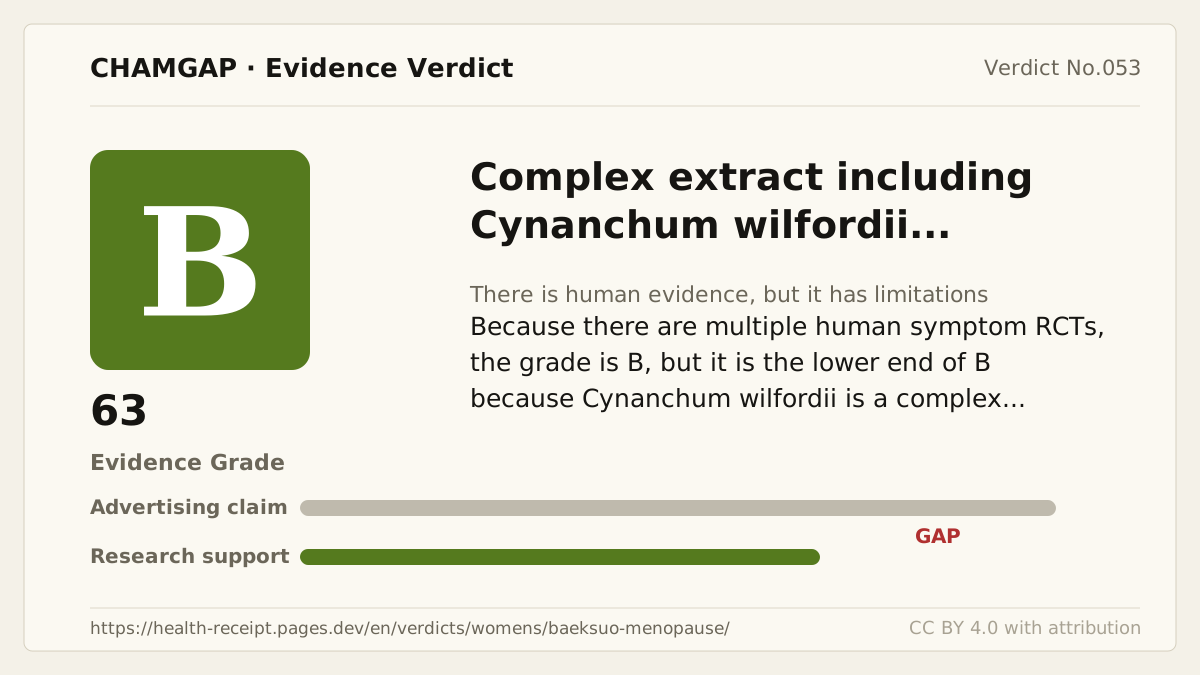
Why this is classified as B (63)
There are several human RCTs that looked at symptoms themselves, and for the complex extract including Cynanchum wilfordii, Korean, U.S./California, and Iranian data point in the same direction; pomegranate also has positive Korean and Iranian RCTs and a 2024 meta-analysis. Therefore, leaving it only at C would underestimate the existence of human symptom RCTs. However, there is no large independent RCT or consistent high-quality meta-analysis required for A. Cynanchum wilfordii is highly manufacturer/product-dependent and is not Cynanchum wilfordii alone, and pomegranate has a negative seed-oil RCT and a meta-analysis warning about risk of bias. Therefore, the verdict is 63 points, the lower end of B.
Counterpoint. The strongest counterargument is that “symptom-index RCTs are repeatedly positive.” In particular, EstroG-100 reduced total KMI more than placebo in a 12-week placebo-controlled trial, and the 2024 Iranian trial specified no funding. Conversely, the mechanistic expression “estrogen-like” is not a sufficient condition for efficacy, and the same evidence cannot be extended to single-ingredient Cynanchum wilfordii or ordinary pomegranate juice.
Rejudgment record. convergent — Draft = blind B. Multiple human RCTs on menopausal symptoms (complex extract). However, it is not Cynanchum wilfordii alone, and the history of raw-material incidents is specified.
Cross-check — Codex and Claude
Evidence Table
| Study | Design | Sample | Funding | Endpoint | Result | Weight |
|---|---|---|---|---|---|---|
| Chang A, Kwak BY, Yi K, Kim JS 2012 | double-blind RCT | 64 | not reported | not specified | EstroG-100 12-week RCT with 64 participants: KMI and vaginal dryness were primary endpoints, and KMI decreased more than placebo. | core |
| Kim et al. 2022 | double-blind RCT | possible manufacturer/industry involvement | not specified | Korean multicenter 12-week RCT: modified KMI change was significant, EstroG -20.31±12.07 versus placebo -14.10±13.51. | core | |
| Farzaneh F, Fallah G, Khalili-chelik A, Fallah A, Hosseini M 2024 | double-blind RCT | 35 | not reported | not specified | Iranian 12-week RCT, analyzed 35 participants/group: from week 6, mild, moderate, and severe hot flashes were all more frequent in the placebo group, and the authors specified no funding. | core |
| Moeini R, Shirafkan H, Gorji N 2024 | meta-analysis of RCTs | not reported | not specified | Pomegranate systematic review/meta-analysis: summarized improvement in hot flash severity and menopause symptoms, but specified that most results were uncertain because of small samples and insufficient blinding/randomization. | core | |
| Adel-Mehraban MS, Tansaz M, Mohammadi M, Yavari M 2022 | double-blind RCT | 78 | not reported | not specified | Pomegranate supplement 4-week RCT in 78 participants: modified KMI and MENQOL improved more than placebo (p<0.001), with university funding and no conflicts of interest. | supporting |
| Ahn KH, Kim SM, Yi KW et al. 2010 | double-blind RCT | 112 | possible manufacturer/industry involvement | not specified | Korean pomegranate concentrate 12-week RCT in 112 participants: Kupperman Index improved significantly versus placebo (p<0.0001), with no E2 difference. | supporting |
| Auerbach L, Rakus J, Bauer C et al. 2012 | double-blind RCT | 81 | not reported | liver | Pomegranate seed oil 12-week RCT, 81 completed: hot flash reduction was not greater than placebo (P=0.17). | supporting |
| Lethaby A, Marjoribanks J, Kronenberg F, Roberts H, Eden J, Brown J 2013 | not specified | not reported | not specified | Cochrane on phytoestrogens overall: there is no conclusive evidence for reducing hot flush/night sweat, and many studies are small and at high risk of bias. | supporting | |
| Study 9 | not specified | not reported | not specified | Complex extract including Cynanchum wilfordii, pomegranate concentrate, and pomegranate extract are included in the domestic individually recognized functional ingredient list. | supporting | |
| Study 10 | not specified | not reported | gut | Example of a domestic informational article: explained that the complex extract including Cynanchum wilfordii is not a single ingredient and described both Kupperman Index improvement and limitations. | supporting | |
| Study 11 | not specified | not reported | gut/menopause | Example of market language: introduced pomegranate extract/concentrate and complex extract including Cynanchum wilfordii as estrogen-like raw materials for menopausal women’s health. | supporting | |
| Study 12 | not specified | not reported | not specified | Explained that at the time of functionality recognition there were company-submitted materials, supplementation of human application trial data, and discussion of the appropriateness of Kupperman Index. | supporting | |
| Study 13 | not specified | not reported | not specified | Safety data on raw-material identity/quality control announcing detection of Cynanchum auriculatum in Cynanchum wilfordii raw materials and products in 2015. | supporting | |
| NCCIH 2025 | not specified | not reported | not specified | Pomegranate juice is generally safe and extracts may also be safe, but caution is needed with large intake of root/stem/peel and with concomitant medication use. | supporting |
Receipt — 14 References
Of 14 cited sources, 4 had limited original-page access (blocked or summary-only) and were verified via index/summary, marked partial; the rest were verified at the original page. As of 2026-07-07.
Reviewed and approved: Chamgap Editorial Team · Approval date: 2026-07-07 · Corrections: none
Cite this verdict
[Chamgap] Complex extract including Cynanchum wilfordii x relief of menopausal symptoms in women — Evidence Grade B·63. 14 cited sources checked. Source: https://chamgap.com/en/verdicts/womens/baeksuo-menopause/ · CC BY 4.0CC BY 4.0 — free to use with attribution; do not distort grades, numbers, or verdict meaning.
What this document does and does not do
Chamgap is an information source. It reports what research has and has not confirmed; it does not tell readers what to take or buy. That decision belongs to readers and, when needed, medical or legal professionals. This verdict reflects literature available up to the search date and may change as new research appears. Nothing here is medical advice.