
Flaxseed,
does it really help with menopausal symptoms (hot flashes/night sweats), gut health (constipation/bowel movements), cholesterol (LDL/total cholesterol)?
research showsThe evidence for viewing flaxseed lignans as a 'menopause relief' ingredient is weak. In the axis of large placebo-controlled RCTs and Cochrane reviews, improvement in hot flashes and night sweats was not clearly different from placebo. In contrast, if constipation/bowel frequency and lowering total cholesterol/LDL-C are considered as separate effects, there is more human research. Cholesterol in particular has relatively consistent RCT meta-analysis signals centered on ground/whole flaxseed, but flaxseed oil and low-dose lignan capsules are difficult to group under the same evidence.
ads claimIn Korean-market and informational articles, phrases recur such as 'flaxseed lignans are phytoestrogens,' 'there are more lignans or estrogenic components than soy/pomegranate,' and 'they replenish female hormones and relieve menopausal symptoms.' In the same content bundles, 'constipation and gut health,' 'instead of probiotics,' 'blood cholesterol and vascular health,' 'cardiovascular health,' and 'antioxidant and cancer prevention' are attached together. For example, a 2015 Newsis article-style advertisement introduced flaxseed lignans as a menopause health food and used comparisons such as 1400 times soy and 460 times pomegranate. Korea Daily, health lecture-style videos, and shopping-mall health blog search results also exposed menopause, constipation/gut, and cholesterol claims together.
Useful facts when choosing a product
- Cholesterol evidence mainly comes from ground/whole flaxseed or lignan supplementation studies. Flaxseed oil has less fiber and lignan, so LDL-C and constipation evidence are difficult to transfer unchanged.
- Constipation RCT doses often use food-level amounts, such as 10 g twice daily in cookie form or 50 g/day flaxseed flour. It must be checked whether this matches exposure from low-dose lignan capsule advertising.
- The reference amount for the cholesterol claim reviewed by Health Canada was ground whole flaxseed 40 g/day. Separate from regulatory recognition status, this shows that the evidence is tied to a specific form and dose.
- A comparison saying lignan content is high is not a clinical outcome. Relief of menopausal symptoms must be evaluated separately using human outcomes such as hot-flash diary, MENQOL, and Kupperman/MRS.
- Gut-microbiome change studies are strongly mechanistic or surrogate-marker in nature. For the constipation judgment, bowel frequency and symptom scores were prioritized.
What the research actually shows
Effect-specific judgment: (1) Menopause/hot flashes: F (12). Placebo-controlled or controlled RCTs such as Lewis 2006, Simbalista 2010, and Pruthi 2012 did not consistently reduce hot flash/MENQOL/Kupperman index more than placebo. Colli 2012 and a 2024 Cureus single-center study had positive signals, but in Colli the between-group comparison of change was not statistically significant, and the 2024 study was single-blind with multiple symptom scores and before independent replication, making it difficult to overturn the key negative RCTs. (2) Gut/constipation: B (64). There are short-term RCTs in functional constipation and diabetes-associated constipation, and bowel frequency, Wexner/ROME III symptoms, and quality of life improved. However, most were 4-12 weeks, small, and some were industry-funded or in special populations. (3) Cholesterol: A (82). Meta-analyses of 28 or more RCTs and later meta-analyses found modest reductions in total cholesterol and LDL-C, mainly observed with ground/whole flaxseed and lignans. Flaxseed oil is not consistent for the same effect. The overall bundled claim is lowered to C because one axis, menopause, is repeatedly negative.
Why this is classified as C (54)
The principle of separating combined claims was applied. Cholesterol has many human RCTs and meta-analyses and would fall in the A range as a stand-alone claim. Constipation/bowel movements have human RCTs but fall in the B range because of limitations in sample, duration, and population. However, menopausal hot-flash claims are negative in independent, relatively large placebo-controlled RCTs, and the Cochrane phytoestrogen review also found conclusions insufficient. Because the most consumer-salient 'menopause lignan' axis collapses, the overall advertising bundle is set at C (54).
Counterpoint. Not all flaxseed effects have weak evidence. LDL-C and total cholesterol reduction with ground/whole flaxseed and improved bowel frequency in constipated patients have human data. However, that evidence does not automatically extend to menopausal symptom relief claims or to all flaxseed oil/low-dose lignan products.
Rejudgment record. Draft and blinded review converged — Flaxseed has human evidence for LDL/total cholesterol and constipation, but 'lignan relief of menopausal hot flashes' repeatedly failed to hold in key placebo-controlled RCTs.
Cross-check — Codex and Claude
Evidence Table
| Study | Design | Sample | Funding | Endpoint | Result | Weight |
|---|---|---|---|---|---|---|
| Study 1 | not specified | not reported | gastrointestinal/menopause | Korean article-style promotion introduced flaxseed lignans as a menopause health food and phytoestrogen. | core | |
| Lethaby A et al. 2013 | RCT | 4364 | not reported | not specified | Review of 43 RCTs and 4,364 participants found that evidence for phytoestrogens overall reducing hot flush/night sweat was not conclusive. | core |
| Pruthi S et al. 2012 | double-blind RCT | 188 | not reported | not specified | In a 188-participant RCT, hot flash score reduction was flaxseed 4.9 vs placebo 3.5, P=0.29, not significant. | core |
| Lewis JE et al. 2006 | RCT | 99 | not reported | not specified | In a 99-participant, 16-week muffin RCT, flaxseed/soy did not significantly improve MENQOL or hot-flash symptoms. | core |
| Simbalista RL et al. 2010 | not specified | 38 | possible manufacturer/industry involvement | not specified | 38 completers; in a 12-week RCT of 25 g/day flaxseed bread, hot flashes and KMI did not differ from control. | supportive |
| Colli MC et al. 2012 | not specified | 90 | not reported | liver | In a 90-participant three-arm RCT, within-group Kupperman decreases occurred, but between-group comparison of changes was unclear, P=0.084. | supportive |
| Shrivastava R et al. 2024 | not specified | 145 | not reported | not specified | A 145-participant single-blind RCT reported improved perimenopausal symptom scores and ED/EL indicators after 10 g/day flaxseed powder for 3 months. | supportive |
| Pan A et al. 2009 | meta-analysis of RCTs | possible manufacturer/industry involvement | LDL | Meta-analysis of 28 RCTs found total cholesterol -0.10 mmol/L and LDL-C -0.08 mmol/L; effects were clearer with whole flaxseed/lignans. | supportive | |
| Comparisons of different flaxseed products on lipid profiles in dyslipidemia-related diseases: systematic review and dose-response meta-analysis of RCTs 2021 | meta-analysis of RCTs | 1698 | not reported | LDL | Meta-analysis of 31 RCTs and 1,698 participants found improvement signals for TC/LDL-C/TG/apoB, and whole flaxseed was more consistent than oil. | supportive |
| Health Canada 2014 | not specified | not reported | LDL | Concluded that a total/LDL cholesterol-lowering claim was supported based on ground whole flaxseed 40 g/day. | supportive | |
| Sun J et al. 2020 | RCT | 90 | possible manufacturer/industry involvement | bowel movements | In a 90-participant Rome IV functional constipation RCT, flaxseed flour 50 g/day improved Wexner score and bowel frequency after 4 weeks. | supportive |
| Soltanian N, Janghorbani M 2018 | RCT | 53 | not reported | not specified | In 53 T2D constipation patients, flaxseed cookies 10 g twice daily lowered constipation symptom score more than placebo. | supportive |
| Soltanian N, Janghorbani M 2019 | not specified | 77 | not reported | not specified | In a 77-participant three-arm RCT of T2D constipation patients, flaxseed improved constipation symptoms and some metabolic indicators versus psyllium/placebo. | supportive |
| Ma J et al. 2022 | RCT | not reported | bowel movements/gastrointestinal | In older constipation patients, bowel movements and some gut-microbiome indicators improved after flaxseed, but there were small-sample and dietary-control limitations. | supportive | |
| NCCIH | not specified | not reported | pregnancy | Presents cautions about raw/unripe flaxseed, high-dose GI symptoms, possible interactions with anticoagulants/antiplatelets, and uncertainty in pregnancy/lactation. | supportive |
Receipt — 15 References
Of 15 cited sources, 4 had limited original-page access (blocked or summary-only) and were verified via index/summary, marked partial; the rest were verified at the original page. As of 2026-07-07.
Reviewed and approved: Chamgap Editorial Team · Approval date: 2026-07-07 · Corrections: none
Cite this verdict
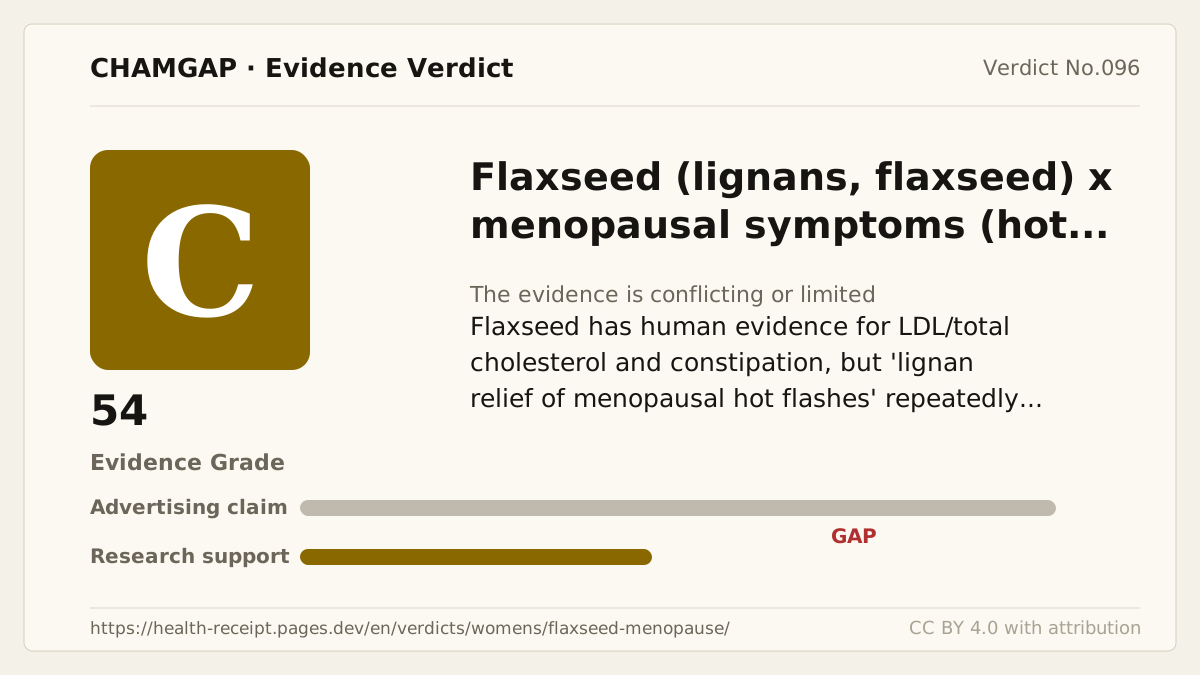
[Chamgap] Flaxseed (lignans, flaxseed) × menopausal symptoms (hot flashes/night sweats), gut health (constipation/bowel movements), cholesterol (LDL/total cholesterol) — Evidence Grade C·54. 15 cited sources checked. Source: https://chamgap.com/en/verdicts/womens/flaxseed-menopause/ · CC BY 4.0CC BY 4.0 — free to use with attribution; do not distort grades, numbers, or verdict meaning.
What this document does and does not do
Chamgap is an information source. It reports what research has and has not confirmed; it does not tell readers what to take or buy. That decision belongs to readers and, when needed, medical or legal professionals. This verdict reflects literature available up to the search date and may change as new research appears. Nothing here is medical advice.