
Evening primrose oil,
does it really help with PMS (discomfort due to premenstrual changes) and skin (immune hypersensitivity/atopic dermatitis, dryness, itching)?
research showsParticipant-rated eczema VAS was MD -2.22 (95% CI -10.48 to 6.04), and physician-rated VAS was -3.26 (-6.96 to 0.45), leaving room for meaningful improvement. A pooled confidence interval for PMS could not be verified. Because the confidence intervals do not exclude clinically meaningful benefit, the grade is D with 25 points, not F.
ads claimIn the Korean market, PMS, premenstrual syndrome improvement, menstrual pain, immune-hypersensitive skin, skin health, blood circulation, and cholesterol are often sold together. Pillize search listings attach tags such as “PMS improvement,” “immune-hypersensitive skin improvement,” “skin health,” and “blood circulation improvement” to multiple evening primrose oil products. Atomy informational/product articles present GLA 240 mg, premenstrual discomfort, blood flow/cholesterol, and immune-hypersensitive skin-state improvement together. A HiNews article states that evening primrose oil helps atopy, itching, skin diseases, and female hormone regulation. Blackmores Korea health information links PMS and prostaglandin metabolism and explains that GLA/evening primrose oil intake may help relieve symptoms. MFDS functional recognition or monograph existence was treated only as a regulatory fact and was not separately reflected in the evidence grade.
Useful facts when choosing a product
- MFDS announced on 2023-12-28 that it had published a monograph on GLA-containing oils. This means a regulatory/informational document exists and is separate from this verdict’s evidence grade.
- Domestic advertising often groups evening primrose oil and borage oil together as “GLA-containing oils.” Atomy material explains borage oil as GLA 20% or more, blackcurrant oil 13%, and evening primrose oil 6-9%.
- Rocha Filho 2011, which may often be cited as a positive PMS RCT, was not EPO alone but a complex preparation containing per 1 g capsule GLA 210 mg, oleic acid 175 mg, linoleic acid 345 mg, other PUFA 250 mg, and vitamin E 20 mg.
- The positive Korean skin RCT used GLA 40 mg per 450 mg EPO capsule; children aged 2-12 took 4 capsules/day and others 8 capsules/day for 4 months. Both groups used moisturizers.
What the research actually shows
Separated by efficacy, skin/atopy is null-leaning but D: Cochrane 2013 reviewed 27 RCTs and 1,596 participants (including 19 EPO studies), and overall eczema symptom improvement with EPO was not significant: participant VAS MD -2.22 (95% CI -10.48 to 6.04), physician VAS MD -3.26 (95% CI -6.96 to 0.45). A small Korean RCT in 2018 (n=50 completed) found significant EASI improvement, but TEWL, moisture, itching, and IgE were not significant, and it is insufficient to overturn the large negative meta-conclusion. PMS is also D: Budeiri 1996 found 7 EPO clinical studies, but randomization was clear in only 5 and the two best-controlled studies did not show benefit. The Whelan 2009 DARE summary also judged that 3 EPO RCTs (2 high quality) had no statistical evidence of efficacy for PMS symptoms. In contrast, Rocha Filho 2011 RCT (n=120, 116 analyzed) showed PRISM score reduction with a complex fatty-acid plus vitamin E preparation containing GLA, but the test product was a mixture of GLA, linoleic acid, oleic acid, other PUFAs, and vitamin E, and there was also product provision.
Why this is classified as D (25)
Participant-rated eczema VAS was MD -2.22 (95% CI -10.48 to 6.04), and physician-rated VAS was -3.26 (-6.96 to 0.45), leaving room for meaningful improvement. A pooled confidence interval for PMS could not be verified. Because the confidence intervals do not exclude clinically meaningful benefit, the grade is D with 25 points, not F.
Counterpoint. It is not that there is absolutely no positive evidence. A Korean mild AD RCT and an Indian AD RCT reported improvement in clinical scores in the EPO group, and Rocha Filho 2011 reported a decrease in PMS scores with a complex fatty-acid preparation containing GLA. However, these positive studies have interpretive limits such as small samples, combination products, completer analyses, concomitant moisturizer use, and product provision, and in skin they conflict with the conclusion of 27 Cochrane RCTs.
Rejudgment record. convergent — Participant-rated eczema VAS was MD -2.22 (95% CI -10.48 to 6.04), and physician-rated VAS was -3.26 (-6.96 to 0.45), leaving room for meaningful improvement. A pooled confidence interval for PMS could not be verified. Because the confidence intervals do not exclude clinically meaningful benefit, the grade is D with 25 points, not F.
Sub-claim grades by effect
This ingredient is marketed for several effects. A single overall grade blends strong and weak claims together, so each effect is graded separately here. The overall grade reflects the strongest disconfirming or core claim.
| Effect (sub-claim) | Grade | Basis |
|---|---|---|
| Skin/atopic dermatitis | D | Eczema symptom improvement null in a large meta-analysis (Cochrane 2013) |
| PMS | D | Well-controlled independent RCTs mostly null; positive results are small or from combinations |
Cross-check — Codex and Claude
Evidence Table
| Study | Design | Sample | Funding | Endpoint | Result | Weight |
|---|---|---|---|---|---|---|
| Study 1 | not specified | not reported | gut | Official notice that safety and functionality information for GLA-containing oils was published as a monograph. | core | |
| Study 2 | not specified | not reported | skin/immunity/gut/PMS | Product listings repeatedly expose tags such as PMS improvement, immune-hypersensitive skin improvement, skin health, and blood circulation improvement. | core | |
| Study 3 | not specified | not reported | skin/cholesterol/blood flow/PMS | Presented GLA 240 mg together with PMS, skin, blood-flow, and cholesterol functions and explained differences in GLA content between borage oil and evening primrose oil. | core | |
| Study 4 | not specified | not reported | skin/gut | Informational article explaining that evening primrose oil is effective for atopy, itching, skin disease, and hormone regulation. | core | |
| Blackmores Korea | not specified | not reported | PMS | Explains that PMS and prostaglandin metabolism are connected and that GLA/evening primrose oil may help relieve symptoms. | supporting | |
| Budeiri D, Li Wan Po A, Dornan JC 1996 | not specified | not reported | gut/PMS | Reviewed 7 EPO PMS clinical studies, but the two best-controlled studies showed no benefit, and concluded that current evidence suggests little value in PMS management. | supporting | |
| Whelan AM, Jurgens TM, Naylor H 2009 | systematic review/RCT | not reported | PMS | DARE summary judged that 3 EPO RCTs (2 high quality) had no statistically significant evidence of efficacy for PMS symptoms. | supporting | |
| Rocha Filho EA, Lima JC, Pinho Neto JS, Montarroyos U 2011 | RCT | 120, | not reported | not specified | In an RCT of a complex fatty-acid plus vitamin E preparation containing GLA (n=120, 116 analyzed), 6-month PRISM scores decreased more than placebo. | supporting |
| Bamford JTM, Ray S, Musekiwa A, van Gool C, Humphreys R, Ernst E 2013 | RCT | 1596 | not reported | skin | Review of 27 RCTs and 1,596 participants; EPO and borage oil were similar to placebo for eczema symptoms, and EPO/BO were concluded not to be effective treatments. | supporting |
| Kim J, Yun H, Jang J et al. 2018 | RCT | 50 | mixed/partly industry-related | moisture | In a Korean mild AD RCT (n=50 completed), 4-month EASI improved significantly more in the EPO group than placebo, but TEWL, moisture, itching, and IgE were not significant. | supporting |
| Senapati S, Banerjee S, Gangopadhyay DN 2008 | RCT | 25 | possible manufacturer/industry involvement | not specified | In an Indian AD RCT, improvement after 5 months was reported as EPO 24/25 and placebo 8/25, but analysis method and blinding/funding information were limited. | supporting |
Receipt — 11 References
All 11 cited sources were verified for existence at the original page (as of 2026-07-07).
Reviewed and approved: Chamgap Editorial Team · Approval date: 2026-07-07 · Corrections: none
Cite this verdict
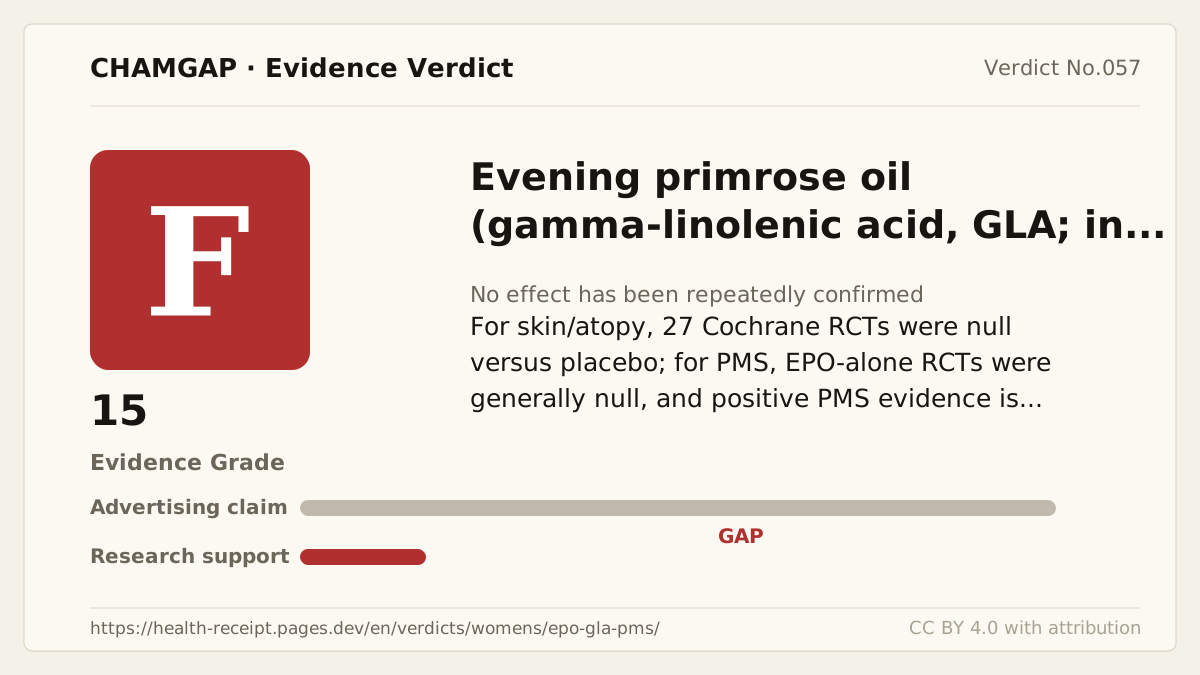
[Chamgap] Evening primrose oil x PMS (discomfort due to premenstrual changes) and skin (immune hypersensitivity/atopic dermatitis, dryness, itching) — Evidence Grade D·25. 11 cited sources checked. Source: https://chamgap.com/en/verdicts/womens/epo-gla-pms/ · CC BY 4.0CC BY 4.0 — free to use with attribution; do not distort grades, numbers, or verdict meaning.
What this document does and does not do
Chamgap is an information source. It reports what research has and has not confirmed; it does not tell readers what to take or buy. That decision belongs to readers and, when needed, medical or legal professionals. This verdict reflects literature available up to the search date and may change as new research appears. Nothing here is medical advice.