
St. John's wort,
does it really help with depression?
research showsSt. John's wort has relatively strong evidence for mild-to-moderate depressive symptoms or mild-to-moderate major depressive disorder. Multiple randomized double-blind clinical trials and meta-analyses show better depression scores and response rates than placebo, and some analyses found short-term effects similar to standard antidepressants. However, it is not appropriate for arbitrary self-use in cases of severe depression, suicidal ideation, possible bipolar disorder, concomitant use with existing antidepressants, or use of oral contraceptives, anticoagulants, immunosuppressants, anti-HIV drugs, anticancer drugs, and similar medications.
ads claimIn domestic search results and articles, St. John's wort is introduced as 'mood improvement,' 'emotional stability,' 'stress relief,' 'relief of depressed mood,' 'depression relief,' 'promotion of positive mood,' and 'natural antidepressant.' Some products are not St. John's wort alone but are sold mixed with other sleep or tension-relief ingredients. This judgment reflects only the clinical evidence for St. John's wort/Hypericum extract alone and does not include the effect of entire combination products or other ingredients.
Useful facts when choosing a product
- Domestic drug-information materials summarize single-ingredient St. John's wort extract products as drugs used for anxiety/lethargy states, mild and transient depressive symptoms, tension states, and relief of sleep abnormalities. Regulatory position was separated from evidence grading.
- Clinical trials mainly used standardized extracts such as LI 160, WS 5570, and Ze 117. Commercial supplements and overseas-direct-purchase products should not be assumed to have the same raw material, extraction method, or hyperforin/hypericin content.
- Study durations are generally 4-12 weeks. Evidence is limited for long-term relapse prevention, quality of life, severe depression, suicidal-risk groups, children/adolescents, pregnancy, and lactation.
- St. John's wort has drug interactions as the central safety issue because of CYP3A4 and P-glycoprotein induction and serotonergic action. Co-use with antidepressants, oral contraceptives, warfarin/DOACs, cyclosporine/tacrolimus, anti-HIV drugs, anticancer drugs, digoxin, anticonvulsants, triptans, and similar medications requires professional review.
What the research actually shows
There are many human RCTs and meta-analyses directly measuring depressive symptoms. The 2008 Cochrane review summarized 29 studies and 5,489 participants with major depression and found St. John's wort extract superior to placebo and similar to standard antidepressants, with response RR of 1.28 in large placebo-controlled trials. The 2016 RAND systematic review included 35 RCTs and evaluated that treatment response versus placebo was significant, RR 0.65 (direction favoring St. John's wort), and depression scale SMD 0.49, though heterogeneity was large. A 2017 SSRI comparison meta-analysis reported that in 27 clinical trials and 3,808 participants, response and remission were similar to SSRIs and discontinuation/dropout was lower. In contrast, U.S. JAMA 2001 placebo-controlled RCT (n=200) and JAMA 2002 St. John's wort-sertraline-placebo RCT (n=340) had null primary outcomes in moderate or more severe major depression. A 12-week minor-depression RCT also found neither St. John's wort nor citalopram better than placebo. Therefore, the center of the judgment is 'short-term monotherapy for mild-to-moderate depression,' and the evidence weakens when extended to severe, long-term, or combination therapy.
Why this is classified as A (82)
A (82 points). There are many human randomized double-blind RCTs targeting actual clinical outcomes of depression, and Cochrane, RAND, and later meta-analyses generally repeatedly report improvement versus placebo and short-term effects similar to antidepressants in mild-to-moderate depression. Because the evidence is not centered on surrogate markers, it is not subject to the C cap. However, because of heterogeneity among studies, possible differences by German-language settings/specific extracts, null results in large independent U.S. RCTs, insufficient evidence for severe depression, minor depression, long-term use, and combination therapy, and product-standardization problems, it is placed at the lower end of A rather than mid-to-high A. Safety requires 'caution' separately from efficacy judgment.
Counterpoint. Negative evidence also exists. The JAMA 2001 study found no significant difference versus placebo in HAM-D change or response rate, and the JAMA 2002 study found that both St. John's wort and sertraline did not differ from placebo in primary outcomes. For this reason, the claim that it can replace treatment as a natural antidepressant for any depression is exaggerated. The judgment is limited to evidence for short-term single use of standardized extract in mild-to-moderate depression.
Rejudgment record. Convergent — St. John's wort has many RCTs and Cochrane meta-analytic evidence of superiority to placebo and noninferiority signals versus standard antidepressants in mild-to-moderate depression. Drug-interaction safety warning
Cross-check — Codex and Claude
Evidence Table
| Study | Design | Sample | Funding | Endpoint | Result | Weight |
|---|---|---|---|---|---|---|
| Linde K, Berner MM, Kriston L 2008 | systematic review | 5,489 | not reported | depression | 29 studies and 5,489 participants with major depression; summarized as superior to placebo, similar to standard antidepressants, and with fewer discontinuations due to adverse events. | core |
| Apaydin EA, Maher AR, Shanman R et al. 2016 | systematic review/RCT | not reported | depression | 35 RCTs included; treatment response versus placebo RR 0.65 and depression scale SMD 0.49 were significant, but heterogeneity was large. | core | |
| Ng QX, Venkatanarayanan N, Ho CYX 2017 | meta-analysis | 3,808 | not reported | liver/gastrointestinal | In 27 clinical trials and 3,808 participants, response and remission were similar to SSRI and discontinuation/dropout was lower. | core |
| Hypericum Depression Trial Study Group 2002 | RCT | 340 | not reported | depression | 340 participants, St. John's wort/sertraline/placebo 8-week RCT; in both primary outcomes, neither St. John's wort nor sertraline differed significantly from placebo. | core |
| Shelton RC, Keller MB, Gelenberg A et al. 2001 | RCT | 200 | not reported | not specified | U.S. placebo-controlled RCT at 11 academic centers with 200 participants; no significant difference versus placebo in HAM-D change or response rate. | supportive |
| Szegedi A, Kohnen R, Dienel A, Kieser M 2005 | RCT | 251 | not reported | not specified | 251-participant noninferiority RCT; HAM-D reduction was WS 5570 14.4 points vs paroxetine 11.4 points, reported as noninferior and statistically superior. | supportive |
| Lecrubier Y, Clerc G, Didi R, Kieser M 2002 | RCT | 375 | possible manufacturer/industry involvement | not specified | 375-participant placebo-controlled trial; WS 5570 reportedly favored placebo in HAM-D total score reduction, response, and remission. | supportive |
| Rapaport MH, Nierenberg AA, Howland R et al. 2011 | not specified | not reported | depression | In a 12-week three-arm RCT in minor depression, neither St. John's wort nor citalopram was better than placebo. | supportive | |
| Mayo Clinic 2025 | not specified | not reported | depression | Recognized possible help for mild-to-moderate depression while recommending caution because of serious interactions. | supportive | |
| NCCIH | not specified | not reported | depression | Summarizes that St. John's wort has important interactions, including serotonin syndrome when combined with antidepressants and reduced drug efficacy through CYP3A4 induction. | supportive | |
| Markowitz JS, Donovan JL, DeVane CL et al. 2003 | not specified | not reported | not specified | In healthy people after 14 days of use, alprazolam AUC decreased by about one-half and CYP3A4 activity was induced. | supportive | |
| Medsafe 2000 | not specified | not reported | not specified | Summarized interacting drug groups including HIV protease inhibitors, cyclosporine/tacrolimus, warfarin, SSRIs, and oral contraceptives. | supportive | |
| Study 13 | not specified | not reported | not specified | Confirmed indications/effects, dosage, contraindications, photosensitivity, and interaction cautions for domestic single-ingredient St. John's wort extract products. | supportive | |
| Study 14 | not specified | not reported | gastrointestinal/anxiety/stress/depression | Product names showed phrases such as stress, anxiety, depression relief, promotion of positive mood, high concentration, and 0.3% hypericin. | supportive | |
| Study 15 | not specified | not reported | gastrointestinal/depression | Example of domestic article introducing St. John's wort as a material for improving depressed mood and stabilizing nerves. | supportive |
Receipt — 15 References
All 15 cited sources were verified for existence at the original page (as of 2026-07-07).
Reviewed and approved: Chamgap Editorial Team · Approval date: 2026-07-07 · Corrections: none
Cite this verdict
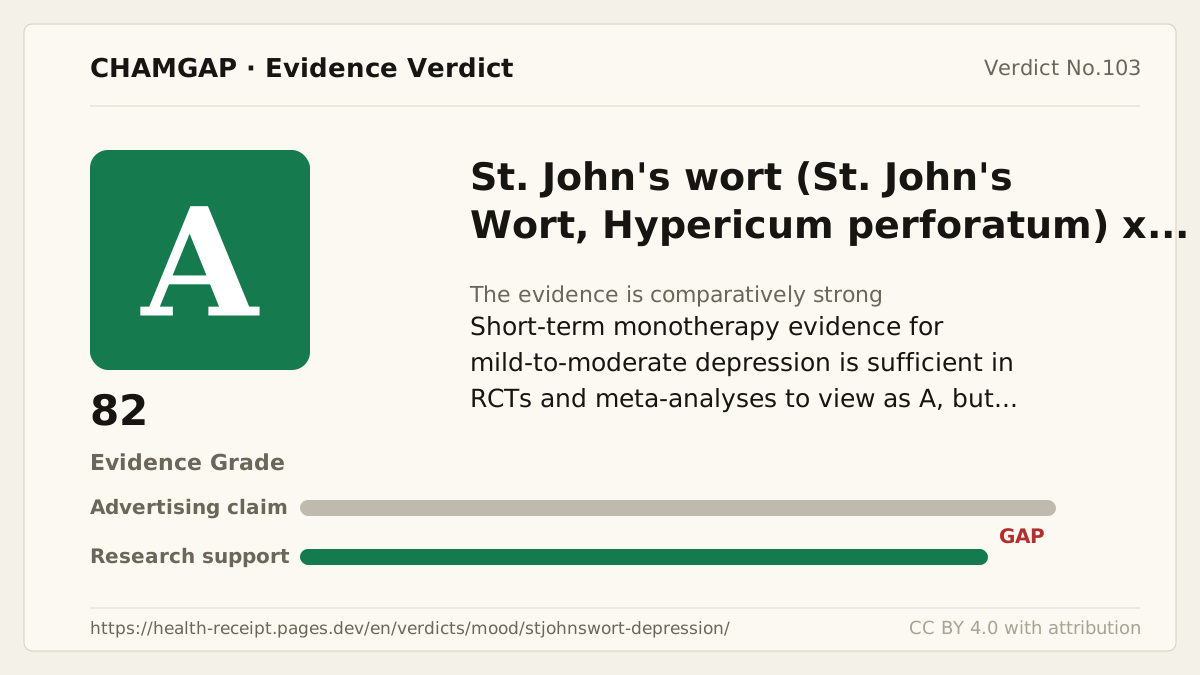
[Chamgap] St. John's wort (St. John's Wort, Hypericum perforatum) × depression — Evidence Grade A·82. 15 cited sources checked. Source: https://chamgap.com/en/verdicts/mood/stjohnswort-depression/ · CC BY 4.0CC BY 4.0 — free to use with attribution; do not distort grades, numbers, or verdict meaning.
What this document does and does not do
Chamgap is an information source. It reports what research has and has not confirmed; it does not tell readers what to take or buy. That decision belongs to readers and, when needed, medical or legal professionals. This verdict reflects literature available up to the search date and may change as new research appears. Nothing here is medical advice.