
Saffron,
does it really help with depression and mood?
research showsSaffron is an ingredient with relatively repeated positive signals from human RCTs and meta-analyses for depressive symptoms, especially mild-to-moderate depression. However, the evidence is centered on short-term 6-12 week, small, partially region-concentrated studies, and when broadened to 'mood improvement' in general people, there are recent primary-endpoint-negative studies, making it difficult to raise to A.
ads claimIn the Korean market, saffron is introduced together with 'depressed mood,' 'anxiety,' 'stress,' 'mood improvement,' 'emotional balance,' 'positive mood,' and 'mental/mood care.' Some shopping-mall product names include saffron with other ingredients and promote 'mood improvement and energy increase,' while informational articles and translations of overseas health information use phrases such as 'natural antidepressant,' 'helps with depression and anxiety,' and 'increases antidepressant effects.' Domestic articles mention saffron extract (Affron) as an individually recognized ingredient that 'may help relieve tension caused by stress,' but this judgment used human evidence for saffron alone in depression and mood rather than regulatory recognition status.
Useful facts when choosing a product
- The most common dose in depression RCTs is saffron stigma or standardized extract 30 mg/day for 6 weeks.
- Products differ in whether they standardize stigma, petal, crocin, crocetin, or safranal, so even under the same name 'saffron,' equivalence between clinical-trial preparations and commercial products is not automatically guaranteed.
- General mood/stress products often use 28-30 mg/day standardized extract, but this area has mixed positive and negative primary endpoints.
- Results from combination products containing saffron were not summed as saffron-alone effects.
- Short-term clinical-trial doses did not show large serious adverse-event signals, but high-dose intake, pregnancy/lactation, and possible co-use with anticoagulants/antiplatelets or psychiatric drugs require separate caution.
What the research actually shows
In clinical depression groups, there are several RCTs and meta-analyses using saffron alone or saffron-derived compounds. A 2019 Nutrition Reviews meta-analysis included 23 studies and reported effect sizes versus placebo of g=0.99 (p<0.001) for depressive symptoms and g=0.95 (p=0.006) for anxiety symptoms, and adjunctive-therapy depressive symptoms g=1.23 (p=0.028), but noted publication bias in Egger testing and lack of regional diversity. A 2026 GRADE meta-analysis included 34 RCTs and 1,769 participants and reported BDI WMD -4.39 across 14 trials and 817 participants and BAI WMD -5.06 across 6 trials and 339 participants, but heterogeneity was very large. A 2024/2025 direct SSRI comparison meta-analysis found no significant difference in improvement of depressive symptoms between saffron and SSRIs across 8 depression-outcome studies (SMD 0.10, 95% CI -0.09 to 0.29), and adverse events were fewer in the saffron group. As individual RCTs, a 2005 stigma extract placebo-controlled trial (40 participants, HAM-D 17, 30 mg/day, 6 weeks) showed significantly greater HAM-D improvement than placebo (F=18.89, p<0.001), and the same research group's fluoxetine and imipramine comparator pilots produced results close to noninferiority. However, most samples are in the 30-60 participant range and follow-up is short. In generally healthy or subclinical mood groups, results are weaker. A 2021 RCT of 56 participants found the POMS total mood disturbance primary indicator failed after 8 weeks of 30 mg standardized extract, but the POMS depression subscale and social relationships were positive, and the study was supported by a raw-material company. A 2025 AJCN RCT (51 participants) found no significant difference in the primary composite z-score combining BDI-II, STAI, and fatigue, or in individual symptoms. Therefore 'depressive symptoms' should be separated as an upper-B signal, and 'general mood improvement' as a lower auxiliary signal.
Why this is classified as B (76)
B. There are many human RCTs, and placebo, active-control, and adjunctive-therapy meta-analyses are generally consistent in the direction of improved depressive symptoms. Therefore there is no basis to lower to C. However, most key trials are short-term and small, research region and research groups are concentrated, some raw-material company funding and publication-bias signals exist, and in healthy/low-mood groups, studies with failed primary endpoints exist. Including 'general mood improvement' claims, the evidence does not meet A requirements for large independent replication and clinical certainty.
Counterpoint. The evidence for saffron is stronger than for many supplements. Especially in patients with mild-to-moderate depression, studies around 30 mg/day for 6-12 weeks are repeatedly positive on clinical symptom scales such as HAM-D and BDI. However, this does not mean long-term treatment effects, severe depression, relapse prevention, or everyday mood enhancement in general people have been proven with the same strength.
Rejudgment record. Convergent — Saffron depression/mood RCTs and meta-analyses are repeatedly significant (including signals of noninferiority to antidepressants), but samples are small and Iranian studies are concentrated
Cross-check — Codex and Claude
Evidence Table
| Study | Design | Sample | Funding | Endpoint | Result | Weight |
|---|---|---|---|---|---|---|
| Mahmoudi R, Mohammadi-Sartang M, Servatyari K, Rafieipour N 2026 | meta-analysis of RCTs | 1769 | not reported | not specified | 34 RCTs, 1,769 participants; BDI 14 trials WMD -4.39 and BAI 6 trials WMD -5.06 were positive, but heterogeneity was very large. | core |
| Marx W, Lane M, Rocks T et al. 2019 | meta-analysis | not reported | anxiety/depression | 23 studies; versus placebo, depression g=0.99, anxiety g=0.95, adjunctive-therapy depression g=1.23. Publication bias and lack of regional diversity were noted. | core | |
| Shafiee A, Jafarabady K, Seighali N et al. 2025 | meta-analysis of RCTs | not reported | depression | Direct SSRI-comparison RCT meta-analysis; across 8 depression studies, SMD 0.10 (95% CI -0.09 to 0.29) showed no difference, and adverse events were fewer in the saffron group. | core | |
| Lopresti AL, Drummond PD 2014 | double-blind/systematic review/RCT | not reported | depression | Review of 6 randomized double-blind placebo- or antidepressant-controlled studies reported a large effect versus placebo and similar efficacy versus medication. | core | |
| Akhondzadeh S, Tahmacebi-Pour N, Noorbala AA et al. 2005 | double-blind RCT | 40 | possible manufacturer/industry involvement | not specified | 40 participants with MDD, 30 mg/day for 6 weeks; HAM-D change was significantly greater than placebo (F=18.89, p<0.001). | supportive |
| Noorbala AA, Akhondzadeh S, Tahmacebi-Pour N, Jamshidi AH 2005 | double-blind RCT | 40 | not reported | not specified | 40 participants with MDD, saffron 30 mg/day vs fluoxetine 20 mg/day for 6 weeks; no difference between the two groups (F=0.13, p=0.71). | supportive |
| Akhondzadeh S, Fallah-Pour H, Afkham K, Jamshidi AH, Khalighi-Cigaroudi F 2004 | double-blind RCT | not reported | not specified | Early pilot RCT comparing saffron 30 mg/day with imipramine 100 mg/day; reported similar HAM-D improvement. | supportive | |
| Dai L, Chen L, Wang W 2020 | meta-analysis | not reported | depression | Summarized that in mild-to-moderate depression, saffron is superior to placebo and similar to synthetic antidepressants. | supportive | |
| Jackson PA, Forster J, Khan J et al. 2021 | double-blind RCT | 56 | not reported | gastrointestinal/anxiety/stress/mood | 56 healthy adults with low mood/anxiety/stress; POMS total mood disturbance was negative, POMS depression subscale p=0.05. Supported by Activ'Inside. | supportive |
| Amadieu C, Leyrolle Q, Farneti M et al. 2025 | double-blind RCT | 51 | not reported | ALT | 51 healthy adults with subclinical symptoms; primary composite z-score of BDI-II, STAI, and fatigue and all individual symptoms showed no significant difference. | supportive |
| Study 11 | not specified | not reported | gastrointestinal/stress | Domestic article mentioned saffron extract (Affron) as a functionally recognized ingredient that 'may help relieve tension caused by stress.' | supportive | |
| WebMD | not specified | not reported | gastrointestinal/pregnancy | Short-term use at 100 mg/day or less is described as possibly safe, but adverse effects such as drowsiness and gastrointestinal symptoms and pregnancy-related cautions are presented. | supportive |
Receipt — 12 References
Of 12 cited sources, 3 had limited original-page access (blocked or summary-only) and were verified via index/summary, marked partial; the rest were verified at the original page. As of 2026-07-07.
Reviewed and approved: Chamgap Editorial Team · Approval date: 2026-07-07 · Corrections: none
Cite this verdict
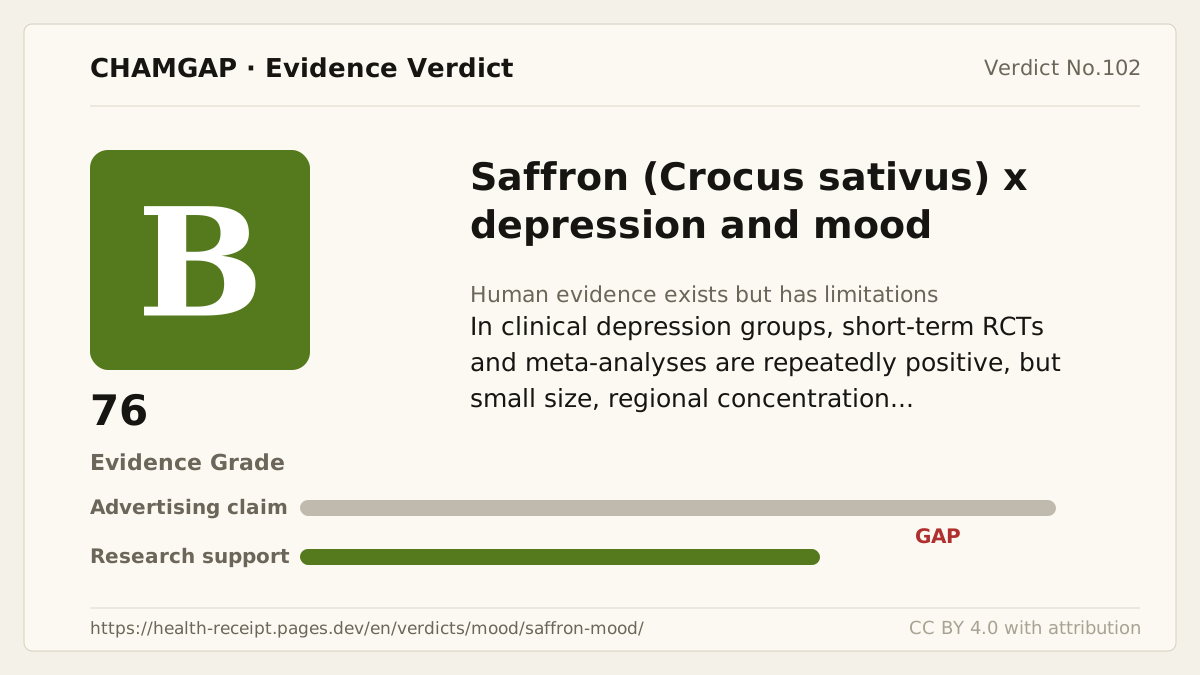
[Chamgap] Saffron (Crocus sativus) × depression and mood — Evidence Grade B·76. 12 cited sources checked. Source: https://chamgap.com/en/verdicts/mood/saffron-mood/ · CC BY 4.0CC BY 4.0 — free to use with attribution; do not distort grades, numbers, or verdict meaning.
What this document does and does not do
Chamgap is an information source. It reports what research has and has not confirmed; it does not tell readers what to take or buy. That decision belongs to readers and, when needed, medical or legal professionals. This verdict reflects literature available up to the search date and may change as new research appears. Nothing here is medical advice.