
Ashwagandha,
does it really help with stress and anxiety relief?
research showsAshwagandha has not only the surrogate claim that it “lowers cortisol,” but also several human randomized controlled trials (RCTs) reporting improvements when stress and anxiety were measured with human-used scales such as PSS and HAM-A. This signal is not present only in studies involving ingredient manufacturers; it also appears in formally peer-reviewed meta-analyses without conflicts of interest. For example, Marchi 2025 (BJPsych Open, explicitly stating that it “received no specific grant from any funding agency, commercial or not-for-profit sectors,” 14 RCTs, 713 participants) significantly improved anxiety (SMD -1.62, CI -2.66 to -0.57, p<0.001), and Arumugam 2024 (Explore, 9 RCTs, 558 participants) significantly lowered perceived stress (PSS), anxiety (HAM-A), and cortisol. This places it above judgments with only surrogate indicators (maximum C). At the same time, three limitations remain. (1) The link “cortisol falls, therefore stress falls” diverges across the literature. Clinical anxiety (HAM-A) and cortisol are repeatedly significant in independent meta-analyses and are relatively robust, but perceived stress (PSS) has both significant (Arumugam 2024) and non-significant results (Albalawi 2025 SMD -0.355 p=0.40; Marchi 2025 PSS subgroup p=0.090) even within formally reviewed meta-analyses. (2) RCTs using scales are generally small, results vary greatly (meta-analysis I² 83~94%), and authors themselves label certainty of evidence as “low.” (3) Many positive results remain concentrated in India-centered studies involving supply, funding, or affiliation from specific ingredient manufacturers (KSM-66=Ixoreal, Sensoril=Natreon, etc.). In short, the human-endpoint signal for “stress/anxiety relief” is real and is also supported by independent meta-analyses (therefore B), while reading cortisol numbers directly as “stress decreased” is a link where the evidence diverges.
ads claimIn the Korean market, ashwagandha is called “Indian ginseng” and prominently claims stress relief, improved sleep quality, and tension/anxiety relief. Detail pages and health-functional-food appeals often state “lowering cortisol/stress hormone,” “improving sleep quality,” “KSM-66/Sensoril ingredient,” “withanolides 5% (KSM-66) / 10% (Sensoril) or higher,” and “300~600 mg/day.” Domestic pharmacy media also cite the 2021 RCT’s “significant decrease in blood cortisol” and the 300 mg dose. The advertising frame is generally surrogate-to-perceived causality: “lower cortisol to reduce stress.” This is where P-B1 applies: cortisol reduction is relatively robust in human data, but the link “therefore perceived stress decreases” diverges even among formally reviewed meta-analyses, as in (4) above.
Useful facts when choosing a product
- Commercial appeal examples: “cortisol (stress hormone) reduction,” “improved sleep quality,” “tension/anxiety relief,” “Indian ginseng” (actual advertising-text types).
- Ingredient brands: KSM-66 (root only, withanolides >=5%, manufacturer Ixoreal Biomed) / Sensoril (root+leaf, withanolides >=10%, manufacturer Natreon). Many stress/cortisol RCTs used products supplied by these two ingredient manufacturers.
- Human RCT intake amounts: generally 300~600 mg/day (extract). Landmark RCT Chandrasekhar 2012 used KSM-66 300 mg twice daily (=600 mg/day) for 60 days.
- Safety (warning): internationally, cases of ashwagandha-induced liver injury (drug-induced liver injury, DILI) have accumulated. LiverTox classifies it as a “likely cause” of liver injury (category B). Iceland/U.S. DILIN 5 cases reported cholestatic/mixed liver injury and jaundice; a Balkan-area report added 2 new cases to prior international cases for a RUCAM total of 12 cases (hepatocellular, cholestatic, mixed; one case liver transplant). Onset is usually 2~12 weeks after use, with about 23 cumulative cases.
- Related precautions (information): domestic and international materials list pregnancy (miscarriage risk reports), thyroid (possible thyroid-hormone increase/hyperthyroid situations), autoimmune disease (possible immune stimulation), sedation/drowsiness, and gastrointestinal discomfort. More severe signals have been reported in people with liver disease or those taking hepatotoxic concomitant drugs.
- Regulatory metadata (neutral/partially verified): domestic media mention functional recognition related to “improving sleep quality” for ashwagandha extract; regulatory recognition is ingredient/labeling regulation, not a guarantee of effect size or clinical benefit (Methodology 2-1 ④), and this judgment targets “stress/anxiety relief.” The exact individual-recognition list was not fully reconfirmed against the original text this round due to search-tool limits (flag).
What the research actually shows
The literature divides into four categories. (1) Strong evidence only for surrogate indicator (cortisol): multiple RCTs/meta-analyses found blood cortisol significantly lower than placebo (e.g., Chandrasekhar 2012 -27.9%). Cortisol is an HPA-axis stress hormone, but is not itself “how much stress is felt.” (2) Clinical-scale (stress/anxiety) evidence: many RCTs report improvement versus placebo on validated scales such as PSS (perceived stress), HAM-A/HAS (anxiety), and DASS. Akhgarjand 2022 meta-analysis (12 RCTs, 1,002 participants) was significant for anxiety SMD -1.55 and stress SMD -1.75, but “certainty of evidence” was low, and heterogeneity was very high (I²=93.8%/83.1%). This clinical-scale signal is replicated in formally reviewed meta-analyses without conflicts of interest: Marchi 2025 (BJPsych Open 11(6):e260, explicitly “no specific funding,” 14 RCTs, 713 participants) found significant anxiety improvement, SMD -1.62 (CI -2.66~-0.57, p<0.001), and Arumugam 2024 (Explore 20(6):103062, 9 RCTs, 558 participants) significantly lowered PSS MD -4.72 (CI -8.45~-0.99), HAM-A -2.19 (CI -3.83~-0.55), and cortisol -2.58 (CI -4.99~-0.16). (3) Evidence measuring both and connecting them within one study: Chandrasekhar 2012 measured cortisol and PSS/DASS in the same participants and showed both improved (manufacturer KSM-66 supplied). (4) However, evidence also breaks the surrogate<->perceived link: Albalawi 2025 (6~7 studies, 488 participants, mostly India) found cortisol significantly lower (-1.16 µg/dL, p<0.001) but perceived stress PSS was not significant (SMD -0.355, p=0.40), and Marchi 2025’s PSS subgroup analysis (3 studies) also did not reach significance (p=0.090). Thus “cortisol↓ -> perceived↓” is not consistent across the literature and diverges particularly at the perceived-stress (PSS) endpoint.
Why this is classified as B (61)
Grade B, score 61 (lower end of B). This is not only a surrogate indicator (cortisol); there are many human RCTs that set validated stress/anxiety clinical scales (PSS, HAM-A, DASS) as primary/co-primary endpoints and reported improvement versus placebo. This clinical signal is not limited to studies involving ingredient manufacturers but is replicated in formally reviewed meta-analyses without conflicts of interest: Marchi 2025 (BJPsych Open, explicitly “no specific funding from any funding agency, commercial or non-profit”) significantly improved anxiety (SMD -1.62, p<0.001), and Arumugam 2024 (Explore) significantly lowered PSS, HAM-A, and cortisol. Because clinical anxiety and cortisol are supported by independent meta-analyses outside industry funding, this sits above a surrogate-only judgment (maximum C). However, it does not reach A: (1) RCTs are generally small, heterogeneity is extreme (I²≈83~94%), and author-rated certainty of evidence is “low~very low.” (2) Much positive evidence is still concentrated in KSM-66 (Ixoreal), Sensoril (Natreon), and India, and the independent meta-analyses are largely secondary independence that reanalyzes the same source RCTs. (3) The core P-B1 link (cortisol↓ -> perceived stress↓) diverges at the perceived-stress (PSS) endpoint (Arumugam 2024 significant vs Albalawi 2025 and Marchi 2025 subgroup non-significant). Score 61 combines both directions: clinical anxiety/cortisol being supported by independent meta-analysis raises it above surrogate-only C, while extreme heterogeneity, low certainty, industry concentration, and PSS divergence keep it below A and at the lower end of B.
Counterpoint. Supportive side (higher): “There are several RCTs not only on cortisol but also on human scales such as PSS and HAM-A, and now formally reviewed meta-analyses without conflicts of interest (Marchi 2025, Arumugam 2024) significantly replicate anxiety and cortisol. Isn’t this close to A?” -> Review: it is correct that scale evidence exists and is replicated in independent meta-analyses, which is why the grade is B. However, A requires multiple sizable RCTs, meta-analytic consistency, and perceptible effect sizes together; here heterogeneity is extreme (I² 83~94%), authors explicitly state “low” certainty, and positive evidence is concentrated in manufacturers/India. Skeptical side (lower): “In the end this is cortisol-centered surrogate evidence, and perceived stress (PSS) is non-significant in several meta-analyses (Albalawi 2025, Marchi 2025 subgroup). Isn’t maximum C?” -> Review: it is true that the PSS link diverges, and this is stated at the top of the judgment. But this divergence is observed within formally reviewed meta-analyses without conflicts of interest (significant: Arumugam 2024; non-significant: Albalawi 2025 and Marchi 2025), and there are RCTs and independent meta-analyses directly measuring PSS and HAM-A, not cortisol “only,” so it does not fit the definition of C as “surrogate only.” The real gap between the two views is the B/C boundary rather than A/B, and this judgment places it at the lower end of B (61) while explicitly stating the PSS divergence under P-B1.
Cross-check — Codex and Claude
Evidence Table
| Study | Design | Sample | Funding | Endpoint | Result | Weight |
|---|---|---|---|---|---|---|
| Chandrasekhar K, Kapoor J, Anishetty S 2012 | double-blind randomized controlled trial | 61 | manufacturer/industry involvement possible | liver, anxiety, stress, and depression | Both measured and connected (clinical scale + surrogate): in the same participants, KSM-66 600 mg/day for 60 days improved blood cortisol -27.9% (p=0.002), perceived stress PSS -44% (p<0.0001), and DASS anxiety/depression together. Representative case connecting P-B1 “within one study,” but small (61 completed), manufacturer (Ixoreal/KSM-66) supplied, single Indian study. | core |
| Marchi M, Grenzi P, Travascio A et al. 2025 | meta-analysis and RCTs | 3 | manufacturer/industry involvement possible | anxiety and stress | Formally reviewed independent meta-analysis without conflicts of interest (core B evidence): in 14 RCTs/713 participants (treatment 360/control 353), anxiety was significant with pooled SMD -1.62 (CI -2.66~-0.57, p<0.001). Funding statement: “received no specific grant from any funding agency, commercial or not-for-profit sectors”; conflicts: “None.” This addresses concern that all positive evidence is manufacturer-funded, because improvement was confirmed in an unfunded independent meta-analysis. However, perceived-stress (PSS) subgroup (3 studies) was SMD -0.95 but did not reach significance (p=0.090), the non-significant axis of P-B1 PSS divergence. | core |
| Arumugam V, Vijayakumar V, Balakrishnan A et al. 2024 | meta-analysis and RCTs | 558 | anxiety and stress | Independent replication meta-analysis (core B evidence): 9 RCTs/558 participants showed significant decreases in perceived stress PSS MD -4.72 (CI -8.45~-0.99), anxiety HAM-A/HAS -2.19 (CI -3.83~-0.55), and cortisol -2.58 (CI -4.99~-0.16). It replicated both clinical-scale (PSS/HAM-A) and surrogate (cortisol) signals. Independent meta-analysis without ingredient-manufacturer funding. Significant axis of P-B1 PSS divergence. | core | |
| Akhgarjand C, Asoudeh F, Bagheri A et al. 2022 | meta-analysis and RCTs | 12 | anxiety and stress | Clinical-scale (stress/anxiety) meta-analysis: in 12 RCTs/1,002 participants, anxiety SMD -1.55 (p=.005) and stress SMD -1.75 (p=.005) were significant. Authors explicitly stated “low certainty” evidence, and heterogeneity was extreme at I²=93.8% (anxiety) and 83.1% (stress). Shows there are many human-scale data while also preventing upgrade to A because of heterogeneity/low certainty. | core | |
| Albalawi AA 2025 | meta-analysis | 7 | stress | Non-significant axis of the P-B1 perceived (PSS) endpoint: cortisol significantly decreased (-1.16 µg/dL, p<0.001, I²=50.9%), but perceived stress PSS was not significant (SMD -0.355, 95% CI -1.188~0.47, p=0.40). A meta-analysis (6~7 studies, 488 participants, mostly India) showing that “cortisol↓” may not translate into “perceived stress↓.” | supporting | |
| Björnsson HK, Björnsson ES, Avula B et al. 2020 | not specified | 4 | liver and recovery | Safety (hepatotoxicity): five cases (mean age 43) of ashwagandha-associated cholestatic/mixed liver injury and jaundice. DILIN causality: definite 1, highly likely 2, probable 1, possible 1. Onset 2~12 weeks, all moderate, 4 recovered within 1~5 months. Safety signal unrelated to efficacy grade. | supporting | |
| Bokan G, Glamočanin T, Mavija Z et al. 2023 | preclinical study | liver and recovery | Safety (hepatotoxicity, independent reinforcement): total 12 cases (prior 10 + new 2). Onset 5~365 days, dose 450~1,350 mg/day, hepatocellular/cholestatic/mixed patterns. Most recovered, but one case (41-year-old woman) required liver transplant for acute liver failure. Hepatotoxicity replicated in independent reports from different regions/research groups. | supporting | ||
| LiverTox: Clinical and Research Information on Drug-Induced Liver Injury — Ashwagandha | not specified | liver and recovery | Safety (authoritative summary): classifies ashwagandha as a “likely cause” of clinically apparent liver injury (likelihood score B). Typical pattern is cholestatic/mixed injury and jaundice 2~12 weeks after use, usually recovery 1~4 months after stopping, rarely fatal/transplant in people with underlying liver disease. About 23 cumulative cases, increasing since 2017. | supporting | ||
| Study 9 | randomized controlled trial | immunity, liver, gastrointestinal, and sleep | Market/regulatory evidence (Korea): ashwagandha is promoted for stress relief, improved sleep quality, and anxiety relief, citing KSM-66 (>=5%) / Sensoril (>=10%) ingredients, 300 mg dose, and the 2021 RCT “significant decrease in blood cortisol.” Domestic media also list pregnancy (miscarriage risk), thyroid, liver-enzyme elevation, and autoimmune cautions. | supporting |
Receipt — 9 References
Of 9 cited sources, 1 had limited original-page access (blocked or summary-only) and were verified via index/summary, marked partial; the rest were verified at the original page. As of 2026-07-06.
Reviewed and approved: Chamgap Editorial Team · Approval date: 2026-07-06 · Corrections: none
Cite this verdict
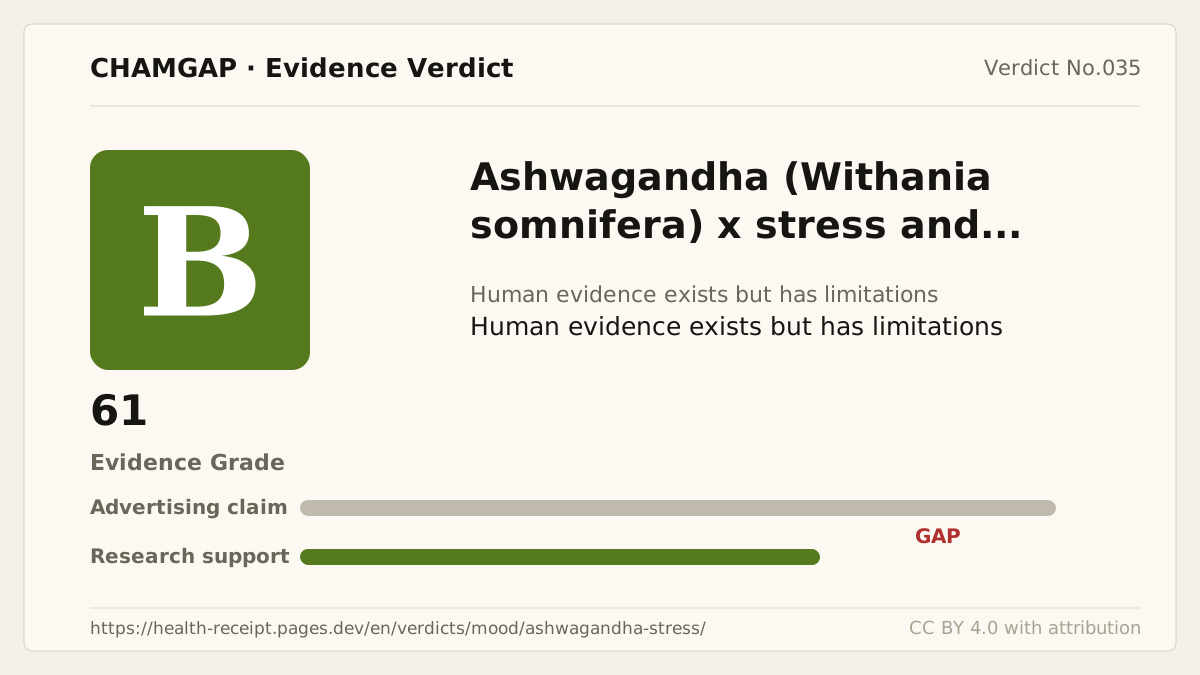
[Chamgap] Ashwagandha x stress and cortisol — Evidence Grade B·61. 9 cited sources checked. Source: https://chamgap.com/en/verdicts/mood/ashwagandha-stress/ · CC BY 4.0CC BY 4.0 — free to use with attribution; do not distort grades, numbers, or verdict meaning.
What this document does and does not do
Chamgap is an information source. It reports what research has and has not confirmed; it does not tell readers what to take or buy. That decision belongs to readers and, when needed, medical or legal professionals. This verdict reflects literature available up to the search date and may change as new research appears. Nothing here is medical advice.