
L-ornithine,
does it really help with Hangover and liver-fatigue improvement?
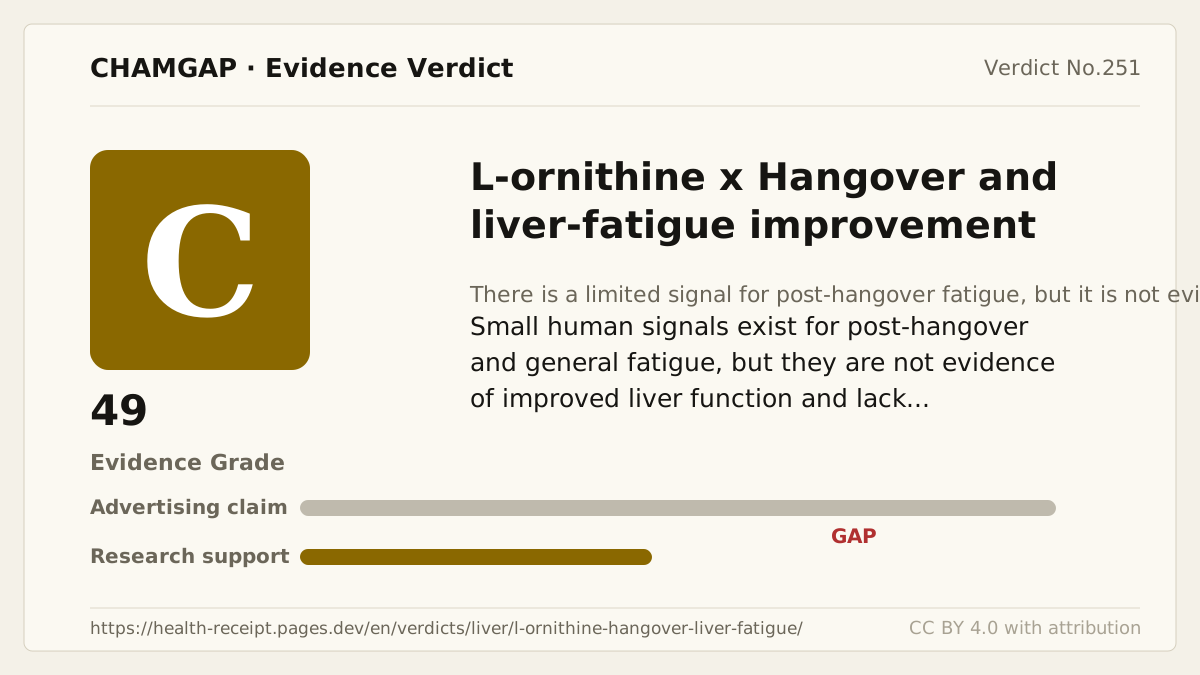
research showsL-ornithine has a small crossover trial reporting improvement in next-morning fatigue and some mood measures after drinking, and trials of general fatigue and stress also improved selected subjective measures. However, the hangover experiment included only 11 participants, the acute alcohol-metabolism experiment only 16, and the research is concentrated in one corporate network and Japanese populations, so the rating is C. Improvement in liver function or liver disease has not been established for L-ornithine alone.
ads claimAdvertisements use the urea cycle and ammonia metabolism to present 'liver fatigue recovery,' 'hangover removal,' and 'alcohol breakdown' together. Human evidence mainly concerns subjective fatigue, mood, and sleep scales, not accelerated alcohol elimination or improved liver function.
Useful facts when choosing a product
- The hangover crossover trial used 400 mg after drinking and analyzed 11 participants.
- Doses in general-fatigue trials ranged from 400 mg/day to a short-term dose of 6,000 mg/day.
- L-ornithine alone is not the same formulation as L-ornithine-L-aspartate used in hepatic encephalopathy.
- Human trials primarily measured fatigue, mood, sleep questionnaires, and cortisol rather than clinical liver outcomes.
What the research actually shows
The Kokubo 2013 crossover trial found that 400 mg ornithine after drinking reduced next-morning fatigue, lassitude, and selected mood scores in 11 adults with the alcohol-flusher phenotype, but a separate experiment in 16 participants found no difference in breath alcohol or acute intoxication measures. The Sugino 2008 crossover trial in 17 participants reported improvement in selected measures of subjective post-exercise fatigue. The Moriyasu 2024 trial in 65 participants improved fatigue-inertia the morning after social stress but did not improve salivary cortisol. These studies did not test clinical liver disease or liver-enzyme improvement.
Why this is classified as C (49)
Because selected measures of post-hangover fatigue and general fatigue were repeatedly positive in small randomized trials, the evidence is not ungradable or D. The small studies, corporate links, population concentration, subjective endpoints, and absence of liver-function data limit the rating to C with 49 points.
Counterpoint. A signal remains for the narrow outcome of next-morning fatigue after drinking. This judgment does not include liver-enzyme improvement or treatment of liver disease.
Rejudgment record. Reassessment (cross-check reflected) — Small RCT signals for post-hangover and general fatigue, but corporate links, subjective endpoints, inadequate independent replication, and no evidence of improved liver function
Sub-claim grades by effect
This ingredient is marketed for several effects. A single overall grade blends strong and weak claims together, so each effect is graded separately here. The overall grade reflects the strongest disconfirming or core claim.
| Effect (sub-claim) | Grade | Basis |
|---|---|---|
| Post-hangover fatigue and stress | C | Small, industry-linked studies of subjective outcomes |
| Alcohol elimination | D | A 16-person trial found no effect on breath alcohol or intoxication |
Cross-check — Codex and Claude
Evidence Table
| Study | Design | Sample | Funding | Endpoint | Result | Weight |
|---|---|---|---|---|---|---|
| Kokubo T et al. 2013 | Randomized double-masked placebo-controlled crossover trial | 16 | Kirin investigators and Kyowa product | Next-morning fatigue, mood, salivary cortisol, and breath alcohol | Selected next-morning subjective measures and cortisol improved, but acute alcohol metabolism did not differ from placebo. | Key |
| Moriyasu K et al. 2024 | Randomized double-blind placebo-controlled parallel trial | 65 | Sponsored by Kirin with employee authors | Fatigue, mood, and salivary cortisol after social stress | Next-morning fatigue-inertia and anger-hostility improved, but cortisol did not differ. | Supportive |
| Sugino T et al. 2008 | Double-blind placebo-controlled crossover trial | 17 | Research funding from Kyowa Hakko Kogyo | Post-exercise subjective fatigue, metabolism, and performance | Selected subjective fatigue and female-subgroup performance measures improved. | Supportive |
Receipt — 3 References
All 3 cited sources were verified for existence at the original page (as of 2026-07-11).
Reviewed and approved: Chamgap Editorial Team · Approval date: 2026-07-11 · Corrections: none
Cite this verdict
[Chamgap] L-ornithine x hangover and liver-fatigue improvement — Evidence Grade C·49. 3 cited sources checked. Source: https://chamgap.com/en/verdicts/liver/l-ornithine-hangover-liver-fatigue/ · CC BY 4.0CC BY 4.0 — free to use with attribution; do not distort grades, numbers, or verdict meaning.
What this document does and does not do
Chamgap is an information source. It reports what research has and has not confirmed; it does not tell readers what to take or buy. That decision belongs to readers and, when needed, medical or legal professionals. This verdict reflects literature available up to the search date and may change as new research appears. Nothing here is medical advice.