
Honeyberry extract powder,
does it really help with Protection from liver injury associated with metabolic abnormalities?
research showsThis specific honeyberry extract powder is an individually recognized ingredient under the Korean regulatory system, so its authorization dossier included a human intervention trial, but the public search found no paper allowing verification of the design, sample, primary endpoint, or numerical results. Because the direct public evidence depends on a manufacturer-specific product dossier, with no clinical liver-disease outcome, the rating is at the low end of C.
ads claimProduct descriptions may combine 'protection from nonalcoholic liver injury,' 'fatty-liver improvement,' and 'liver detoxification.' The verifiable regulatory functionality is limited to possible support against liver injury associated with metabolic abnormalities, while public papers do not establish treatment of clinical fatty liver or detoxification.
Useful facts when choosing a product
- The public daily intake for the individually recognized honeyberry extract powder is 1,960 mg/day.
- Cyanidin-3-glucoside is presented as a standardization marker, and ordinary honeyberry fruit is not equivalent to the extract powder.
- The sample, primary endpoint, and effect size of the authorization trial could not be verified in a public paper.
- Most published liver research consists of cell and mouse data rather than clinical liver outcomes.
What the research actually shows
The applicant dossier for honeyberry extract powder recognized as No. 2019-19 contains a human intervention trial, but its sample size and primary endpoint are not public. The published Park et al. 2019 paper evaluated honeyberry extract in free-fatty-acid-treated HepG2 cells and high-fat-diet mice; it is preclinical and is not counted as a human trial. No published independent replication or data on MRI-PDFF, liver biopsy, fibrosis, or liver-related events were identified.
Why this is classified as C (41)
A human trial exists in the applicant dossier for No. 2019-19, so the grade is not unknown, but regulatory authorization itself is not grading evidence. Positive evidence is confined to a nonpublic dossier for one manufacturer-specific product, without a public sample size or primary endpoint, independent replication, or clinical liver-disease outcomes. Park 2019 is a HepG2-cell and mouse study and is excluded from human evidence, resulting in low C with 41 points.
Counterpoint. It remains established that a human signal was reviewed for the exact authorized ingredient at 1,960 mg/day. Its magnitude and reproducibility cannot be judged from public information.
Rejudgment record. Reassessment (cross-check reflected) — A human trial exists in the applicant dossier for No. 2019-19, but regulatory recognition is not grading evidence; its sample, primary endpoint, public results, independent replication, and clinical liver-disease outcomes are absent, it is specific to one manufacturer product, and Park 2019 is excluded because it reports HepG2-cell and mouse data
Cross-check — Codex and Claude
Evidence Table
| Study | Design | Sample | Funding | Endpoint | Result | Weight |
|---|---|---|---|---|---|---|
| MFDS individual-recognition dossier No. 2019-19 | Human intervention trial for functionality review; insufficient public detail | Dossier submitted by the ingredient authorization applicant | Liver markers related to metabolic injury; insufficient public detail | Functionality was reviewed with a human trial, but the effect size and primary-endpoint values cannot be verified in a public paper. | Key, nonpublic manufacturer dossier | |
| Park M et al. 2019 | HepG2 cell and high-fat-diet mouse experiments | 6 | Academic institutions and research support; no commercial funding reported | Hepatic triglycerides, histology, AMPK and ACC, and lipid metabolism | Honeyberry extract reduced hepatic lipid accumulation in cells and mice, but this is not human efficacy evidence. | Preclinical support |
| Kang P et al. 2026 | Regulatory-system and database review | Korean government research support | Individual-recognition framework, human-evidence submission requirements, and ingredient classification | The review described inclusion of human intervention evidence in individual recognition and classified honeyberry extract powder as a liver-health ingredient. | Regulatory context |
Receipt — 2 References
All 2 cited sources were verified for existence at the original page (as of 2026-07-11).
Reviewed and approved: Chamgap Editorial Team · Approval date: 2026-07-11 · Corrections: none
Cite this verdict
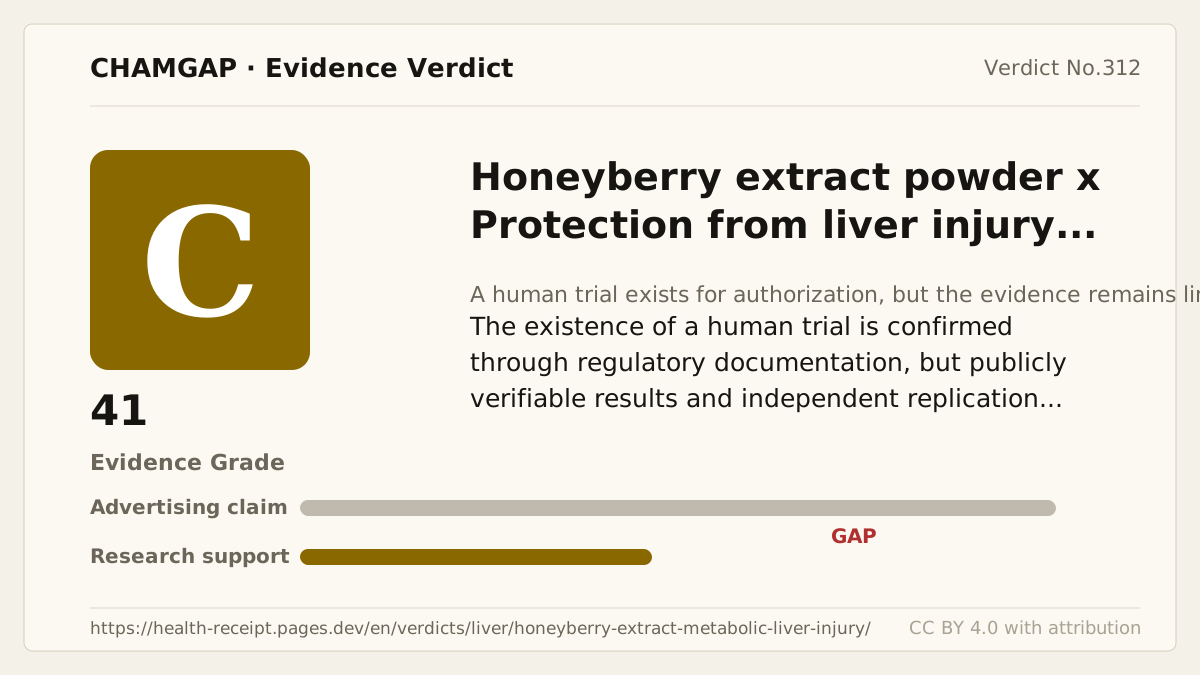
[Chamgap] Honeyberry extract powder × protection from liver injury associated with metabolic abnormalities — Evidence Grade C·41. 2 cited sources checked. Source: https://chamgap.com/en/verdicts/liver/honeyberry-extract-metabolic-liver-injury/ · CC BY 4.0CC BY 4.0 — free to use with attribution; do not distort grades, numbers, or verdict meaning.
What this document does and does not do
Chamgap is an information source. It reports what research has and has not confirmed; it does not tell readers what to take or buy. That decision belongs to readers and, when needed, medical or legal professionals. This verdict reflects literature available up to the search date and may change as new research appears. Nothing here is medical advice.