
Artemisia annua extract powder,
does it really help with Liver protection and liver-function improvement?
research showsIn an eight-week multicenter RCT that randomized 96 adults with borderline or mild nonalcoholic liver-function abnormalities, Artemisia annua hot-water extract powder SPB-201 at 686 mg/day lowered AST and ALT relative to placebo. However, the published positive human evidence is concentrated in one product trial and liver-enzyme surrogate markers, so efficacy is rated C. Hepatotoxicity cases involving other Artemisia formulations are separate safety signals and do not refute this efficacy trial.
ads claimAdvertising may combine 'liver protection,' 'liver detoxification,' and 'liver-function recovery.' The direct result of the published RCT is change in AST and ALT after eight weeks of a specific hot-water extract powder, not treatment of liver disease or a clinical detoxification outcome.
Useful facts when choosing a product
- The study ingredient was the Artemisia annua hot-water extract powder SPB-201 at a published intake of 686 mg/day.
- Ninety-six participants were randomized, 87 completed, and 79 entered the per-protocol efficacy analysis.
- Efficacy outcomes centered on AST, ALT, and a fatigue questionnaire; imaging, histology, fibrosis, and liver-related events were not measured.
- Tea, oil, supercritical extracts, and artemisinin medicines differ in composition and exposure, so the SPB-201 result cannot be directly transferred to them.
What the research actually shows
Han et al. 2020 assigned 96 adults with AST or ALT of 45-120 U/L to Artemisia annua hot-water extract powder SPB-201 or placebo. Eighty-seven completed the trial, and in the per-protocol analysis of 79 participants, 686 mg/day for eight weeks reduced AST and ALT relative to placebo at weeks four and eight. Liver imaging, histology, and clinical events were not measured. A separate pharmacovigilance study addressed hepatic reactions to a supercritical carbon-dioxide extract in grapeseed oil, and a case report addressed acute cholestatic hepatitis from Artemisia tea. These concern different formulations and are safety signals, not evidence refuting the SPB-201 efficacy trial.
Why this is classified as C (52)
Regulatory recognition itself is not grading evidence. The multicenter randomized double-blind design assigned 96 participants, and AST and ALT improved at two time points among 79 in the per-protocol analysis. However, the evidence is limited to liver-enzyme surrogates over eight weeks in one company-authored trial of the proprietary Artemisia annua hot-water extract powder SPB-201, with no independent replication, supporting C with 52 points. Hepatotoxicity cases involving other formulations are safety signals and do not refute this efficacy trial.
Counterpoint. A liver-enzyme signal exists for the exact SPB-201 formulation at 686 mg/day. Effects and safety of other Artemisia annua formulations are not established by this result.
Rejudgment record. Reassessment (cross-check reflected) — Regulatory recognition is not grading evidence; a multicenter trial of Artemisia annua hot-water extract powder SPB-201 randomized 96 participants and found positive AST and ALT signals in a 79-person per-protocol analysis, but it lasted eight weeks, used surrogate endpoints, involved company authors, tested one product, and lacks independent replication; hepatotoxicity cases involving other formulations are safety signals rather than efficacy refutation
Cross-check — Codex and Claude
Evidence Table
| Study | Design | Sample | Funding | Endpoint | Result | Weight |
|---|---|---|---|---|---|---|
| Han B et al. 2020 | Multicenter randomized double-blind placebo-controlled parallel trial | 79 | Supported by the Korean agriculture ministry and IPET; included authors from ingredient-related companies | AST, ALT, Multidimensional Fatigue Scale, and safety tests | In the per-protocol analysis, SPB-201 at 686 mg/day for eight weeks reduced AST and ALT relative to placebo at weeks four and eight. | Key, specific product |
| Savage RL et al. 2019 | Pharmacovigilance spontaneous-report case series | 29 | New Zealand health regulatory and pharmacovigilance institutions | Jaundice, liver enzymes, hospitalization, and recovery after discontinuation | A safety signal linked a supercritical Artemisia annua extract in grapeseed oil with hepatotoxicity. | Key for safety, different formulation |
| Ruperti-Repilado FJ et al. 2019 | Case report | 1 | Academic medical institutions | Cholestatic hepatitis, biopsy, and RUCAM causality assessment | Severe acute cholestatic hepatitis occurred after Artemisia annua powder tea and resolved after discontinuation. | Supportive for safety, different formulation |
Receipt — 3 References
All 3 cited sources were verified for existence at the original page (as of 2026-07-11).
Reviewed and approved: Chamgap Editorial Team · Approval date: 2026-07-11 · Corrections: none
Cite this verdict
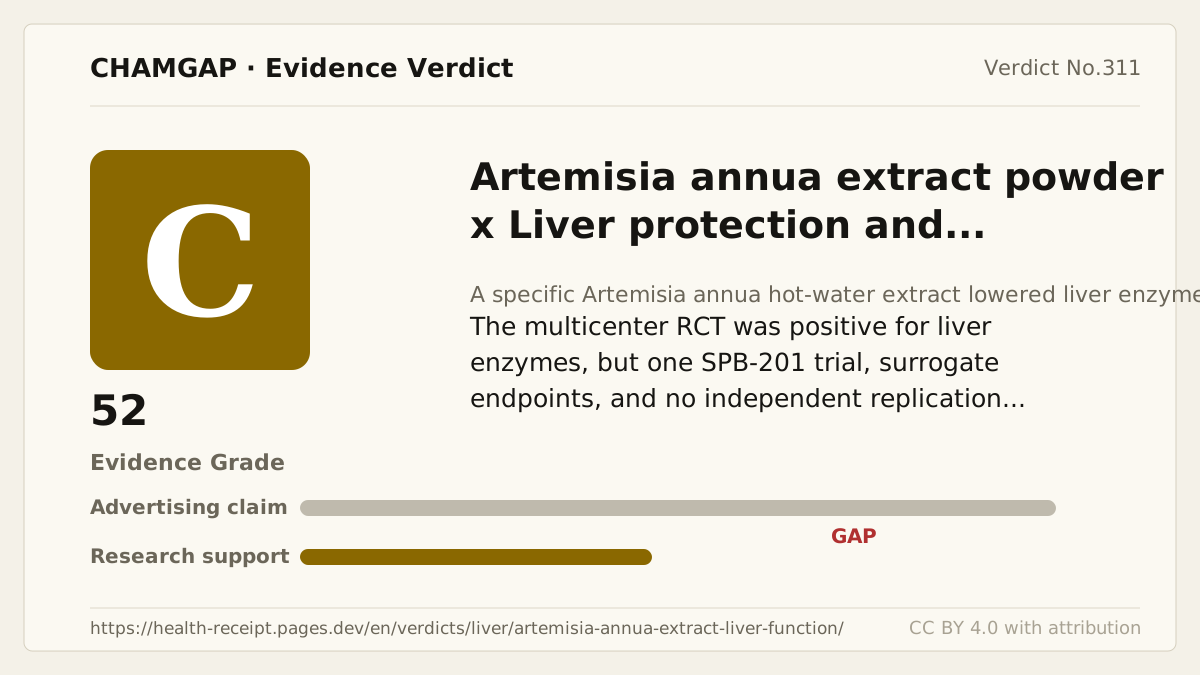
[Chamgap] Artemisia annua extract powder × liver protection and liver-function improvement — Evidence Grade C·52. 3 cited sources checked. Source: https://chamgap.com/en/verdicts/liver/artemisia-annua-extract-liver-function/ · CC BY 4.0CC BY 4.0 — free to use with attribution; do not distort grades, numbers, or verdict meaning.
What this document does and does not do
Chamgap is an information source. It reports what research has and has not confirmed; it does not tell readers what to take or buy. That decision belongs to readers and, when needed, medical or legal professionals. This verdict reflects literature available up to the search date and may change as new research appears. Nothing here is medical advice.